
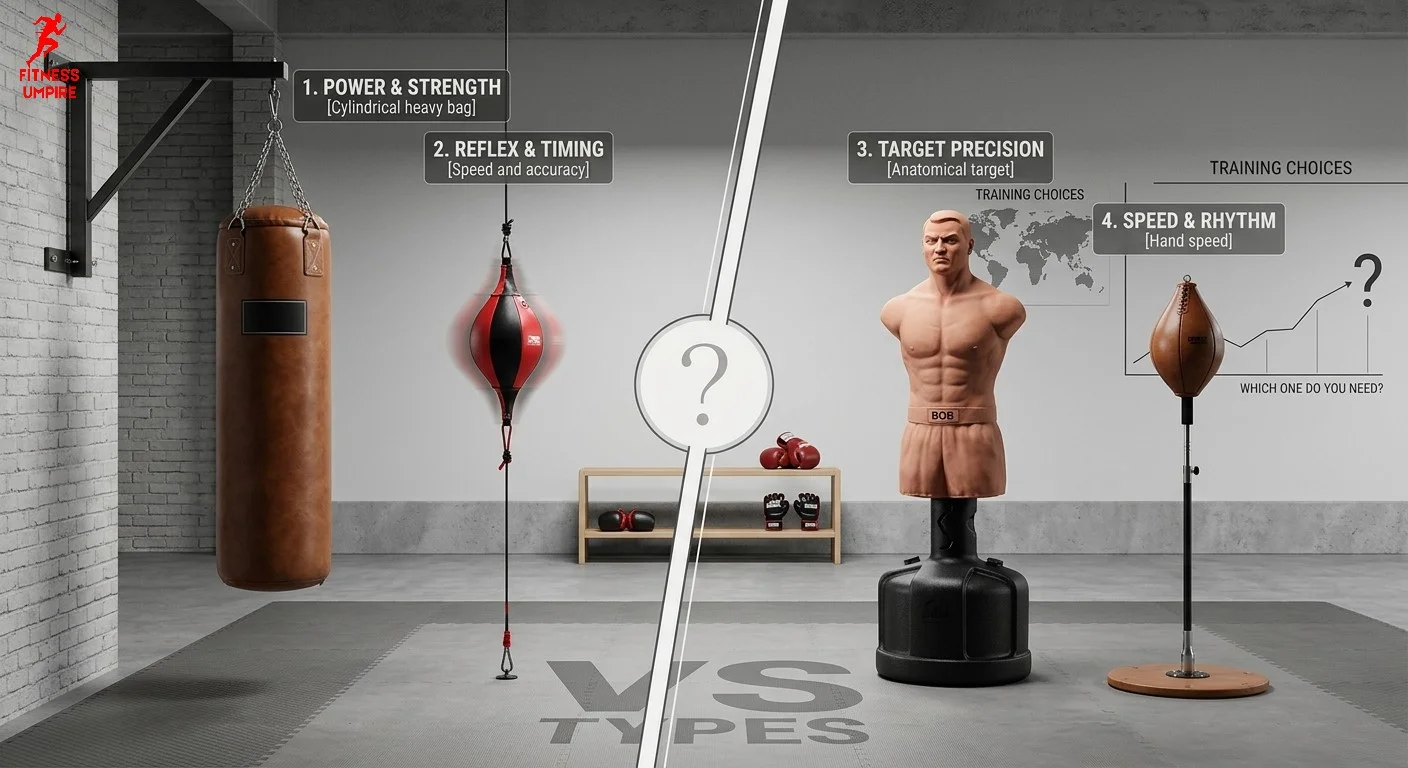
Punching bags are not all designed for the same kind of training. A heavy bag is built for powerful combinations, a speed bag develops rhythm and hand speed, a double-end bag moves unpredictably for timing and accuracy, while a freestanding bag can be easier to install at home.
The right choice depends on what you want to practice, how much space you have, how much installation you can handle, and how much you want to spend.
Punching Bag Types Compared
| Type | Best For | Difficulty | Typical Price Range | Full Guide |
|---|---|---|---|---|
| Freestanding punching bag | Home workouts, beginners, apartments | Beginner–Intermediate | $80–$300+ | Freestanding Punching Bag |
| Hanging punching bag | Power, boxing, Muay Thai, serious training | Intermediate–Advanced | $50–$250+ | Hanging Punching Bag |
| Heavy punching bag | Punches, kicks, combinations, conditioning | Intermediate | $70–$250+ | Heavy Punching Bag |
| Speed bag | Hand speed, rhythm, timing | Intermediate | $30–$150 | Speed Bag |
| Double-end bag | Accuracy, timing, head movement, combinations | Intermediate–Advanced | $40–$150 | Double-End Bag |
| Water punching bag | More forgiving impact, home training | Beginner–Intermediate | $80–$250+ | Water Punching Bag |
| Teardrop punching bag | Uppercuts, hooks, knees and close-range combinations | Intermediate | $70–$250+ | Teardrop Punching Bag |
| Reflex punching bag | Reaction time, movement and accuracy | Beginner–Intermediate | $80–$250+ | Reflex Punching Bag |
| Punching dummy | Striking practice against a human-shaped target | Intermediate | $150–$500+ | Punching Dummy |
Prices are broad typical retail ranges and vary by size, construction, brand and included hardware.
1. Freestanding Punching Bag
A freestanding punching bag is usually the most convenient punching-bag type for people who want to train at home without hanging a bag from the ceiling. The striking section sits on a weighted base, so the entire unit stands on the floor.
It is particularly useful when permanent installation is difficult or when you want to move your training equipment when needed. Depending on the model, freestanding bags can support punches, kicks, combinations and general conditioning workouts.
The main trade-off is stability. A freestanding bag does not behave exactly like a properly mounted heavy bag. Hard strikes can make some models shift, rock or slide, especially on smooth flooring.
Freestanding bags are available in different heights and construction styles, including foam-filled models and bags designed around water-filled bases. Choosing the right height and base stability matters more than simply buying the largest model.
For home users, this type can provide a practical balance between training versatility, installation convenience and space requirements.
Full guide → Freestanding Punching Bag
See tested picks → Best Freestanding Punching Bags
2. Hanging Punching Bag
A hanging punching bag is suspended from a ceiling, beam, wall bracket or another appropriately rated mounting system. Unlike a freestanding model, the bag is free to swing after it is struck.
That movement is one of its biggest advantages. A hanging bag can provide a more dynamic target for combinations because the user has to adjust position and distance as the bag moves.
Hanging bags are commonly used for boxing, kickboxing, Muay Thai and other striking workouts. Depending on the bag’s shape and filling, they can accommodate punches, kicks, knees and combination drills.
Installation is the major consideration. The mounting point must be suitable for the bag and the forces generated during training. A heavy bag should never simply be attached to an unsuitable ceiling fixture or piece of drywall.
A hanging bag also needs enough surrounding clearance to swing safely. That makes it less convenient for some bedrooms, apartments or multipurpose rooms.
For users with an appropriate mounting location, however, the swinging movement makes this one of the most versatile traditional punching-bag setups.
Full guide → Hanging Punching Bag
3. Heavy Punching Bag
A heavy punching bag is a substantial training bag designed to withstand repeated striking. Traditional heavy bags are usually suspended from above and are available in different lengths, weights and fillings.
They are used for practicing punches, combinations, power generation, conditioning and, depending on the bag, kicks and other strikes.
The weight of the bag affects how it responds. A heavier bag generally moves less from each strike, while a lighter bag can swing more readily. Bag selection should therefore consider the user’s training style rather than relying on weight alone.
Heavy bags can be filled with textile material, foam or other materials, and some designs use layered construction to produce a consistent striking surface. The feel can vary considerably between models.
Because the bag is suspended, installation is an important part of the setup. The support system must be appropriate for the equipment and the training environment.
A heavy bag is generally better suited to users who have enough room for a swinging target and want a traditional striking workout rather than simply a stationary fitness target.
Full guide → Heavy Punching Bag
4. Speed Bag
A speed bag is a small, lightweight bag mounted to a platform. Instead of being designed primarily for powerful strikes, it is used for developing rhythm, timing, hand speed, coordination and accuracy.
The bag rebounds quickly from the platform, requiring the user to establish a consistent striking rhythm. This makes speed-bag training very different from hitting a heavy bag.
Because the target is small and moves rapidly, beginners may initially find it difficult to maintain a consistent pattern. The challenge is primarily coordination and timing rather than generating maximum power.
A speed bag also requires its own platform or mounting system. The platform needs to be positioned at an appropriate height and securely mounted so the bag can rebound consistently.
Speed bags are particularly useful as a complement to other forms of striking practice. They do not replace a heavy or freestanding bag when the goal is to practice powerful full-body strikes.
If your main goal is improving hand coordination, rhythm and fast repetitive combinations, the speed bag fills a very different role from most other punching bags.
Full guide → Speed Bag
5. Double-End Bag
A double-end bag is attached at both the top and bottom, usually with elastic cords. This allows the target to move in multiple directions when struck.
Its movement makes it useful for practicing timing, accuracy, defensive movement and combination punching. Instead of simply hitting a relatively large stationary target, the user must track a moving target and adjust each strike.
The double-end bag is especially useful for boxing-style drills involving combinations, slipping, rolling and changing angles. Because the bag rebounds toward the user, it can also encourage quicker reactions after each punch.
The setup requires suitable attachment points above and below the bag. The tension of the cords affects how quickly and unpredictably the bag moves.
This type is usually more demanding than a conventional heavy bag because accuracy becomes much more important. Beginners can use it, but learning the basic rhythm and controlling the bag may take some practice.
For someone who already has a basic punching bag and wants to add timing and movement work, a double-end bag can provide a useful second training target.
Full guide → Double-End Bag
6. Water Punching Bag
A water punching bag uses water as part of its filling or weight system. Water-filled designs are available in several shapes, including freestanding and hanging configurations.
One reason people choose water bags is their impact feel. The contents can move inside the bag, producing a different response from a conventional solidly packed or textile-filled bag.
Water bags are also available in designs intended for home use. Depending on the model, they can be installed as a hanging bag or combined with a base for freestanding use.
The important consideration is setup. A water-filled bag becomes substantially heavier once filled, so its support system, base and surrounding floor area need to be appropriate for the finished weight.
Water bags should also be handled carefully during filling, transport and installation to reduce the risk of leaks or damage.
For people who prefer the feel and movement characteristics of a water-filled target, this type offers an alternative to conventional heavy-bag construction. It can also be attractive to home users who want a different impact response from a traditional filled bag.
Full guide → Water Punching Bag
7. Teardrop Punching Bag
A teardrop punching bag has a distinctive rounded shape that is wider through the upper or middle section and narrows toward the bottom. The shape creates target areas that differ from those found on a conventional cylindrical heavy bag.
This makes the teardrop design useful for practicing combinations involving hooks, uppercuts and close-range strikes. Certain versions are also suitable for knees and other techniques depending on their size and construction.
Because the bag’s shape changes along its length, it can provide more varied striking surfaces than a simple straight-sided bag. That can be useful for fighters who want to practice combinations that move between different target heights.
Teardrop bags are normally suspended and therefore require appropriate mounting hardware and sufficient clearance.
They are not necessarily a replacement for a standard heavy bag. Instead, they can complement one by providing a different target shape and training experience.
When choosing one, consider its dimensions, weight, filling, mounting requirements and intended striking techniques. A compact teardrop bag may work well in a smaller training space, while a larger model provides more surface area for varied combinations.
Full guide → Teardrop Punching Bag
8. Reflex Punching Bag
A reflex punching bag is designed to move or rebound after being struck, creating a target that requires continuous reaction and adjustment.
Many reflex bags use a flexible shaft, spring mechanism or similar system connected to a weighted base. When the target is hit, it moves away and returns toward the user.
This movement makes the reflex bag useful for practicing reaction time, accuracy, footwork and combinations. It can also make a home workout more dynamic because the target does not simply remain in one position.
Compared with a traditional heavy bag, a reflex bag is generally less focused on absorbing powerful repeated strikes. Its value comes from movement and reaction rather than simply providing a heavy stationary target.
Setup is usually simpler than installing a ceiling-mounted bag because many reflex designs use a floor-standing base. However, the base still needs enough space and stability for the unit to move without becoming a hazard.
Reflex bags can be particularly appealing to home users who want striking practice combined with movement and reaction drills.
Full guide → Reflex Punching Bag
9. Punching Dummy
A punching dummy is a human-shaped striking target designed to provide a more anatomically recognizable target than a conventional cylindrical punching bag.
Depending on the design, the dummy may include a head, torso and other recognizable target areas. This makes it useful for practicing combinations that require the user to transition between different target heights and positions.
Punching dummies are commonly found in freestanding formats. The base provides stability while the upper section acts as the striking target.
One advantage is the ability to visualize a human-shaped target during technique practice. However, a dummy does not automatically reproduce the movement of a live opponent. It is therefore best considered a training tool rather than a substitute for partner drills or coached practice.
Size and construction are important because larger dummies require more floor space. The base also needs to remain stable during repeated strikes.
A punching dummy can make sense for users who specifically want a human-shaped target and have enough room for a freestanding training setup.
Full guide → Punching Dummy
How to Choose Between Punching Bag Types
Start with what you want to practice, rather than choosing a bag based only on appearance or price.
For power-focused training, a heavy bag or hanging bag provides a traditional option. If installation is difficult, a freestanding bag can eliminate the need for an overhead mounting point.
For speed and coordination, consider a speed bag. For accuracy, timing and movement, a double-end bag or reflex bag may be more appropriate.
If you want a different striking shape, a teardrop bag or punching dummy can provide target characteristics that a standard cylindrical bag does not.
A water punching bag is another option when you specifically prefer the impact and movement characteristics of a water-filled design.
Space should also influence your decision. A hanging bag needs overhead support and room to swing, while floor-standing bags need sufficient floor area around their base. Before buying, check the bag’s dimensions, finished weight, mounting requirements and intended use.
For a broader buying framework, start with the How to Choose a Punching Bag guide. If you are specifically comparing models intended for purchase, use the Best Punching Bags buying guide.
Common Mistakes When Choosing a Punching Bag
Choosing only by price. The cheapest bag may not provide the construction, stability or size required for your training.
Ignoring installation. A hanging bag requires an appropriate support structure. A floor-standing bag requires enough floor space and a stable base.
Buying the wrong type for the workout. A speed bag and heavy bag serve different purposes. Neither is simply a smaller or larger version of the other.
Ignoring movement. Some users want a stationary target, while others benefit from a bag that swings, rebounds or moves.
Buying without checking dimensions. Measure the available training area before ordering, especially for larger bags and models with moving targets.
Assuming one bag does everything. Different punching bags emphasize different skills. A combination of equipment may be useful when training goals are varied.
Frequently Asked Questions
What is the most common type of punching bag?
The traditional heavy punching bag is one of the most familiar types, while freestanding punching bags are also widely used for home training because they do not require overhead mounting.
Which punching bag is best for beginners?
A freestanding or conventional heavy bag can be a straightforward starting point, depending on available space and installation options. Beginners should choose based on their training goals rather than assuming there is one universally suitable bag.
What type of punching bag is best for speed?
A speed bag is specifically designed for rhythm, coordination and rapid hand movements. A double-end bag can also be useful when speed is combined with timing and accuracy.
Which punching bag is best for kicks?
A sufficiently large heavy bag, hanging bag or suitable freestanding bag can accommodate kick training. The exact choice depends on the bag’s height, construction and intended use.
What is the difference between a speed bag and a heavy bag?
A speed bag is small and designed primarily for rhythm, timing, coordination and hand speed. A heavy bag is larger and intended for practicing strikes, combinations, conditioning and power.
What is the difference between a double-end bag and a speed bag?
A speed bag rebounds from a platform and emphasizes rhythm and hand coordination. A double-end bag is attached at both ends and moves around the user, placing more emphasis on timing, accuracy and reaction.
Are freestanding punching bags good for home use?
They can be practical for home use because they do not require a ceiling or wall mounting point. Their suitability depends on the available floor space, base stability and the type of training you want to perform.
Final Takeaway
There is no single punching bag type that serves every training purpose.
Heavy and hanging bags are suited to traditional striking and combination work. Freestanding bags offer a convenient floor-standing setup. Speed bags focus on rhythm and coordination, while double-end and reflex bags add movement, timing and reaction. Water bags provide a different impact experience, while teardrop bags and punching dummies offer alternative target shapes.
Choose the type according to your training goal, available space, installation requirements and budget. Once you know which category fits your needs, comparing individual models becomes much easier.