
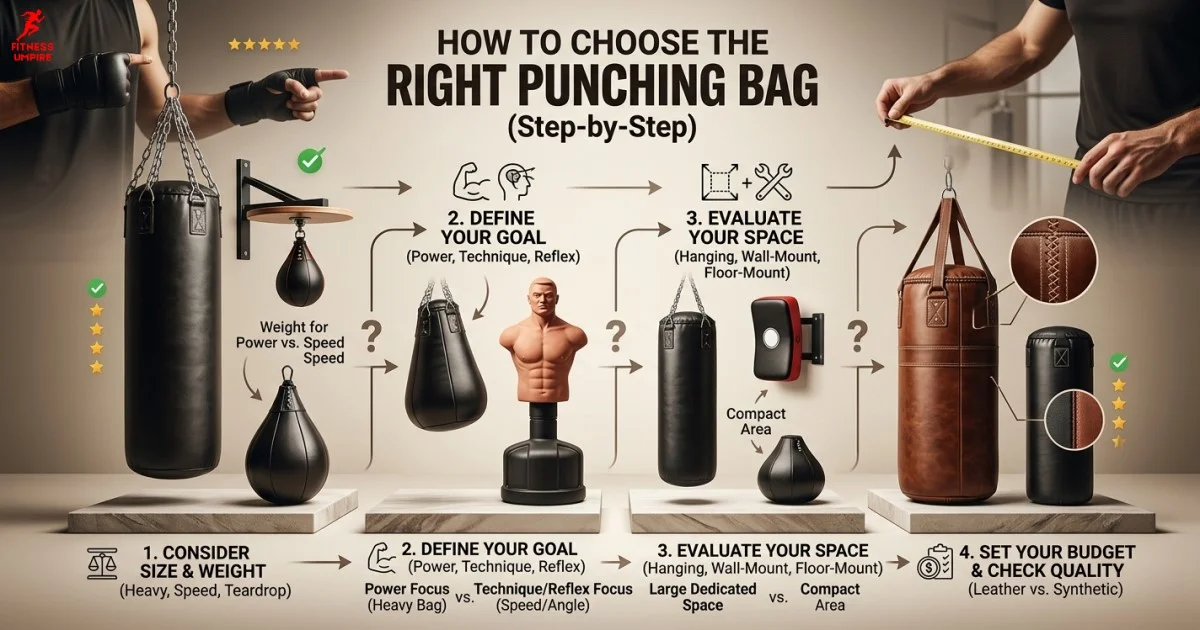
Choosing a punching bag gets much easier when you stop comparing dozens of products and start with five things that actually determine what will work for you:
Space → Experience level → Budget → Training goal → Body size
The right punching bag is the one that fits your available space, handles your training style, matches your experience, and gives you enough stability and durability for how you intend to use it.
A beginner training in an apartment has very different needs from a heavy hitter building a home gym. Likewise, someone practicing boxing combinations may want a different bag from someone training kicks, knees, or MMA.
Use the framework below to narrow your options before comparing individual bags.
1. Start With Your Available Space
Space should be the first factor because a punching bag needs room around it, not just enough space for the bag itself.
Think about three things:
- Where the bag will sit or hang
- How much room you need to move around it
- Whether the floor, ceiling, or walls can handle the setup
For a small room or apartment, a freestanding punching bag can be easier to work with because it does not require a ceiling mount. However, its base also takes up floor space.
A hanging heavy bag can provide a different training experience, but you need an appropriate mounting point and enough clearance for the bag to move.
Choosing a bag for an apartment
If you live in an apartment, consider:
- Floor space
- Ceiling height
- Noise and vibration
- Whether drilling or permanent installation is allowed
- How easily the bag can be moved or stored
A freestanding model may make more sense when you cannot install a ceiling-mounted system.
See the dedicated guide to choosing a punching bag for an apartment for a more detailed space-focused decision.
Choosing a bag for a home gym
If you have a dedicated training area, you have more flexibility. You can potentially accommodate a larger freestanding bag, hanging heavy bag, or multiple types of bags.
Don’t automatically choose the biggest bag available, though. Leave enough clearance to move, circle, kick, and work combinations safely.
For a dedicated training space, see choosing a punching bag for a home gym.
2. Match the Bag to Your Experience Level
Your experience level determines how much stability, forgiveness, and versatility you are likely to need.
A beginner usually does not need an extremely specialized bag. A straightforward, stable bag that allows basic punches and combinations can be easier to learn on.
More experienced users may have specific requirements for:
- Punching power
- Movement around the bag
- Kicking
- Knees
- Combination training
- Bag rebound
- Training intensity
If you’re a beginner
Look for a bag that is:
- Stable
- Easy to set up
- Suitable for basic combinations
- Appropriate for your available space
- Not unnecessarily complicated
A beginner-friendly setup should allow you to concentrate on technique rather than constantly adjusting or fighting with the equipment.
Our punching bags for beginners guide focuses specifically on this use case.
If you’re an experienced striker
An experienced boxer, kickboxer, or martial artist may benefit from a bag chosen around a particular training objective rather than simply buying a general-purpose model.
That brings us to the next major factor: what you actually want to train.
3. Set Your Budget Before Comparing Products
Your budget should narrow the field rather than determine the entire decision by itself.
Punching bags can vary substantially in price because of differences in construction, size, materials, design, filling, stability, and included equipment.
Instead of asking, “What is the cheapest punching bag?” ask:
What features do I actually need within my budget?
For example, a recreational user may not need the same construction as someone who trains several times per week at high intensity.
Budget checklist
Before buying, consider the complete cost rather than only the listed bag price.
You may need to account for:
- The punching bag
- Stand or mounting equipment
- Gloves
- Hand wraps
- Floor protection
- Replacement or additional components
- Shipping
A less expensive bag can become a less attractive option if the required accessories or installation add substantially to the total cost.
At the same time, paying more does not automatically mean a particular bag is right for you. Match the construction and features to your actual training requirements.
4. Choose Based on Your Training Goal
Training goal is one of the most important factors because different punching bags support different types of training.
Ask yourself what you will actually do with the bag.
| Training goal | What to prioritize |
|---|---|
| Basic boxing | Stable target for punches and combinations |
| Boxing combinations | A bag that allows consistent punching and movement |
| Kickboxing | Enough space and clearance for punches and kicks |
| MMA | A versatile setup suitable for mixed striking practice |
| General fitness | Easy setup, stability, and comfortable use |
| Power training | Strong construction and sufficient stability |
| Home practice | Size and setup compatible with your available space |
Boxing-focused training
If your primary goal is boxing, prioritize a bag that lets you practice punches, combinations, footwork, and movement around the target.
A traditional heavy bag can be useful when you have an appropriate mounting setup. A freestanding bag may be more convenient when installation is difficult.
Kickboxing
Kickboxing introduces kicks into the equation, so the useful training area can be different from a punching-only setup.
Consider the bag’s:
- Height
- Target area
- Stability
- Base or mounting system
- Clearance around the bag
For this use case, see how to choose a punching bag for kickboxing.
MMA
MMA training can involve punches, kicks, knees, combinations, and movement from different positions.
A bag for MMA should therefore be selected around the movements you actually practice rather than simply its label.
See choosing a punching bag for MMA for the MMA-specific considerations.
5. Consider Your Body Size
Your body size matters because the bag needs to provide a suitable target and enough stability for your training intensity.
A very small or lightweight bag may not provide the training experience you expect if you regularly strike with substantial force.
On the other hand, a larger or heavier bag isn’t automatically necessary for every user.
Consider:
- Your body weight
- Your striking power
- Whether you punch, kick, or both
- How aggressively you train
- How much movement you want from the bag
A simple way to think about bag stability
The harder you intend to strike, the more important stability becomes.
This is particularly relevant for heavier users and people who train at high intensity. If the bag moves excessively, tips, or requires constant repositioning, it may not suit your training style.
For more specific guidance, see punching bags for heavy hitters.
For adults looking for a general starting point, see punching bags for adults.
What Type of Punching Bag Should You Choose?
Once you’ve considered the five factors above, look at the type of bag that matches your requirements.
A punching bag can be broadly selected around its installation and training characteristics.
Freestanding punching bags
Freestanding bags have a weighted base and stand on the floor.
They can be useful when:
- You cannot install a ceiling mount
- You want a movable setup
- You train in a multipurpose room
- You prefer a floor-standing system
The trade-off is that the base occupies floor space and the bag may respond differently from a hanging heavy bag.
Hanging heavy bags
Hanging bags are suspended from a suitable mounting system.
They can work well when you have:
- A suitable ceiling or support structure
- Enough clearance
- A permanent training area
- A preference for a moving bag
Installation requirements are an important part of the decision.
Specialized punching bags
Other designs exist for particular training purposes. Depending on your goals, you may encounter bags designed around speed work, specific striking techniques, or specialized martial arts training.
Before choosing one, make sure the design actually matches your training rather than buying a specialized product simply because it has more features.
See the punching bag types guide to compare the major categories.
Don’t Ignore Materials and Construction
Two bags with similar dimensions can perform differently because of their construction.
Pay attention to:
- Outer covering
- Filling
- Seams
- Target surface
- Base construction
- Mounting hardware
- Overall build quality
The material should be appropriate for the amount and type of training you expect to do.
If you’re comparing construction rather than simply size, see punching bag materials.
You can also use the punching bag brands guide when you have narrowed down the type and features you need.
What Gear Do You Need With a Punching Bag?
The bag itself is only part of the setup.
Depending on your training, you may also need:
- Boxing gloves
- Hand wraps
- Suitable footwear
- Floor protection
- Mounting equipment or a stand
- Other training accessories
Don’t assume every punching bag includes everything required for training. Check exactly what comes with the product before comparing prices.
See the punching bag gear guide for related equipment.
A Simple Punching Bag Decision Framework
If you want to make the decision quickly, use this sequence:
1. How much space do you have?
Small apartment → start with apartment punching bags.
Dedicated training area → consider home gym punching bags.
2. What’s your experience level?
New to bag training → see punching bags for beginners.
3. What’s your budget?
Set a realistic total budget, including any required stand, mounting equipment, or accessories.
4. What are you training for?
Boxing → prioritize punching and combination work.
Kickboxing → consider both punching and kicking clearance → kickboxing punching bags.
MMA → consider mixed striking requirements → MMA punching bags.
5. How hard and how often will you train?
Higher-intensity training and heavier users should pay particular attention to stability and construction → punching bags for heavy hitters.
For a general adult setup → punching bags for adults.
6. Still unsure about dimensions?
Continue to the punching bag size guide before choosing a specific product.
Common Mistakes When Choosing a Punching Bag
Choosing by price alone
The cheapest option may not provide the construction or stability your training requires.
Choosing the largest bag
Bigger is not automatically better. The bag must fit your space and training goals.
Forgetting clearance
Measure the area around the bag, not just the footprint of its base.
Ignoring installation
A hanging bag requires an appropriate mounting solution. Make sure your intended location can support the setup.
Buying for a training style you don’t actually use
A specialized bag may be unnecessary if your training consists primarily of basic boxing combinations.
Forgetting accessories
Gloves, wraps, stands, mounts, and other equipment can affect your actual setup cost.
Choosing a bag before deciding your goal
This is one of the easiest ways to end up comparing products that were never suitable for your intended training.
Frequently Asked Questions
What is the most important factor when choosing a punching bag?
There isn’t one factor that works for everyone. Start with available space, then consider experience level, budget, training goal, and body size. These factors together narrow down the appropriate type of bag.
Should a beginner get a heavy punching bag?
A beginner can use a heavy bag, but the appropriate choice depends on available space, training goals, stability, and the user’s experience. A straightforward, stable setup is generally easier to learn on than a complicated specialized system.
Is a freestanding or hanging punching bag better?
They solve different setup requirements. A freestanding bag can be convenient when you cannot install a hanging system, while a hanging bag may suit a permanent training area with appropriate mounting support. Your space and training style should determine the choice.
How much space do I need for a punching bag?
You need enough room for the bag itself plus movement around it. Consider punching distance, footwork, kicks if applicable, and the movement of the bag. A bag that technically fits in a room may still be impractical if there isn’t enough clearance around it.
Should heavier people use a heavier punching bag?
Body size is one factor, but it isn’t the only one. Training intensity, striking power, bag stability, and the type of training also matter. Heavier users and heavy hitters should pay particular attention to how securely the bag stays in position.
Do I need a special punching bag for kickboxing?
Not necessarily, but kickboxing places different demands on the training target because kicks are part of the workout. Consider the bag’s height, target area, stability, and the amount of clearance available for kicks.
What punching bag should I choose for MMA?
Start with the movements you intend to practice. If your training includes punches, kicks, knees, and mixed combinations, look for a setup that accommodates those movements and provides adequate stability and clearance.
Should I choose the punching bag first or the accessories?
Choose the bag and installation method first, then make sure your gloves, wraps, mounting equipment, stand, and other accessories are compatible with the setup.
The Bottom Line
Choosing a punching bag doesn’t have to start with comparing hundreds of products.
Start with space, determine your experience level, establish your budget, identify your training goal, and then consider body size and training intensity. From there, choose the bag type, construction, and accessories that fit those requirements.
The simplest path is:
Space → Experience → Budget → Training Goal → Body Size → Bag Type → Construction → Gear
If you already know your situation, skip directly to the relevant scenario: