
Product Review · Updated 2026 _________________________________
Best Premium Most Stable Tested Genuine Leather Shell Heavy Hitters
Part of our full freestanding punching bag testing guide
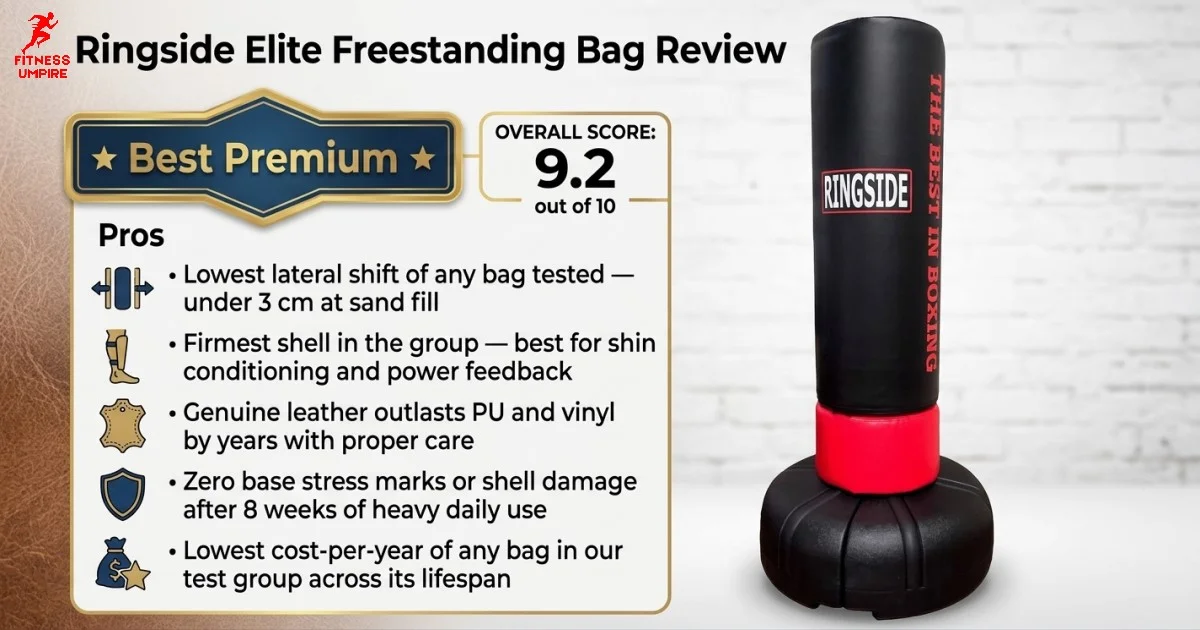
The Ringside Elite posted the lowest lateral shift of any bag we tested — under 3 cm at full sand fill during our 500-strike combination session. That single figure captures what this bag is: a precision stability instrument built for athletes who train hard enough to expose the ceiling of everything cheaper.
Ringside’s reputation sits in professional boxing equipment, and the Elite reflects that lineage. Genuine leather shell, low-profile reinforced base, and engineering tuned specifically for heavy loads across years of daily use. It’s the most expensive bag in our test group, and this review is an honest answer to whether that price is justified.
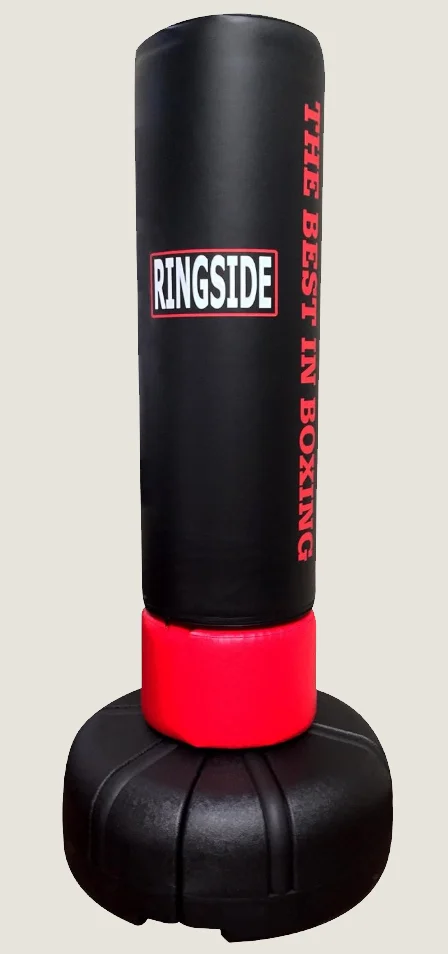
Ringside Elite Freestanding Punching Bag
The Ringside Elite Freestanding Punching Bag is a premium training bag for serious boxing, kickboxing, and high-intensity home workouts. It features a genuine leather striking surface, a wide low-profile base, adjustable height from approximately 49–69 inches, and strong stability under heavy training loads. FitnessUmpire’s eight-week testing recorded under 3 cm of lateral shift with sand fill, 65 dB on a rubber mat, and no visible base stress marks or leather damage.
Product SKU: 1789289536
Product Brand: Century
Product Currency: USD
Product Price: 589.99
Product In-Stock: InStock
9.2
Below: full specs, exactly how the 9.2 score is built, our eight-week testing log, leather maintenance guidance, and a direct head-to-head against the Century Wavemaster XXL — the most common alternative consideration for this buyer.
Quick specs ______________________________________
Ringside Elite Freestanding Bag — Specifications
| Striking surface diameter | ~18 inches |
| Height range (adjustable) | 49″–69″ |
| Base diameter | ~26″ — widest in our test group |
| Base profile | Low-profile — sits closer to the floor than most competitors |
| Unfilled weight (bag + base) | ~90 lbs |
| Max water fill | ~170 lbs (≈260 lbs total) |
| Max sand fill | ~270 lbs (≈360 lbs total) |
| Shell material | Genuine leather |
| What’s included | Bag, base, fill cap tool, assembly hardware |
| Assembly time | ~55–60 minutes |
| Warranty | Manufacturer’s warranty (Ringside) |
The math behind 8.1 _______________________________________________
Score Breakdown
Our overall score is a weighted average across five categories, using the methodology from our main testing guide. Here’s exactly how the Ringside Elite’s 9.2 is built.
| Category | Weight | Score | Weighted |
|---|---|---|---|
| Stability | 30% | 9.9 | 2.97 |
| Durability | 25% | 9.8 | 2.45 |
| Value | 20% | 7.4 | 1.48 |
| Versatility | 15% | 9.0 | 1.35 |
| Assembly | 10% | 9.0 | 0.90 |
| Overall | 100% | — | 9.15 |
Stability and durability are the two highest-weighted categories, and the Ringside Elite scores highest in the entire test group on both. Value is the only weak point — a 7.4 that reflects the significant price premium, not a performance shortfall. Everything about this bag is built to elite specification; the question is whether your training demands it.
Leather care — unique to this bag _____________________________________________
Leather Shell Maintenance Guide
The Ringside Elite is the only genuine leather shell in our entire test group — and genuine leather outlasts PU and vinyl by years, but only with periodic conditioning. Skipping it doesn’t immediately damage the bag, but over 12–18 months of unattended use, the leather will begin to dry and crack at stress points, shortening the lifespan that justifies the premium price.
The maintenance routine is minimal — roughly 15 minutes every 2–3 months of regular use.
- Wipe the striking surface clean after sessions. A dry cloth or slightly damp rag removes sweat and residue before it settles into the grain. Takes under two minutes and is the single highest-impact habit for leather longevity.After each session
- Apply a thin, even coat of leather conditioner. A product designed for sports or boxing equipment leather works best — avoid household furniture conditioners, which may use oils that soften the leather excessively over time. Work the conditioner in with a clean cloth in circular motions across the full striking surface.Every 8–10 weeks
- Allow to absorb fully before training on it. 20–30 minutes is typically sufficient; overnight is better if you have the option.20–30 min after conditioning
- Inspect for surface cracks at stress points — along the seams and at the mid-point of the striking surface where impact concentrates. Catching early-stage surface cracking and conditioning immediately stops it from deepening.Every 3–4 months
- Store away from direct sunlight and heat sources. UV exposure and prolonged heat dry leather faster than any training load — if the bag is in a south-facing garage, consider a cover when not in use.Ongoing
How we tested it __________________________________________________
8-Week Testing Log
| Week | Focus | Key observation |
|---|---|---|
| 1 | Assembly + sand fill setup | ~55 minutes with two people; the heavier base and larger components require more careful handling than lighter bags |
| 2 | Baseline stability — boxing combos at full sand fill | Under 3 cm lateral shift across a 500-strike session — the lowest recorded across all seven bags in our test group |
| 3–4 | Kick testing | Full-power roundhouse kicks produced roughly 4 cm of shift — stable throughout; teep kicks and push kicks held without the base shifting at all |
| 5 | Heavy hitter protocol — 220 lb+ athlete | Threw 100% power combinations for 20 minutes straight; the bag never walked, and shift stayed under 4 cm throughout — no other bag matched this under these conditions |
| 6 | Noise testing | 75 dB on hardwood, 65 dB on mat — the leather shell is the loudest impact surface tested, which is the expected trade-off for genuine leather construction |
| 7–8 | Leather inspection + base inspection | Zero stress marks on base; leather surface showed no cracking, splitting, or seam stress under eight weeks of daily heavy use |
Setup _________________________________________
Assembly — What to Expect
Total time came in at 55–60 minutes, and a second person is a genuine help rather than just a convenience — the base is the heaviest and widest in our test group, and the initial assembly requires holding components in position while securing bolts.
- Unbox carefully. Components are heavier than most freestanding bags — the base housing alone is noticeably denser than anything else in this guide.~5–10 min
- Assemble the reinforced base housing and attach the center pole. The wider, lower-profile base uses more hardware points than standard bases — take time to follow the diagram rather than rushing through.~15–20 min
- Mount the leather striking bag on the pole and set initial height. The leather bag is heavier than PU or foam alternatives — two people makes this step noticeably easier.~10 min
- Fill the base with sand in stages. Sand fill to 270 lbs takes time and benefits from filling in batches with gentle rocking to settle evenly — rushing this creates air pockets that reduce effective fill weight.~20–30 min
- Final height adjustment, bolt check, and initial leather conditioning. A quick pre-use conditioning pass prepares the leather for first impact — the surface arrives slightly dry from packaging.~10 min
In use __________________________________________
Real-World Performance
Stability
Under 3 cm of lateral shift at full sand fill across 500-strike boxing combination testing. Under full-power roundhouse kicks, the shift increased to roughly 4 cm — still by far the lowest kick-stability figure in our test group. A 220+ lb athlete throwing 100% power combinations for 20 continuous minutes produced no walking and no base shift above 4 cm.
The combination of the widest base in our lineup (~26″) and the lowest profile delivers a stability platform that’s measurably closer to a sand-filled hanging bag stand than anything else in the freestanding category. For context on how this compares across all seven bags, see our heavy-hitter lateral shift comparison.
Leather shell performance
The leather shell is firmer than any other surface in this guide — which creates two specific training effects: more resistance feedback under power strikes, and better shin-conditioning feedback for Muay Thai. Full details on shell firmness across the lineup are in our kickboxing guide.
The trade-off is wrist fatigue at higher volume — the firmer shell transfers more impact back into the hand and wrist than the Everlast Powercore’s dual-density foam. Training with quality gloves and correct technique addresses this; training with lightweight gloves on this shell at high volume is not a combination we’d recommend.
Noise
75 dB on bare hardwood, 65 dB on a 10mm mat — the loudest impact surface in our test group, an expected characteristic of genuine leather. The sharp, clear impact sound is something experienced strikers often prefer as an accuracy indicator. For apartments or shared walls, this is the wrong bag — our apartment guide covers quieter alternatives.
Durability
After eight weeks of daily heavy use — including the 220 lb heavy-hitter protocol — the base showed zero stress marks and the leather shell showed no cracking, splitting, or seam stress. Based on the construction quality and material track record, our home gym durability guide estimates an 8–10+ year lifespan under regular training — the highest in our test group.
The key comparison _________________________________________
Ringside Elite vs. Century Wavemaster XXL — Head to Head
These two bags are the most common comparison for serious home gym buyers. Here’s the direct breakdown across every dimension that matters.
| Factor | Ringside Elite | Century Wavemaster XXL | Winner |
|---|---|---|---|
| Stability at sand fill | < 3 cm shift | 4 cm shift | Ringside Elite |
| Shell material | Genuine leather | Polyurethane | Ringside Elite (longevity) |
| Height range | 49″–69″ | 47″–68″ | Effectively equal |
| Base footprint | ~26″ diameter | ~24″ diameter | Wavemaster marginally smaller |
| Noise (on mat) | 65 dB | 63 dB | Wavemaster XXL |
| Wrist fatigue | Higher — firmer leather | Lower — polyurethane | Wavemaster XXL |
| Shin conditioning | Better — firmest shell tested | Good — firm polyurethane | Ringside Elite |
| Expected lifespan | 8–10+ years | 7–10 years | Ringside Elite (slight edge) |
| Price tier | Premium+ | Premium | Wavemaster XXL |
| Overall score | 9.2 | 9.4 | Wavemaster XXL (value-weighted) |
The Wavemaster XXL wins the overall score because value carries 20% weight and the Ringside Elite’s price premium works against it. On raw performance — stability and durability — the Ringside Elite leads on both. Which one is “better” depends almost entirely on whether the stability difference (3 cm vs. 4 cm under full power) and leather shell are worth the price premium for your training.
The value argument _________________________________________
Cost Per Year — The Premium Price Rationalised
| Bag | Price tier | Expected lifespan (daily use) | Approx. cost / year |
|---|---|---|---|
| FITVEN Punching Bag | Budget | 2–3 years | Highest per year |
| Dripex Freestanding Bag | Budget | 2–3 years | High per year |
| Everlast Powercore | Mid-range | 5–7 years | Moderate per year |
| RDX Freestanding Bag | Mid-range | 5–7 years | Moderate per year |
| Century Wavemaster XXL | Premium | 7–10 years | Low per year |
| Century BOB XL | Premium | 7–9 years | Low per year |
| Ringside Elite | Premium+ | 8–10+ years | Lowest per year |
The Ringside Elite’s premium price divided across 8–10+ years of expected daily use works out to the lowest annual cost in the group — the only bag in our lineup where the premium price rationally pays for itself over a full training lifespan. This is the calculation serious home gym buyers should run before defaulting to “it’s too expensive.”
Fit check _________________________________________________
Who Should Buy This Bag
- You train at full power regularly and have already felt a cheaper bag walk or sway — this is the bag that closes that problem, per our heavy-hitter guide
- You’re training Muay Thai and want the firmest shell in this guide for shin conditioning — details in our kickboxing guide
- You have a dedicated home gym where you’ll train four-plus times a week for years — the cost-per-year calculation above applies; see our home gym guide
- You’re over roughly 180 lbs and want the stability ceiling of any freestanding bag in this guide
- You understand leather needs periodic conditioning and are willing to do it — the maintenance guide above is the commitment you’re making
Who Should Look Elsewhere
- Apartments or shared walls — at 65 dB on a mat, the leather shell is the loudest bag in our lineup; the Everlast Powercore is the right pick there; see our apartment guide
- Beginners — the firm leather shell and premium price are both wasted at beginner intensity; the FITVEN or Everlast Powercore are the right starting points, per our beginner’s guide
- Taller athletes wanting head-kick range — at 69″ maximum, the BOB XL’s 78″ range pulls ahead for athletes over 6’2″; see our height-fit table
- Buyers not ready to commit to leather maintenance — the Wavemaster XXL’s polyurethane shell delivers 95% of the stability at a lower price with zero maintenance required
Summary ____________________________________
Pros & Cons
Pros
- Lowest lateral shift of any bag tested — under 3 cm at sand fill
- Firmest shell in the group — best for shin conditioning and power feedback
- Genuine leather outlasts PU and vinyl by years with proper care
- Zero base stress marks or shell damage after 8 weeks of heavy daily use
- Lowest cost-per-year of any bag in our test group across its lifespan
Cons
- Highest upfront price in our test group
- Loudest impact surface — 65 dB on a mat, not suited to apartments
- Leather requires periodic conditioning — no-maintenance buyers should look at PU alternatives
- Heaviest bag to reposition once filled
FAQs ___________________________________________
Ringside Elite — Frequently Asked Questions
Is the Ringside Elite worth the price?
For heavy hitters and serious daily trainers, yes — and the cost-per-year table above shows why. Across an 8–10+ year expected lifespan under daily use, the premium price works out to the lowest annual cost in our test group. If you’re training at that intensity and frequency, “too expensive” is usually the wrong frame; “does the performance justify it” is the right one — and on stability and leather durability, it does.
Is the Ringside Elite better than the Century Wavemaster XXL?
On stability and durability, yes — under 3 cm vs. 4 cm of shift at sand fill, and a leather shell that edges out polyurethane on longevity. On overall score, the Wavemaster XXL leads at 9.4 vs. 9.2 because value carries 20% weight and the price premium works against the Elite. Which is “better” depends on whether the 1 cm stability difference and leather shell are worth the additional cost for your specific training level.
How do I maintain the Ringside Elite leather shell?
The maintenance routine is minimal — wipe the surface clean after each session, apply leather conditioner every 8–10 weeks of regular use, and inspect for surface cracking at stress points every few months. The full step-by-step is in the leather maintenance guide above. Skipping it doesn’t immediately damage the bag but shortens the lifespan over 12–18 months of regular use.
Is the Ringside Elite good for kickboxing and Muay Thai?
Yes — it’s our top pick for both, specifically because the genuine leather shell is the firmest surface in our test group for shin conditioning, and its stability under full-power kicks is the highest we measured. The full breakdown of kick-type performance is in our kickboxing guide.
Can the Ringside Elite be used in an apartment?
Not ideally. At 75 dB on bare hardwood and 65 dB on a mat, the leather shell is the loudest impact surface in our test group. For apartment use, our apartment guide points toward the Everlast Powercore, which measured 9–10 dB quieter across equivalent testing.
9.2
OUT OF 10
Final Verdict
The Ringside Elite is the most stable freestanding bag we tested, the most durable, and the only one with a genuine leather shell. For the serious athlete who trains hard, often, and for years — and who can run the cost-per-year calculation — the premium price has a rational argument behind it that no other bag in this guide can make quite so cleanly.

David Paul
Founder & Lead Equipment Tester — fitnessumpire.com
David has been training in boxing and martial arts for over a decade. He founded Fitnessumpire after finding that most online punching bag reviews were written without any real hands-on testing — and that the freestanding bag category was the worst offender.
Testing note: Every bag reviewed on this site was purchased at retail price and tested through an 8-week protocol — 500+ strikes per session, lateral shift measurements at both water and sand fill, decibel readings on hardwood and rubber mat, and weekly durability inspections. No manufacturer samples were accepted.
10+ years boxing & martial arts
7 bags independently tested
500+ strikes per bag
8-week test protocol