
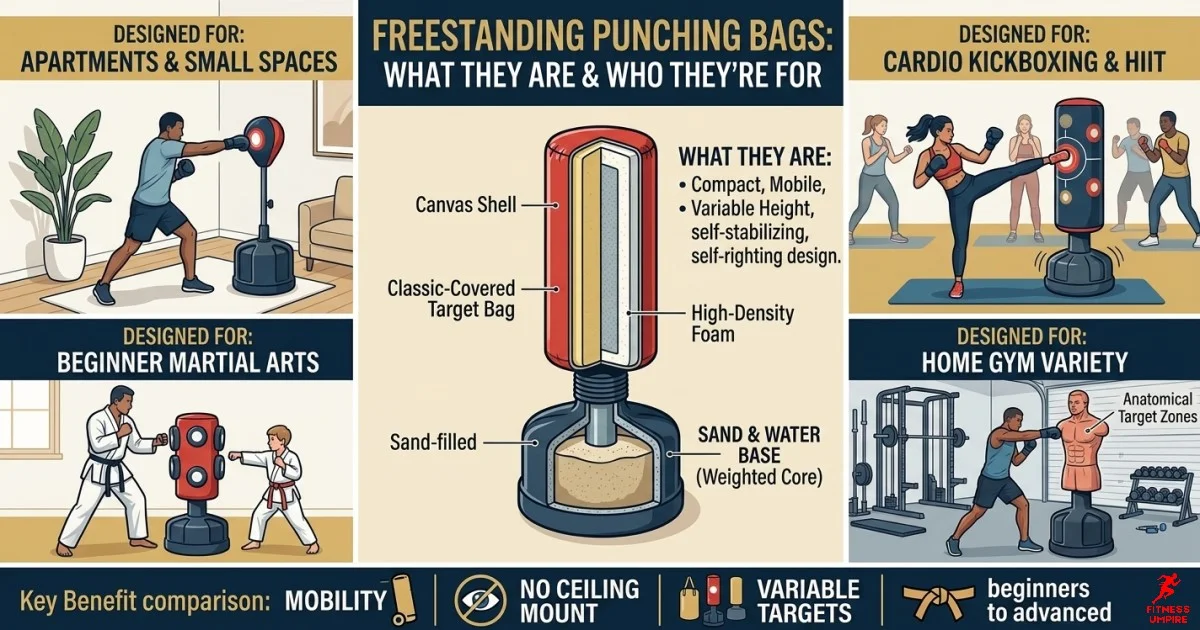
A freestanding punching bag is a floor-standing heavy bag with a weighted base instead of a ceiling or wall mounting point. You fill the base with water or sand, place it on the floor, and the bag is ready to use without drilling holes or installing a ceiling mount.
That makes freestanding bags particularly useful for apartments, rental homes, garages, and beginners who want a convenient punching bag without permanent installation.
If you’re comparing different types of punching bags, start with our punching bag types guide. For a broader look at choosing a punching bag, see our complete punching bag guide.
What Is a Freestanding Punching Bag?
A freestanding punching bag is a floor-mounted training bag designed to stand on its own. Instead of hanging from a chain, bracket, or ceiling beam, the bag is attached to a large base that provides stability.
The basic design has three main parts:
| Part | What it does |
|---|---|
| Bag body | Provides the striking surface for punches, kicks, and other training drills |
| Base | Holds the weight that keeps the bag standing |
| Connector/shaft | Joins the bag to the base and transfers movement when the bag is struck |
Most freestanding bags are designed so the base can be filled with water or sand. Once filled, the added weight makes the unit substantially more difficult to move during training.
The major difference from a traditional hanging heavy bag is therefore simple: a freestanding bag gets its stability from the floor and weighted base, while a hanging bag gets its support from an overhead mounting point.
Do Freestanding Punching Bags Need Installation?
Usually, they require much less installation than hanging bags.
You don’t normally need to drill into a ceiling, locate a structural beam, install a heavy-bag hanger, or permanently modify the room. Assembly is still required for many models, and the base needs to be filled before use, but the process is generally much simpler than mounting a hanging bag.
This is one of the biggest reasons freestanding bags appeal to renters and people training in rooms where permanent modifications aren’t practical.
Water vs. Sand for the Base
Freestanding punching bags commonly use either water or sand to add weight to the base.
Water is convenient because it is easy to add and remove. That’s useful if you expect to move or store the bag periodically. Sand can provide a heavier, more permanent setup and avoids having a large container of water inside the base.
The better option depends on how you use the bag, how often you move it, and the specific manufacturer’s instructions.
For a detailed comparison, see our water vs. sand freestanding punching bag base guide.
Freestanding vs. Hanging Punching Bags
Both designs can be useful for striking practice, but they solve different setup and space problems.
| Feature | Freestanding bag | Hanging bag |
|---|---|---|
| Installation | Minimal compared with permanent mounting | Requires a suitable mounting point |
| Ceiling drilling | Usually unnecessary | Often required |
| Suitable for renters | Generally convenient | Can be difficult depending on the property |
| Portability | Can usually be relocated after emptying/moving | Mounting location limits placement |
| Floor space | Requires floor space around the base | Leaves the floor beneath the bag more open |
| Swinging movement | Often more controlled by the base | Can swing freely |
| Setup flexibility | Easy to place in different rooms | Dependent on mounting structure |
| Kicking practice | Many models are designed for punches and kicks | Depends on bag type and setup |
| Permanent installation | Usually unnecessary | Commonly part of the setup |
The Main Trade-Off
The biggest advantage of a hanging bag is its free movement. Once properly mounted, it can swing and move after strikes, creating a different training experience.
A freestanding bag trades some of that movement for installation convenience and placement flexibility.
That doesn’t make one design universally better. The right choice depends on your available space, training style, property restrictions, and how much setup you’re willing to do.
Pros of Freestanding Punching Bags
1. No ceiling mount is required
This is the most obvious benefit.
A freestanding bag doesn’t depend on a ceiling joist, wall bracket, or specialized mounting hardware. That can make it much easier to add a training bag to an existing room.
2. Good option for renters
Renters often cannot drill into ceilings or walls or make permanent changes to a property.
A freestanding bag can solve that problem because its support comes from its own base rather than the building structure.
3. Easier to relocate
When the base isn’t filled, many freestanding bags are considerably easier to move than a fully installed hanging system.
This can be useful when you need to clear a room, rearrange a home gym, or store the equipment.
4. Beginner-friendly setup
For someone buying a first punching bag, a freestanding design can eliminate some of the decisions associated with mounting a hanging bag.
You still need to assemble it correctly, select an appropriate location, and follow the manufacturer’s instructions, but you don’t have to design a ceiling or wall mounting system.
5. Works in rooms without suitable mounting points
Not every room has an obvious structural location for a heavy bag.
A freestanding model can be placed on an appropriate floor surface without requiring an overhead support point.
Cons of Freestanding Punching Bags
Freestanding bags aren’t perfect for every training environment.
1. They take up floor space
The weighted base occupies floor area, and you also need enough clearance around the bag to train safely.
In a small room, that footprint can become an important consideration.
2. The base can get in the way
Depending on the design, the base sits around the bottom of the bag. This can affect how close you can stand to the target and how you move around it.
For users who want unrestricted movement around a hanging bag, this can be a noticeable difference.
3. Movement is different from a hanging bag
A freestanding bag can move, rock, or rebound after a strike, but its movement is constrained by the base.
A hanging bag can swing through a larger arc because it is suspended from above. That difference can matter if swinging movement is an important part of your training.
4. Moving a filled base can be difficult
The same weight that keeps a freestanding bag stable also makes it harder to relocate when the base is full.
Before filling it, choose a practical location with enough room for your intended training.
5. Stability varies by design and use
Not every freestanding bag behaves the same way. Base size, construction, filling method, bag height, and striking force can all affect how the equipment moves.
A freestanding bag should therefore be evaluated as a complete system rather than by looking only at the bag itself.
Who Should Use a Freestanding Punching Bag?
Apartment users
Freestanding bags are particularly practical when ceiling mounting isn’t possible or desirable.
If you have enough floor space and a suitable surface, you can create a training area without installing hardware overhead.
For apartment users, the main considerations are available space, floor protection, noise, and how much movement the bag produces during training.
Renters
Renters are another natural audience.
If you don’t want to make permanent changes to your home, a floor-standing bag avoids many of the installation issues associated with hanging equipment.
You should still check your lease and consider whether the impact noise or movement could affect neighbors.
Beginners
A freestanding bag can be a straightforward way to start practicing basic striking techniques.
It doesn’t require you to understand ceiling construction or choose specialized mounting hardware. Once assembled and properly positioned, the bag provides a target for basic punching and kicking drills.
Home-gym users
Freestanding bags can also work well in home gyms where flexibility matters.
You can dedicate floor space to the bag when training and potentially move it when the room needs to be used for another activity.
People who don’t want permanent installation
Even if you’re not a renter, you may simply prefer equipment that doesn’t require drilling into your home.
A freestanding bag gives you that option.
Who May Prefer a Hanging Bag?
A hanging bag may make more sense if you already have a suitable structural mounting point and specifically want a bag that can swing freely after strikes.
It can also be preferable when preserving floor space beneath the bag is more important than avoiding installation.
The decision ultimately comes down to the training experience you want and the physical limitations of your space.
What Should You Look for in a Freestanding Punching Bag?
Before buying one, consider these basic factors:
Base: Look at the base design, filling method, and how much floor space it requires.
Height: Make sure the striking area is appropriate for the techniques you intend to practice.
Stability: Consider how the bag is expected to behave under your normal training intensity.
Construction: Check the materials and overall construction rather than judging the bag by appearance alone.
Footprint: Measure your available training area, including the space needed to move around the bag.
Portability: If you expect to move it regularly, consider how the base is filled and how practical relocation will be.
Training style: A model suitable for general punching practice may not provide the same experience as one designed with substantial kicking practice in mind.
Are Freestanding Punching Bags Good for Beginners?
Yes. Freestanding punching bags can be a practical choice for beginners, particularly when easy setup and flexible placement are priorities.
However, “beginner-friendly” doesn’t mean every model is suitable for every beginner. Consider your available space, training goals, height, striking style, and how frequently you expect to move the equipment.
The best choice is the one that fits your environment as well as your training needs.
Common Misconception: Freestanding Means No Setup
A freestanding bag is easier to install than a hanging bag, but it isn’t necessarily completely setup-free.
Many models require assembly, and the base must be filled with the appropriate material. The bag also needs to be placed on a suitable surface with enough clearance for training.
So the more accurate description is low-installation, rather than zero setup.
Ready to Buy?
If you’ve decided that a freestanding design fits your space and training style, the next step is comparing actual models rather than choosing based only on the type.
Ready to buy? See our 7 tested freestanding punching bags.
That guide focuses on individual freestanding bags so you can compare their features and find a model that fits your setup.
Frequently Asked Questions
What is a freestanding punching bag?
A freestanding punching bag is a floor-standing punching bag attached to a weighted base. The base provides stability, so the bag does not need to be suspended from a ceiling or wall.
Do freestanding punching bags need to be mounted?
No. Their defining feature is that they stand on a weighted base rather than requiring an overhead mounting point. Assembly and base filling may still be necessary.
Are freestanding punching bags good for apartments?
They can be a practical option for apartments because they generally don’t require ceiling or wall mounting. However, you still need sufficient floor space and should consider impact noise and movement.
Is water or sand better for a freestanding punching bag?
Neither is universally better. Water is generally convenient when the base may need to be emptied, while sand can provide a heavier, more permanent fill. Follow the manufacturer’s instructions for your specific model.
Can beginners use freestanding punching bags?
Yes. Their relatively simple installation and flexible placement make them suitable for many beginners. The specific bag should still match the user’s training goals and available space.
Are freestanding bags better than hanging bags?
There is no universal answer. Freestanding bags prioritize easier installation and flexible placement, while hanging bags provide a different training experience with more natural swinging movement. Your space and training goals should determine which design fits you.
Can you kick a freestanding punching bag?
Many freestanding punching bags are designed for both punching and kicking, but capabilities vary by model. Check the manufacturer’s specifications before using a particular bag for intensive kicking drills.
Bottom Line
A freestanding punching bag is essentially a self-supporting training bag built around a weighted floor base. Its biggest advantages are straightforward setup, no permanent ceiling mount, and flexibility for apartments, rentals, home gyms, and beginners.
Its trade-offs are equally clear: it uses floor space, the base can affect movement around the bag, and its behavior differs from a freely swinging hanging bag.
If those trade-offs fit your training environment, a freestanding model can be a convenient way to add striking practice without installing a traditional hanging heavy bag.