
Buying Guide · By Scenario ____________________________________
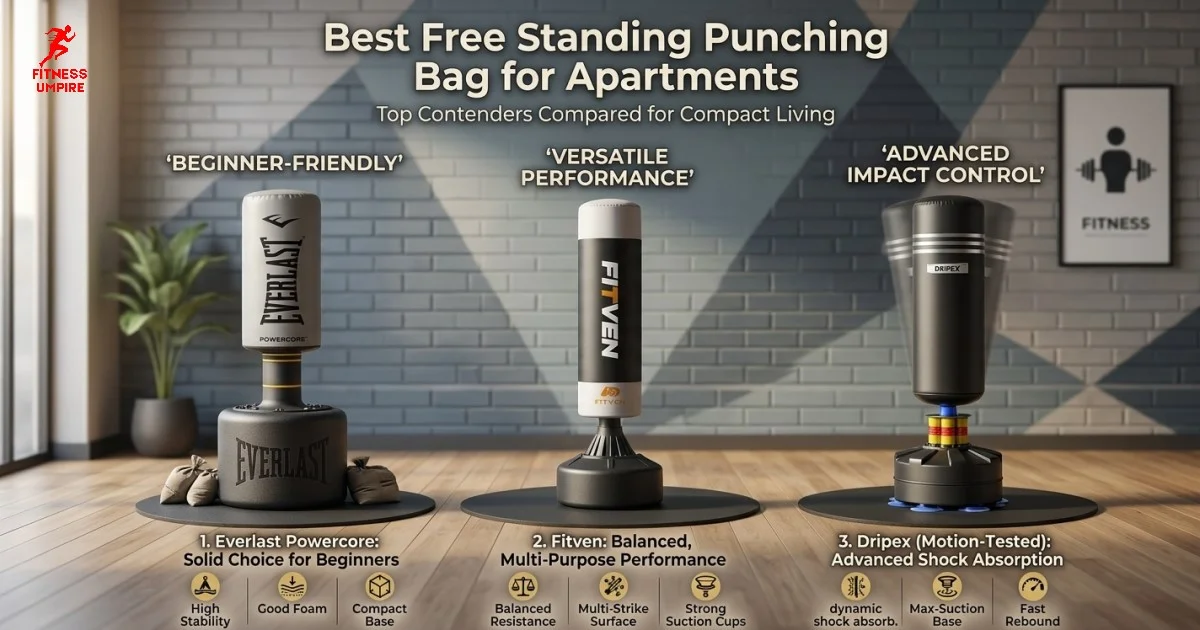
Part of our full freestanding punching bag testing guide
A bag that’s brilliant for a garage can be a genuine problem in a third-floor walk-up. Training above, below, or beside other people changes the entire decision — what wins “best overall” often isn’t what belongs in your living room.
In our main testing guide, we measured every bag for impact noise on hardwood and on a rubber mat, and tracked how much each base footprint took up on the floor. Two factors that barely register in most buying guides turn out to be the deciding ones for apartment training — and three bags from our test group stood out as genuinely apartment-ready.
This page focuses on exactly that: what changes when your training partner is, unintentionally, the person living below you.
The problem ____________________________________________
Why “Best Overall” Doesn’t Mean “Best for Apartments”
The two bags that topped our overall rankings — the Century Wavemaster XXL and the Ringside Elite — earned those scores largely through sand-filled bases and dense, hard-wearing shells. That combination is exactly what makes a bag stable enough for full-power combinations.
It’s also exactly what makes it loud and heavy on a shared floor. A denser shell reflects more impact sound instead of absorbing it, and a heavier sand-filled base transmits more force into whatever it’s sitting on. Neither of those bags is a bad product — they’re simply optimized for a different environment than a rented apartment with neighbors on the other side of the wall.
For apartment training, the priority order flips: noise output and footprint come first, with stability as the third consideration rather than the first.
What actually matters _________________________________
Impact Noise vs. Floor Vibration — Know the Difference
Apartment complaints come from two distinct sources, and they call for different fixes.
Impact noise is the airborne sound of the strike itself — the crack or thud you hear when a glove or shin connects with the bag. This is what travels through walls and bothers a neighbor beside you. Shell material is the biggest factor here: softer, dual-density foam absorbs that sound, while harder polyurethane or leather shells reflect more of it outward.
Floor vibration is structure-borne — the force of the impact transmitted down through the base into the floor, and from there into the ceiling of the unit below. This is usually the bigger source of complaints in buildings with shared floors. Base fill is the main lever here: sand’s extra mass increases what gets transferred into the floor, while water fill transmits noticeably less.
In practice, this means the quietest setup for apartments combines a softer-shell bag with a water-filled base — which happens to describe exactly the bags that performed best in our apartment testing.
The fix ______________________________________
The Apartment Setup That Actually Works
Across every bag we tested, the single biggest noise reduction came from one change: adding a rubber mat. A 10mm mat cut transmitted noise by 8–12 dB in our testing — roughly the difference between “audible in the next room” and “barely noticeable.”
For apartments specifically, a few additional choices compound that effect:
Go thicker than the minimum. 10mm is the baseline. If you’re on an upper floor with a wood subfloor, or you simply want maximum isolation, step up to a 15–20mm mat or double-layer two thinner mats.
Add an anti-vibration layer underneath the mat. Interlocking foam tiles beneath your rubber mat create a second layer of isolation between the base and the floor — this is the same principle used under washing machines and treadmills, and it makes a measurable difference for downstairs neighbors.
Choose water fill over sand. Even on a bag that supports both, water fill transmits less force into the floor. You give up some stability — but for apartment-intensity training, that trade is almost always worth it.
Position thoughtfully. Where possible, place the bag away from walls shared with neighbors, and toward the center of a room rather than against an exterior or party wall.
Our picks _____________________________________
Best Freestanding Punching Bags for Apartments
From the seven bags in our full test group, these three handled apartment conditions best.
01
Top Pick · Apartments
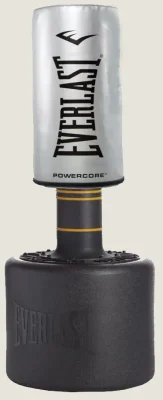
Everlast Powercore Freestanding Bag
The quietest bag in our test group on bare hardwood, thanks to a dual-density foam shell that absorbs impact rather than reflecting it. A moderate footprint and water-fill base round out a setup that’s genuinely workable in a shared building. Read the full review →
69 dB
HARDWOOD
02
Best for Tight Spaces
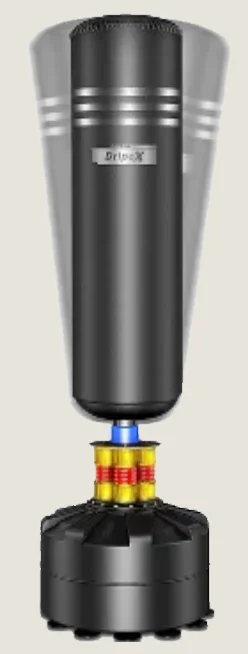
Dripex Freestanding Punching Bag
The smallest base footprint of any bag we tested, which matters as much as noise in a small apartment. Easy to drain and store between sessions if the room needs to serve other purposes. Read the full review →
58 dB
ON MAT
03
Best Budget Option
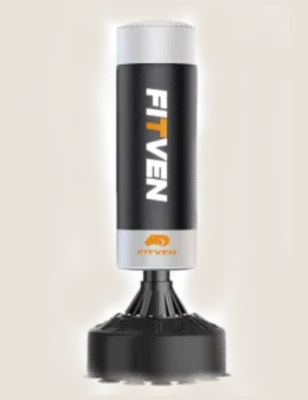
FITVEN Punching Bag
Solid noise performance for the price, and the bundled gloves and wraps make it a sensible all-in-one starting point if you’re also new to training. Stick to water fill — sand isn’t supported on this base. Read the full review →
62 dB
ON MAT
If you only read one line
Everlast Powercore with a 10mm+ rubber mat is the best balance of quiet operation and real training quality for apartment use.
The full picture __________________________________________
Noise Levels Compared, All 7 Bags
Measured one meter from each bag during a three-minute hard combination round, on a 10mm rubber mat.
| Bag | Noise (on mat) | Footprint | Apartment fit |
|---|---|---|---|
| Century BOB XL | 56 dB | Large | Quietest, but too large for most apartments |
| ⭐Dripex Freestanding Bag | 58 dB | Compact | Recommended |
| ⭐Everlast Powercore | 59 dB | Moderate | Recommended |
| RDX Freestanding Bag | 61 dB | Moderate | Workable |
| FITVEN Punching Bag | 62 dB | Moderate | Workable, good budget pick |
| Century Wavemaster XXL | 63 dB | Large | Better suited to a home gym |
| Ringside Elite Freestanding | 65 dB | Large | Better suited to a home gym |
One result is worth a second look: the Century BOB XL technically posts the lowest noise reading of any bag. But it shares the Wavemaster’s large base footprint and sits at a premium price point — which makes it impractical for most apartments despite the quiet impact. If targeting accuracy is your priority and you have the space, it’s worth a look on our best bags for MMA page.
What to skip ________________________________________________
What to Avoid for Apartment Use
The Century Wavemaster XXL and Ringside Elite Freestanding Bag are two of the best-performing bags in our entire test group — but not for this scenario. Both rely on sand fill and harder shells for their class-leading stability, which is precisely what makes them louder and harder on a shared floor.
If you have a dedicated training space — a garage, basement, or detached structure — these are genuinely excellent choices, and we cover them in detail on our best bags for a home gym page. They’re just not the right starting point for a shared building.
Skip for apartments
Century Wavemaster XXL — excellent for a home gym, too loud and heavy for shared floors.
Ringside Elite Freestanding Bag — best-in-class stability, but the leather shell and sand fill work against you here.
Before you start ____________________________________________
Apartment Setup Checklist
Run through this before your first session, not after a complaint.
FAQs ___________________________________________
Apartment Training — Frequently Asked Questions
Will my downstairs neighbors hear or feel a freestanding punching bag?
It depends almost entirely on your setup, not just the bag. Impact noise travels through walls, while floor vibration travels through the structure to the unit below — often the bigger concern. A water-filled base, a thick rubber mat, and an anti-vibration layer underneath address both. With that setup, even hard training sessions are typically unnoticeable to neighbors below.
Can I use a freestanding punching bag in a rented apartment without violating my lease?
In most cases, yes — freestanding bags require no installation, drilling, or wall mounting, which is exactly why they’re the recommended option for renters over hanging bags. That said, some leases include noise clauses, so a proper mat-and-isolation setup is worth treating as a requirement rather than an option.
Does a freestanding punching bag need special flooring?
No special flooring is required, but a rubber mat is effectively mandatory for apartment use — both to protect hardwood from scratches caused by base movement, and to reduce noise and vibration transfer. A 10mm mat is the minimum; thicker or double-layered mats perform better on upper floors.
What’s the quietest freestanding punching bag?
In our testing, the Century BOB XL produced the lowest raw noise reading, but its large footprint and price make it impractical for most apartments. Among bags actually suited to apartment use, the Everlast Powercore and Dripex Freestanding Bag were the quietest, both performing well with a standard rubber mat.
Should I use water or sand fill in an apartment?
Water fill. Sand provides more stability for heavy training, but its added mass transmits more vibration into the floor — exactly the trade-off you don’t want in a shared building. Water fill at full capacity, paired with a rubber mat, is the right balance for apartment intensity.
Want the full picture?
See how all seven bags scored across stability, durability, and value — plus our complete buyer’s guide and head-to-head comparisons.

David Paul
Founder & Lead Equipment Tester — fitnessumpire.com
David has been training in boxing and martial arts for over a decade. He founded Fitnessumpire after finding that most online punching bag reviews were written without any real hands-on testing — and that the freestanding bag category was the worst offender.
Testing note: Every bag reviewed on this site was purchased at retail price and tested through an 8-week protocol — 500+ strikes per session, lateral shift measurements at both water and sand fill, decibel readings on hardwood and rubber mat, and weekly durability inspections. No manufacturer samples were accepted.
10+ years boxing & martial arts
7 bags independently tested
500+ strikes per bag
8-week test protocol