
Buyer’s Guide · Setup Comparison _________________________________
Part of our full freestanding punching bag testing guide
This decision is separate from which bag you buy. Almost every freestanding bag in our test group can be filled with water, and most of the higher-tier options also support sand — which means the fill question is really about how you train, not which product you’ve chosen.
Across our testing, fill type was consistently one of the largest single factors in how stable a bag felt under real combinations. This page is the dedicated, complete answer: a direct comparison, full setup walkthroughs for both options, and the data behind exactly how much fill type actually matters.
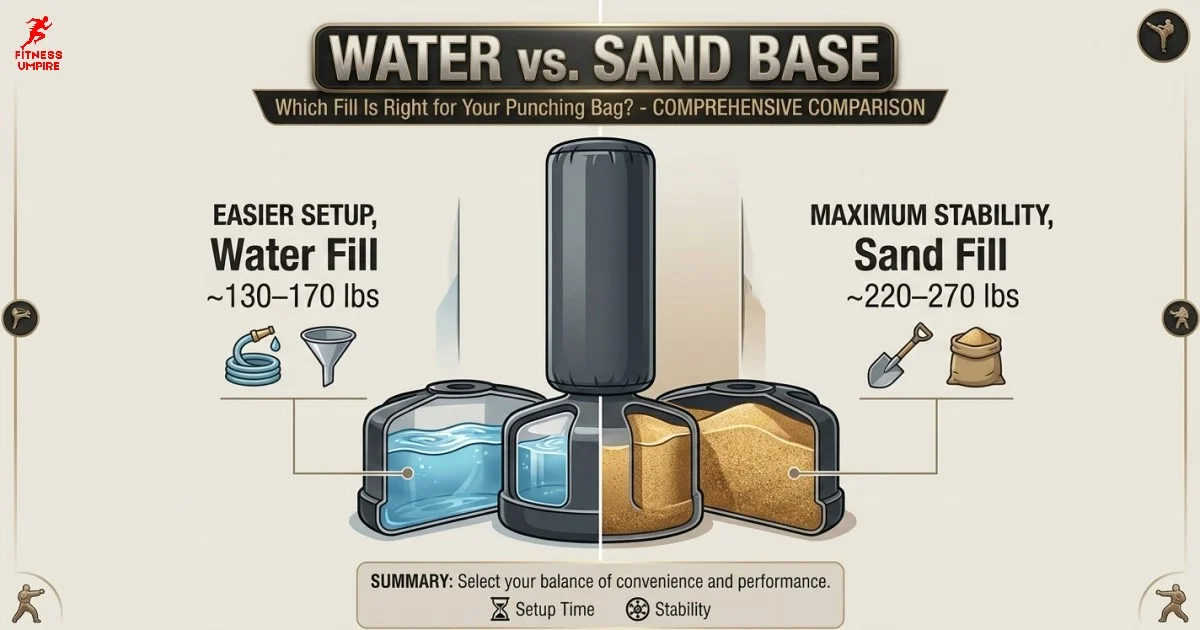
EASIER SETUP
Water Fill
~130–170 lbs
VS
MAXIMUM STABILITY
Sand Fill
~220–270 lbs
At a glance _______________________________________
Water vs. Sand — Direct Comparison
| Factor | Water Fill | Sand Fill |
|---|---|---|
| Typical max weight | 130–170 lbs | 220–270 lbs |
| Stability under full power | Good | Excellent |
| Setup time | 5–10 minutes | 20–45 minutes |
| Setup cost | Effectively free (hose) | Cost of sand, one-time |
| Portability once filled | Can drain and move | Very difficult to move |
| Mess / cleanup risk | Minimal — drains cleanly | Spills are harder to manage |
| Floor vibration transmitted | Lower | Higher |
| Freezing risk (unheated spaces) | Possible below freezing | Not a concern |
| Bag compatibility | Universal — all 7 bags tested | 4 of 7 bags tested support it |
How much it actually matters _______________________________
Stability Data Across the Lineup
The clearest evidence comes from the one bag in our test group measured at both fill types under identical conditions. The Century Wavemaster XXL posted 6 cm of lateral shift during our 500-strike combination testing at full water fill — and 4 cm at full sand fill. A real, measurable difference, but smaller than many buyers expect.
The bigger factor is usually which bag you’re filling, not just which substance you put in it. A well-engineered base at water fill — like the Everlast Powercore’s 6–7 cm shift — can outperform a poorly-designed base even at sand fill. Our heavy-hitter lateral shift comparison has the full sand-versus-water breakdown across all seven bags, including which ones don’t support sand at all.
The practical takeaway: choose the right bag first, then optimize fill type within that choice. Fill type is a meaningful lever, not the entire answer.
If you’re going with sand _______________________________
Sand Fill — Full Setup Walkthrough
Sand fill rewards patience during setup. Rushing it is the most common cause of underperformance — air pockets and uneven distribution can leave a sand-filled base less stable than a properly filled water base.
- Use clean, dry play sand — not construction or builder’s sand. Builder’s sand can carry debris or excess moisture, which adds inconsistent weight and may damage the base liner over time.Before you start
- Confirm your bag’s base actually supports sand. Not every base does — forcing sand into a water-only housing risks cracking it. Check your specific model first.Before you start
- Fill in stages, roughly a quarter of total capacity at a time. Adding all the sand at once is the single most common mistake — it traps air pockets that reduce effective stability even at “full” capacity.Throughout
- Gently rock the base between each stage. This settles the sand and closes air pockets without needing to compress it by force.After each stage
- Don’t feel obligated to fill to maximum on day one. A partially sand-filled base is still a meaningful upgrade over water alone — you can always add more later as you confirm how much stability you actually need.Ongoing
- Seal the fill cap fully and check it periodically. A loose cap is the most common cause of slow sand leakage, which quietly reduces stability without an obvious cause.After filling, then monthly
Total time for a full sand fill typically runs 20–45 minutes depending on base capacity — noticeably longer than water, but a one-time cost rather than something you redo each session.
If you’re going with water _____________________________
Water Fill — Full Setup Walkthrough
Water fill is the default for most home users, and for good reason — it’s fast, requires no extra purchase, and is the only fill type that’s fully reversible in minutes if you need to move or store the bag.
- Locate the fill cap and confirm the maximum recommended capacity. Most freestanding bases max out between 130 and 170 lbs of water — check your specific model’s documentation.Before you start
- Use a garden hose or large container for filling. A hose is faster for full capacity; a container works fine for smaller bases or top-offs.~5–10 min
- Fill to the manufacturer’s maximum line, not beyond it. Overfilling can stress the base housing and doesn’t meaningfully improve stability once you’ve reached design capacity.During fill
- Seal the cap fully and wipe away any spillage. A properly sealed cap prevents slow leaks that can quietly reduce your fill level over weeks.~1 min
- Check the fill level periodically. Evaporation is slow but real over months — a quick top-off every few weeks keeps stability consistent.Every few weeks
- In unheated garages or outdoor-adjacent spaces, consider draining before freezing temperatures. Water expands as it freezes and can stress or crack a base housing — this is one scenario where water fill needs more seasonal attention than sand.Seasonal
Total time for a full water fill typically runs 5–10 minutes — by far the fastest setup of any option, and the reason it remains the default choice for beginners and anyone prioritizing simplicity. Our beginner’s guide covers why this matters more than people expect when you’re just getting started.
A middle option _________________________________________
Mixed Fill — Is It Worth Combining Sand and Water?
Some bases technically allow a combination — a layer of sand at the bottom for added base weight, topped off with water to reach full capacity. It’s a reasonable middle ground if you want more stability than pure water provides but aren’t ready for a full sand commitment.
Worth knowing before you try it
Mixed fill adds complexity without a clean performance story — you get partial stability gains, but draining becomes messier (sand at the bottom won’t drain with the water), and you lose water fill’s main advantage: fast, clean reversibility. For most buyers, the better path is choosing one fill type deliberately based on the comparison table above, rather than splitting the difference. If you’re still unsure which way to lean, our bodyweight-to-base-fill table gives a clearer, more direct answer based on your training profile.
By scenario__________________________________
Decision Matrix
Choose water fill if
Your bag’s base doesn’t officially support sand
You’re a beginner or training at light-to-moderate intensity
You’re in an apartment and floor vibration is a concern — see our apartment guide
You need the option to drain and move the bag regularly
Choose sand fill if
The bag is staying in one place long-term and portability isn’t a priority
You’re training with real power, typically above 180 lbs of bodyweight with developed technique
You’ve already noticed a bag walking or wobbling under combinations at water fill
Your training includes regular kicks, especially at full power — see our heavy-hitter guide
FAQs ___________________________________________
Water vs. Sand Fill — Frequently Asked Questions
Is sand or water better for a freestanding punching bag?
Sand provides more weight and better stability — up to 270 lbs versus roughly 170 lbs for water — making it the better choice for heavy hitters and full-power training. Water is faster to set up, fully reversible, and sufficient for most light-to-moderate training. Most home users are well served by water; serious athletes should consider sand.
Can I add sand to a base that’s only designed for water?
No. Bases not designed for sand have housings that aren’t built to handle the additional weight and pressure, and forcing it in risks cracking the base. Check your specific bag’s specifications before attempting a sand fill.
How much more stable is sand fill compared to water?
On the one bag we tested at both fill types under identical conditions, lateral shift during full-power combinations dropped from 6 cm with water to 4 cm with sand — a real but moderate improvement. Choosing a well-engineered bag matters more than fill type alone; a quality base at water fill can outperform a poor base at sand fill.
Can water freeze in a punching bag base?
Yes, in unheated spaces during cold winters. Water expands as it freezes, which can stress or crack the base housing over time. If your bag lives in an unheated garage or similar space, draining it before sustained freezing temperatures is a sensible precaution — this is one scenario where sand has a practical advantage over water.
Is it worth mixing sand and water in the same base?
Generally not recommended. Mixed fill offers partial stability gains but makes draining messier and eliminates water fill’s main advantage of fast, clean reversibility. Choosing one fill type deliberately, based on your training intensity and bodyweight, is usually the better approach.
READ THE FULL REVIEWS ___________________________________
Training With Real Power?
Still Choosing a Bag?

David Paul
Founder & Lead Equipment Tester — fitnessumpire.com
David has been training in boxing and martial arts for over a decade. He founded Fitnessumpire after finding that most online punching bag reviews were written without any real hands-on testing — and that the freestanding bag category was the worst offender.
Testing note: Every bag reviewed on this site was purchased at retail price and tested through an 8-week protocol — 500+ strikes per session, lateral shift measurements at both water and sand fill, decibel readings on hardwood and rubber mat, and weekly durability inspections. No manufacturer samples were accepted.
10+ years boxing & martial arts
7 bags independently tested
500+ strikes per bag
8-week test protocol