
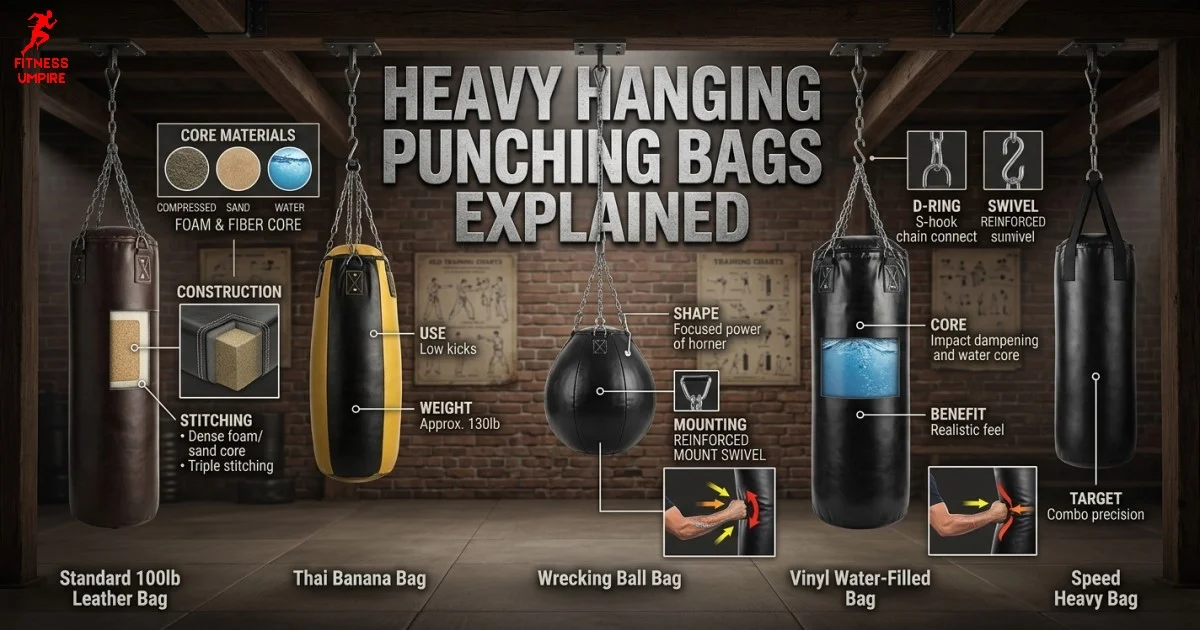
A heavy hanging punching bag is a suspended training bag designed for boxing, kickboxing, Muay Thai, MMA, and other striking workouts where stability, resistance, and realistic bag movement matter. Most traditional heavy bags weigh roughly 70 to 150 pounds, although lighter and much heavier models are also available.
Unlike a freestanding bag, a hanging bag is attached to an overhead support such as a properly reinforced ceiling joist, beam, or dedicated heavy-bag frame. That fixed connection allows the bag to absorb hard punches and kicks while swinging away from the striker rather than simply rocking on a base.
For beginners, a lighter bag can be easier to control. Experienced boxers and power-focused athletes often prefer heavier bags because they provide more resistance and tend to move less dramatically when struck with force.
What Is a Heavy Hanging Punching Bag?
A heavy hanging punching bag is a cylindrical or specially shaped striking bag that hangs from an overhead mounting point. It is commonly filled with textile materials, foam, or other padding and is covered with materials such as synthetic leather, vinyl, canvas, or genuine leather depending on the model.
The word heavy describes both the bag category and its intended training purpose. These bags are built to provide substantial resistance when you punch, kick, or work combinations.
A hanging bag also behaves differently from a freestanding punching bag. Because it is suspended from above, it can move backward, sideways, and rotate after impact. The movement requires the athlete to adjust position and distance instead of simply striking a stationary target.
Typical Heavy Bag Weights
There is no single weight that every boxer needs. The appropriate weight depends on the athlete’s size, experience, training style, available space, and whether the bag will be used primarily for punches or also for powerful kicks.
| Heavy Bag Weight | Typical Use | What to Expect |
|---|---|---|
| 40–60 lb | Beginners, lighter training | Easier to install and move, but can swing more |
| 70–80 lb | General boxing fitness | Good starting range for many home users |
| 90–100 lb | Regular boxing training | More resistance and stability |
| 110–150 lb | Advanced or power training | Better suited to hard combinations and powerful strikes |
| 150+ lb | Specialized heavy training | Very substantial support and mounting requirements |
These ranges are general categories rather than strict rules. Bag manufacturers may offer different weights, dimensions, and filling densities, so two bags with the same listed weight can feel different when struck.
How Heavy Should a Hanging Punching Bag Be?
A useful starting point is to choose a bag that provides enough resistance without being unnecessarily difficult to move or mount.
For a beginner primarily practicing punches, a 70- to 80-pound bag can provide a practical balance between stability and movement. Someone who already trains regularly may prefer a 90- to 100-pound bag, while experienced athletes who generate considerable power may choose a 110-pound or heavier model.
However, body weight alone should not determine the choice.
Consider these factors:
- Skill level: Beginners generally benefit from a manageable bag that allows them to learn technique and distance.
- Striking power: A heavier bag tends to move less when hit hard.
- Training style: Boxing and kickboxing may require different bag shapes and movement characteristics.
- Bag height: Longer bags can provide more usable striking area for combinations and kicks.
- Mounting location: The structure supporting the bag must be capable of handling the installation and repeated movement.
- Available space: A hanging bag needs clearance to swing safely.
The goal is not simply to buy the heaviest bag available. The right bag should match the type of training you actually intend to do.
Why Do Boxers Prefer Hanging Heavy Bags?
The biggest advantage of a hanging bag is the way it responds to impact.
When you hit a properly suspended heavy bag, it can swing away from you. You then have to control your distance, move your feet, and adjust your next strike as the bag returns.
That makes the training experience different from repeatedly hitting a stationary target.
1. Better movement after impact
A hanging bag naturally moves when struck. This lets you practice combinations while responding to changing distance.
For example, after throwing a combination, the bag may move away from your preferred range. Instead of simply resetting your feet in place, you can practice stepping, pivoting, and repositioning.
2. Strong resistance for power training
A heavier suspended bag provides substantial resistance against punches and kicks.
When a lighter bag is hit forcefully, it may travel significantly. A heavier bag generally absorbs more of that impact without moving as dramatically.
That does not mean a heavier bag automatically improves punching power more than a lighter one. Technique, timing, accuracy, conditioning, and consistent training remain important.
3. Useful for combinations
A traditional heavy bag provides a large target for combinations involving different punch angles and levels.
Depending on its length and shape, you may be able to work:
- Jabs
- Crosses
- Hooks
- Uppercuts
- Body punches
- Punch combinations
- Kicks
- Knees on suitable bags
A long heavy bag can be particularly useful for athletes who want to combine punches with lower-body strikes.
4. More realistic bag movement
Because the bag is suspended, it can swing toward and away from the athlete. That movement can make training more dynamic.
A freestanding bag can also move, but its movement is influenced heavily by its base and floor contact. A hanging bag instead pivots from its overhead suspension point.
Hanging vs. Freestanding Heavy Bags
The biggest difference is how each bag is supported.
A hanging heavy bag is suspended from above, while a freestanding heavy bag stands on a weighted base.
| Feature | Hanging Heavy Bag | Freestanding Heavy Bag |
|---|---|---|
| Support | Ceiling, beam, joist, or frame | Floor-mounted base |
| Installation | Requires overhead mounting | Usually simpler setup |
| Movement | Swings from suspension point | Moves around its base |
| Floor drilling | Usually not required for the bag itself | Usually not required |
| Ceiling requirements | Important | Minimal |
| Power training | Well suited | Depends on model and base |
| Portability | More difficult once installed | Generally easier to relocate |
| Space | Needs swing clearance | Needs floor space around base |
| Best for | Dedicated training areas | Rooms where overhead mounting is impractical |
Neither design is universally suitable for every athlete.
A hanging bag makes sense when you have a suitable structure, enough clearance, and want the movement and resistance of a traditional suspended bag.
A freestanding model can make more sense when installation restrictions are the deciding factor.
What Do You Need to Hang a Heavy Punching Bag?
The bag itself is only one part of the installation.
A typical hanging setup may include:
- Heavy punching bag
- Heavy-bag chain or suspension straps
- Rated swivel
- Mounting hardware
- Suitable structural support
- Adequate clearance around the bag
The most important consideration is where the load is transferred.
A heavy bag should not simply be attached to a convenient point in a ceiling. The mounting system needs to connect to an appropriate structural member capable of supporting the bag and handling the forces created when the bag swings.
Can You Hang a Heavy Bag From a Ceiling Joist?
A ceiling joist can potentially provide a suitable mounting point, but the specific structure and mounting hardware must be appropriate for the load.
Do not assume that any visible ceiling surface can safely support a heavy bag.
Drywall, plaster, decorative ceiling materials, or other non-structural surfaces are not substitutes for structural support.
The exact installation method depends on the building structure, joist orientation, mounting hardware, bag weight, and manufacturer instructions.
For the complete installation process, see the heavy punching bag mounting guide.
That guide should cover the structural and hardware considerations in greater detail rather than trying to turn this article into a full installation manual.
How Much Ceiling Clearance Does a Heavy Bag Need?
The bag needs enough vertical and horizontal clearance to move without hitting walls, furniture, lights, doors, or other equipment.
The required space depends on the bag’s dimensions and the way you intend to train.
A bag used primarily for punches may need less usable height than a long bag intended for punches and kicks. You should also consider the height of the suspension point and the bag’s attachment hardware.
Before installation, measure:
- The ceiling or overhead support location.
- The total hanging height.
- The bag’s length.
- The distance to nearby walls.
- The available training area around the bag.
- The position of lights, fans, shelves, and other obstacles.
The bag should have enough room to swing naturally without repeatedly colliding with surrounding objects.
What If You Don’t Want to Drill Into the Ceiling?
This is where a freestanding punching bag becomes an alternative worth considering.
If you rent your home, cannot access suitable structural support, do not want to install overhead hardware, or simply want a setup that is easier to relocate, a freestanding bag removes much of the ceiling-installation problem.
Freestanding bags stand on a weighted base rather than hanging from an overhead structure. You still need adequate floor space and a suitable training surface, but you don’t have to create an overhead mounting point.
Explore the freestanding punching bag guide if drilling, structural access, or permanent installation is your main concern.
Hanging or Freestanding: Which Setup Fits Your Training?
Think about the decision in terms of your training environment rather than assuming one type is always better.
Choose a hanging bag when:
- You have suitable structural support.
- You want a traditional swinging heavy-bag experience.
- You regularly train boxing or other striking sports.
- You want substantial resistance for powerful strikes.
- You have a dedicated training area.
- Permanent installation is acceptable.
Consider a freestanding bag when:
- You cannot use an overhead mounting point.
- You rent and want to avoid permanent installation.
- You need to move the equipment.
- Ceiling access is inconvenient.
- Your available training area is better suited to floor equipment.
The important distinction is that the best bag is the one that fits your training needs and installation constraints. Buying an extremely heavy hanging bag without having an appropriate structure to support it solves only half the problem.
Common Heavy Bag Mistakes
Choosing the heaviest bag possible
Heavier does not automatically mean better. A very heavy bag can be unnecessary for a beginner and may create additional installation demands.
Choose based on your experience, training style, and available support.
Mounting into the wrong material
Attaching a heavy bag to drywall or another non-structural surface can create a serious installation problem. The mounting point needs to transfer the load into appropriate structural support.
Ignoring swing clearance
A bag does not remain perfectly stationary. Leave adequate space for it to move and for you to move around it.
Buying the bag before checking the mounting location
The mounting location should be considered before purchasing the equipment. A 100-pound bag is not particularly useful if your intended room cannot accommodate a safe overhead installation.
Treating bag weight as the only specification
Two bags with similar weights can have different lengths, diameters, fillings, covers, and movement characteristics. Consider the complete design rather than the weight printed on the box.
Frequently Asked Questions
What is considered a heavy hanging punching bag?
A traditional heavy hanging bag commonly falls somewhere around 70 to 150 pounds, although manufacturers also produce bags outside that range. The term describes a category of substantial suspended training bags rather than one exact weight.
Is a 70-pound heavy bag good for beginners?
A 70-pound bag can be a reasonable starting point for many beginners, particularly when the goal is general boxing or fitness training. The appropriate weight still depends on the person’s size, experience, striking style, and the bag’s construction.
Is a 100-pound punching bag too heavy?
Not necessarily. A 100-pound bag can be appropriate for regular or more advanced training, provided the mounting structure and hardware are suitable for the installation.
Can a heavy punching bag be hung from any ceiling?
No. The bag should be attached to an appropriate structural support rather than simply to the ceiling surface. The structure, hardware, bag weight, and installation method all need to be considered.
Is a hanging heavy bag better than a freestanding bag?
They serve different installation and training needs. Hanging bags provide suspended movement and require suitable overhead support, while freestanding bags use a floor base and generally avoid ceiling installation.
Do heavy hanging bags move when you hit them?
Yes. A suspended bag can swing, rotate, and move away from the striker after impact. The amount of movement depends on the bag’s weight, construction, suspension system, and the force and location of the strike.
Do you need a special mount for a heavy bag?
A suitable heavy-bag mounting system is normally required. The mounting hardware must be compatible with the bag and structural support, and the installation should follow the relevant manufacturer’s requirements.
Conclusion
A heavy hanging punching bag is designed for substantial striking practice and provides a different training experience from a floor-based freestanding bag. Its ability to swing after impact makes it useful for practicing combinations, distance management, footwork, and powerful strikes.
For many users, a bag in the 70- to 100-pound range provides a practical starting point, while heavier bags can suit experienced athletes and dedicated power training. But weight should never be considered separately from the bag’s dimensions, construction, training purpose, and mounting requirements.
The biggest decision is often not the bag itself but the installation environment. If you have appropriate structural support and enough clearance, a hanging bag can be an excellent choice. If you do not want to drill or cannot safely access suitable overhead support, a freestanding punching bag may be a more practical alternative.
Before purchasing a heavy hanging bag, check the available support, mounting hardware, ceiling height, surrounding clearance, and intended training style. That preparation can prevent an expensive bag from becoming an impractical piece of equipment.