
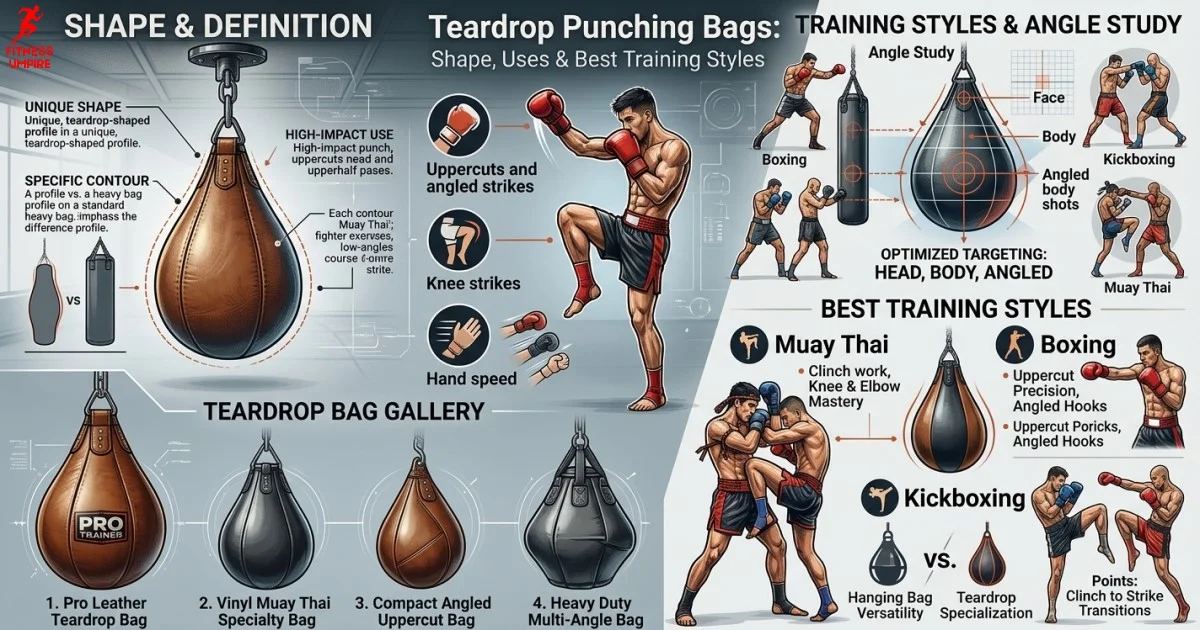
A teardrop punching bag is a heavy bag with a rounded, tapered shape that is wider through the upper or middle section and narrows toward the bottom. Unlike a traditional cylindrical heavy bag, its shape creates different striking surfaces and angles, making it particularly useful for uppercuts, knees, clinch drills, and Muay Thai-style combinations.
The unusual shape is the main reason to choose one. If your training involves mostly straight punches and basic combinations, a conventional cylindrical heavy bag may be sufficient. If you want to practice uppercuts, close-range punches, knees, and clinch-oriented movements, a teardrop bag can provide a more natural target.
What Is a Teardrop Punching Bag?
A teardrop punching bag is a type of heavy bag designed with a distinctive rounded, tapered profile. Instead of maintaining roughly the same diameter from top to bottom, the bag changes shape as it descends.
The result is a target that feels different depending on where you strike it.
The broader sections provide a substantial target for punches and kicks, while the lower, narrower portion can create useful angles for close-range techniques. This makes the bag especially relevant to fighters who train more than basic boxing combinations.
Teardrop vs. cylindrical heavy bag
| Feature | Teardrop bag | Cylindrical heavy bag |
|---|---|---|
| Shape | Rounded and tapered | Long, relatively uniform cylinder |
| Main advantage | Varied striking angles | Versatile general-purpose target |
| Uppercuts | Excellent | Good |
| Knees | Excellent | Good |
| Clinch drills | Very useful | Useful |
| Boxing combinations | Very good | Excellent |
| Muay Thai training | Very useful | Very useful |
| Kickboxing | Very useful | Very useful |
| Close-range work | Strong choice | Good |
| General beginner training | Suitable | Usually simpler |
The difference is not that one shape can perform techniques that the other physically cannot. Rather, the target geometry changes how naturally certain techniques can be practiced.
Why Is a Teardrop Bag Shaped This Way?
The shape gives you more than one type of striking surface.
A cylindrical heavy bag presents a fairly consistent vertical target. You can throw jabs, crosses, hooks, body shots, kicks, and combinations against it without the target changing dramatically.
A teardrop bag introduces more variation.
The rounded upper section can represent a useful target for punches, while the narrowing lower section creates a different surface for close-range strikes. This can make combinations involving changes in punching height and range feel more varied.
For fighters who regularly move between long-range punches and short-range attacks, that variation can be useful.
What Are Teardrop Punching Bags Used For?
Teardrop bags are particularly useful for:
- Uppercut training
- Short hooks and close-range punches
- Knee strikes
- Clinch-related drills
- Muay Thai combinations
- Kickboxing combinations
- Punch-to-knee combinations
- Body-shot practice
- Close-range striking
- General heavy-bag conditioning
They can still be used for ordinary boxing combinations, but their biggest advantage is the additional variety they offer at close range.
Best Drills for a Teardrop Punching Bag
1. Uppercut combinations
Uppercuts are one of the techniques most commonly associated with teardrop-shaped bags.
Start at a comfortable distance and work combinations such as:
Jab → Cross → Lead Uppercut → Rear Uppercut
You can also alternate between body-level and head-level targets as you move around the bag.
The important point is not simply to hit the bag as hard as possible. Work on maintaining your stance, rotating correctly, returning your hands to guard, and changing distance smoothly.
2. Knee strikes
The rounded shape also makes the bag useful for knee training.
A basic drill can combine punches with a knee:
Jab → Cross → Lead Knee
Then work:
Cross → Hook → Rear Knee
For Muay Thai-style training, you can also practice alternating knees while maintaining control of your position around the bag.
3. Clinch drills
A teardrop bag can be incorporated into clinch-oriented training, although it does not completely reproduce the experience of working with a live training partner.
You can practice:
- Closing distance
- Establishing position
- Controlling the bag
- Knee strikes
- Switching sides
- Maintaining balance
- Combining clinch movement with strikes
The bag can provide resistance and a fixed target, allowing you to repeat movements without requiring a partner.
4. Punch-to-knee combinations
This is where the shape can become particularly useful for mixed striking.
Try combinations such as:
Jab → Cross → Lead Knee
or:
Jab → Hook → Rear Knee → Exit
The objective is to connect your punching range to your close-range attack rather than treating every technique as a separate drill.
5. Close-range boxing
Move closer to the bag and work short punches rather than standing at maximum punching distance.
Examples include:
- Short hooks
- Uppercuts
- Body hooks
- Hook-to-uppercut combinations
- Uppercut-to-hook combinations
This helps make use of the bag’s different surfaces while developing comfort at close range.
Teardrop Bags for Muay Thai
A teardrop heavy bag can be a useful option for Muay Thai training because Muay Thai involves punches, elbows, knees, kicks, and clinch work.
However, a teardrop bag should not be viewed as a complete replacement for a long Muay Thai heavy bag.
Longer cylindrical bags provide substantial vertical striking space, which is valuable when practicing:
- Low kicks
- Body kicks
- Head kicks
- Punch-kick combinations
- Long-range combinations
A teardrop bag instead gives you a particularly useful target for close-to-mid-range striking.
For a Muay Thai-focused home gym, the choice therefore depends on what you want the bag to accomplish.
Want a single general-purpose bag? A conventional heavy bag may cover more techniques.
Already have a standard heavy bag? A teardrop bag can add another type of training target.
Focus heavily on knees, uppercuts, and close-range combinations? The teardrop shape becomes more relevant.
Teardrop Bags for Kickboxing
Teardrop bags also work well for kickboxing, where punches and kicks are combined continuously.
A kickboxing session might involve:
Jab → Cross → Lead Hook → Rear Kick
or:
Jab → Cross → Lead Knee → Exit
Because kickboxing combines different striking ranges, the varied shape of the bag can provide another target for combination work.
If your training is specifically focused on kickboxing, see our guide to punching bags for kickboxing for a broader comparison of bag types and training requirements.
Are Teardrop Punching Bags Good for Boxing?
Yes, but they are not necessarily the first choice for every boxer.
A teardrop bag can be excellent for:
- Uppercuts
- Hooks
- Body shots
- Close-range combinations
- Combination training
A traditional cylindrical heavy bag can be more straightforward for general boxing practice because its consistent shape provides a large, predictable target.
If your training is almost entirely traditional boxing, consider the techniques you practice most often before choosing the bag shape.
If your boxing includes plenty of uppercuts and inside fighting, the teardrop design becomes more attractive.
Who Should Use a Teardrop Punching Bag?
A teardrop bag can make sense for:
Muay Thai practitioners
Especially those who want to emphasize knees, close-range combinations, and clinch-oriented drills.
Kickboxers
The shape works well for combining punches, knees, and kicks at different ranges.
Boxers
Particularly useful for fighters who want additional uppercut, hook, and close-range work.
Home-gym users with an existing heavy bag
A teardrop bag can provide a different target rather than duplicating the same training experience.
Beginners
Beginners can use a teardrop bag, but the unusual shape is not automatically necessary for learning the fundamentals. If you are buying your first heavy bag, consider your overall training style, available space, mounting setup, and the techniques you expect to practice most.
Teardrop vs. Other Heavy Bag Shapes
Heavy bags come in different designs because different shapes emphasize different types of training.
| Bag type | Particularly useful for |
|---|---|
| Teardrop | Uppercuts, knees, clinch and close-range combinations |
| Cylindrical heavy bag | General punching and kicking |
| Long heavy bag | Punches, body kicks and low kicks |
| Uppercut bag | Uppercuts, hooks and close-range boxing |
| Double-end bag | Timing, accuracy and movement |
| Speed bag | Rhythm, hand speed and coordination |
The best shape depends on the training problem you are trying to solve.
A teardrop bag is not simply a “better” heavy bag. It is a specialized variation of the heavy-bag format.
What to Look for When Choosing a Teardrop Bag
Before buying one, consider several practical factors.
Size and weight
A heavier bag generally provides more resistance and stability, while a lighter bag can move more readily when struck.
Choose according to your training needs and installation setup rather than assuming the heaviest available bag is automatically the right option.
Hanging and mounting requirements
A teardrop bag still needs a secure mounting system capable of supporting its weight and absorbing repeated impacts.
Check the manufacturer’s installation requirements before purchasing.
Filling and construction
Look at the bag’s construction, outer material, filling, stitching, and suspension system.
These affect how the bag feels under repeated strikes and how it holds its shape over time.
Training style
This should be one of the first considerations.
If you mainly practice boxing combinations, a standard heavy bag may meet your needs.
If your training regularly includes uppercuts, knees, clinch work, and Muay Thai or kickboxing combinations, a teardrop design may be more appropriate.
Available space
Measure the area where you intend to install the bag, including room for movement around it.
You need enough space not only for the bag itself but also for your stance, footwork, kicks, and combinations.
Common Teardrop Punching Bag Mistakes
Choosing one only because it looks different
The shape should match your training goals. A different-looking bag is not automatically more useful.
Using it only for power punches
A teardrop bag can be used for much more than hitting as hard as possible. Work combinations, positioning, timing, uppercuts, knees, and controlled movement.
Expecting it to replace every other bag
Different heavy-bag designs have different strengths. A teardrop bag can complement a conventional heavy bag rather than replace every possible training target.
Ignoring installation
A heavy bag generates substantial force and movement during training. Make sure the mounting point and hardware are appropriate for the specific bag and installation surface.
Frequently Asked Questions
What is a teardrop punching bag good for?
A teardrop punching bag is particularly useful for uppercuts, hooks, knees, close-range combinations, and clinch-oriented drills. It is also suitable for Muay Thai and kickboxing training.
Are teardrop bags good for Muay Thai?
Yes. Their shape can be useful for knees, close-range punches, and clinch-related drills. However, a long heavy bag can provide more surface area for practicing low kicks and full-length kicking combinations.
Can you use a teardrop bag for boxing?
Yes. Teardrop bags work well for boxing combinations, particularly uppercuts, hooks, body shots, and inside fighting.
Are teardrop bags good for kickboxing?
Yes. The shape works well for mixed striking combinations involving punches, knees, and kicks. The best choice still depends on the specific techniques and range you practice most.
What is the difference between a teardrop bag and a regular heavy bag?
The primary difference is the shape. A regular cylindrical heavy bag has a relatively consistent diameter, while a teardrop bag has a rounded, tapered profile that creates different striking surfaces and can be especially useful for close-range techniques.
Is a teardrop bag better for uppercuts?
Its shape can make uppercut practice particularly convenient, but an uppercut bag or conventional heavy bag can also be used for uppercuts. The choice depends on your overall training requirements.
Can beginners use a teardrop punching bag?
Yes. Beginners can train on one, although the specialized shape is not essential for learning basic punching technique. Beginners should prioritize appropriate size, secure installation, and proper technique.
Final Takeaway
A teardrop punching bag is a specialized heavy bag designed around varied striking surfaces and close-range training. Its rounded, tapered profile makes it especially useful for uppercuts, knees, clinch drills, and combinations used in Muay Thai and kickboxing.
For general-purpose boxing and kicking, a conventional heavy bag may be enough. For fighters who want more emphasis on close-range striking and knee work, a teardrop bag can add useful variety to a home training setup.
If you are ready to compare specific models, see our guide to the best teardrop punching bags to evaluate available options based on construction, training style, size, and other practical factors.