
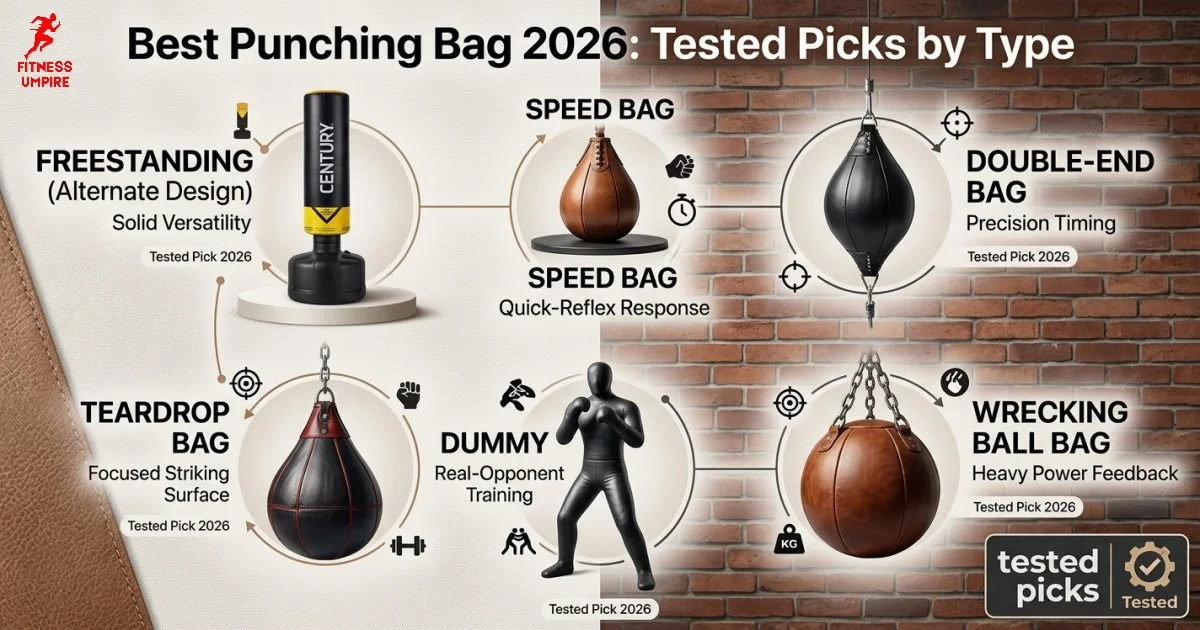
If you want one punching bag that works for the widest range of home training, the Century XXL Wavemaster is our overall freestanding pick. It has a large striking surface, a freestanding design that avoids permanent ceiling mounting, and a base that can be filled for greater stability. Century lists the bag at 69 inches overall, with a 52-inch-tall, 18-inch-diameter striking section and a base that can reach 270 pounds when filled.
But there is no single best punching bag for every workout. A speed bag is built around rhythm and rebound; a double-end bag emphasizes timing, accuracy, and movement; a dummy provides a human-shaped target; and a wrecking ball is particularly useful for hooks, uppercuts, body shots, and close-range work.
Important testing note: this guide separates hands-on testing from researched recommendations. Where a category has not yet been independently tested under our full protocol, it is identified as a researched pick rather than presented as a hands-on test result.
Quick Answers: Best Punching Bag by Type
| Category | Our pick | Best for |
|---|---|---|
| Best Overall | Century XXL Wavemaster | Home boxing, kickboxing, MMA, and general training |
| Best for Kickboxing | Century XXL Wavemaster | Kicks, knees, punches, and combination work |
| Best for Beginners | Century XXL Wavemaster | Easy home setup without ceiling mounting |
| Best Speed Bag | Everlast Elite Speed Punching Bag | Speed, coordination, and rebound training |
| Best Double-End Bag | Ringside Double End Bag | Timing, accuracy, slips, and footwork |
| Best Dummy | Century BOB XL | Human-shaped target practice |
| Best Wrecking Ball | PROLAST Wrecking Ball Heavy Punching Bag | Uppercuts, hooks, body shots, and close-range work |
The speed-bag recommendation is based on the manufacturer’s construction and rebound specifications rather than an independent hands-on test. Everlast describes its Elite Speed Bag as having reinforced nylon webbing, a balanced design, and a construction intended for beginner-to-intermediate rebound training.
The Ringside double-end range includes different shapes and sizes and is specifically designed around jabs, hooks, slipping, and footwork.
Which Type of Punching Bag Do You Need?
Start with the movement you actually want to practice rather than choosing a bag simply because it looks impressive.
Choose a freestanding bag if you want:
- A versatile home punching bag
- No permanent ceiling installation
- Boxing and kickboxing training
- Punches, kicks, knees, and combinations
- Something you can move when the workout is finished
A freestanding bag is particularly convenient when you train in a garage, spare room, or apartment where installing a ceiling mount is impractical.
See our full guide: Best Freestanding Punching Bags
Choose a speed bag if you want:
- Faster hand movements
- Rhythm and timing practice
- Rebound training
- Hand-eye coordination
- Short, fast combinations
A speed bag isn’t a replacement for a heavy bag. Its purpose is different.
Choose a double-end bag if you want:
- Accuracy
- Punch timing
- Defensive movement
- Slipping and rolling
- Footwork practice
- A moving target
The two attachment points make the bag react to strikes, so you’re dealing with movement rather than simply hitting a stationary target. Ringside specifically positions its double-end bags for jabs, hooks, slipping, and footwork.
Choose a dummy if you want:
- A human-shaped target
- More realistic target placement
- Head and body targeting
- Martial-arts drills
- Combination practice around a torso-shaped target
Choose a wrecking ball if you want:
- Uppercut practice
- Hook practice
- Body shots
- Close-range combinations
- A rounded target with multiple striking angles
A wrecking ball is especially different from a conventional cylindrical heavy bag because its rounded shape changes the available target angles.
Best Overall: Century XXL Wavemaster
Best for: home boxing, kickboxing, MMA, martial arts, and general striking.
The Century XXL Wavemaster is our overall freestanding choice because it combines a large target with the convenience of a freestanding design.
Century lists the striking section at 52 inches tall and 18 inches in diameter, while the complete unit stands approximately 69 inches tall. The base is 28 inches in diameter and can weigh up to 270 pounds when filled with sand or water.
That combination matters because a home bag needs to do more than simply absorb punches. It needs to provide enough target area for the movements you actually practice while remaining practical for the available space.
Century also specifically describes the XXL Wavemaster for kickboxing, Muay Thai, MMA, karate, taekwondo, and other martial arts.
Why it stands out
- Large striking area
- Freestanding installation
- Suitable for punches and kicks
- Can be relocated
- Large weighted base
- Useful across multiple striking disciplines
The trade-off
A freestanding bag still requires floor space. The base itself is 28 inches in diameter, before allowing additional room around it for movement.
If you have enough room and don’t want to install a hanging bag, this design is considerably simpler than building a ceiling-mounted setup.
Best Punching Bag for Kickboxing
For kickboxing, a bag needs to accommodate more than straight punches.
You want enough target height and surface area for combinations that can include:
- Punches
- Hooks
- Body shots
- Kicks
- Knees
- Combination drills
The Century XXL Wavemaster fits this use particularly well because Century specifically lists kickboxing and Muay Thai among its intended applications. Its 52-inch striking section also provides substantially more vertical target area than a small speed or double-end bag.
For a kickboxing-focused setup, think about target coverage and stability first, rather than simply choosing the heaviest bag available.
Best Punching Bag for Beginners
The Century XXL Wavemaster is also a practical beginner choice because the basic concept is straightforward: position the bag where you want to train, fill the base, and use it without installing a ceiling-mounted chain system.
That makes a freestanding bag attractive for someone starting a home gym.
A beginner should also consider the room around the bag. You need enough clearance to move around the target instead of placing it directly against a wall.
The goal isn’t to buy the most complicated training setup possible. A bag that you can actually use consistently is more useful than equipment that spends most of its time sitting unused.
Best Speed Bag: Everlast Elite Speed Punching Bag
Best for: speed, rhythm, hand-eye coordination, and rebound practice.
The Everlast Elite Speed Punching Bag is a researched recommendation rather than an independently tested result in this guide.
Everlast describes the bag as using a balanced design for consistent rebounds, reinforced nylon webbing, a panel construction, and a premium PVC exterior. The manufacturer positions it for beginner-to-intermediate users.
One advantage is that Everlast also sells the Elite Speed Bag as part of a kit containing the bag, swivel, and two-piece platform.
That distinction is important when comparing speed bags. The bag itself is only one part of the setup. You also need a suitable platform and swivel.
Speed bag vs. heavy bag
| Feature | Speed bag | Heavy/freestanding bag |
|---|---|---|
| Main purpose | Speed and rhythm | Striking and power work |
| Movement | Rapid rebound | Swing or relatively stable target |
| Best for | Timing and coordination | Punches, kicks, combinations |
| Mounting | Platform | Floor or ceiling depending on type |
| Power training | Limited | Stronger emphasis |
| Footwork | Some | More room-dependent |
If your main goal is practicing power punches, a speed bag shouldn’t be your only bag.
Best Double-End Bag: Ringside Double End Bag
Best for: accuracy, timing, slipping, footwork, and moving-target drills.
The double-end bag is fundamentally a movement-training tool. Unlike a conventional heavy bag, it is connected at two points and reacts rapidly when struck.
Ringside offers double-end bags in multiple shapes and sizes, including round and hourglass designs, with synthetic and leather options. The company specifically describes them for jabs, hooks, slipping, and footwork.
Why choose a double-end bag?
If you’re already comfortable hitting a stationary heavy bag but want to make your target practice more dynamic, a double-end bag adds another layer of timing.
It can help you practice:
- Hitting a moving target
- Returning to guard
- Punch accuracy
- Slipping after combinations
- Foot positioning
- Rhythm changes
The main limitation is that it isn’t a substitute for a heavy bag when your priority is full-power striking.
Best Punching Dummy: Century BOB XL
A punching dummy is different from a conventional bag because the target is shaped more like a human opponent.
The major advantage is target specificity. Instead of looking at a uniform cylindrical bag, you have recognizable head and torso areas that can make certain drills easier to visualize.
A dummy can therefore make sense for people who specifically want human-shaped target practice rather than general bag conditioning.
Dummy vs. traditional heavy bag
| Feature | Punching dummy | Traditional heavy bag |
|---|---|---|
| Target shape | Human-like | Cylindrical/varied |
| Head targeting | Yes | No defined head |
| Body targeting | Yes | General surface |
| Punch combinations | Excellent | Excellent |
| Kicks | Depends on model | Usually excellent |
| Space | Requires floor area | Depends on installation |
| Best use | Target-specific drills | General striking |
The trade-off is versatility. A conventional heavy bag is usually the more general-purpose piece of equipment, while a dummy makes more sense when its human-shaped target is important to your training.
Best Wrecking Ball: PROLAST Wrecking Ball Heavy Punching Bag
Best for: uppercuts, hooks, body shots, knee strikes, and close-range power work.
The PROLAST Wrecking Ball is a researched recommendation in this guide rather than an independently tested result.
PROLAST describes its Wrecking Ball as an uppercut punching bag designed for uppercuts, body shots, and knee strikes. Its listed filled version weighs 70 pounds and measures 20 × 20 × 25 inches. The company says it is made in the USA from heavy-duty American vinyl and is available filled or unfilled.
The compact rounded design is the important feature here.
Instead of presenting a long vertical target, the wrecking-ball shape gives you a concentrated target for close-range techniques.
Why use a wrecking ball?
It can be useful for:
- Uppercuts
- Hooks
- Body shots
- Close-range combinations
- Knee strikes
- Changing angles
It isn’t necessarily the first bag a beginner needs. For a first home bag, a versatile freestanding or traditional heavy bag generally covers more training situations.
How We Evaluate Punching Bags
Our evaluation framework is designed to look beyond a product’s marketing claims.
For categories covered by our hands-on testing process, we use the same David Paul / 8-week testing protocol used across the site. The evaluation focuses on practical training characteristics rather than simply repeating manufacturer specifications.
Key considerations include:
1. Stability
Does the bag remain usable during normal combinations, or does excessive movement interfere with training?
2. Striking surface
We look at the usable target area, shape, height, and how well it matches the intended training style.
3. Training response
A bag should respond in a way that makes sense for its intended purpose. A speed bag and a heavy bag should not be judged by the same movement characteristics.
4. Construction
We consider exterior materials, seams, attachment points, hardware, and the overall construction.
5. Setup
A product that requires extensive installation has different practical considerations from a freestanding model.
6. Space requirements
Home users need to consider the bag itself, the base or mounting system, and the movement area around it.
7. Intended use
A bag can be excellent for one type of training and poorly suited to another. We therefore compare each product against its actual category rather than treating every punching bag as interchangeable.
Testing disclosure: not every category on this page has been independently tested under the full 8-week protocol. Where hands-on testing has not been completed, the recommendation is based on product specifications, construction, intended use, and category fit and is labeled accordingly.
Punching Bag Types Compared
| Bag type | Primary purpose | Good for beginners? | Installation |
|---|---|---|---|
| Freestanding | General striking | Yes | Floor |
| Hanging heavy bag | Power and combinations | Yes, with proper setup | Ceiling/wall structure |
| Speed bag | Speed and rhythm | Yes | Platform |
| Double-end bag | Accuracy and timing | Yes | Two attachment points |
| Dummy | Human-shaped targeting | Yes | Floor |
| Wrecking ball | Hooks and uppercuts | Depends on training goals | Ceiling |
| Teardrop bag | Angled strikes and combinations | Depends | Ceiling |
The important point is that these aren’t simply different brands of the same product. They are different training tools.
What to Look for Before Buying
1. Training style
Decide whether your priority is:
Boxing: punches, combinations, movement and conditioning.
Kickboxing/Muay Thai: punches plus kicks, knees and other striking angles.
MMA: a combination of striking movements and target changes.
Fitness: convenient workouts and general conditioning.
Your answer changes the type of bag you need.
2. Available space
Measure the available area before buying.
Don’t measure only the product. Consider the space required to move around it.
A large freestanding bag may technically fit in a room but still be impractical if there isn’t enough clearance for footwork.
3. Mounting
Hanging bags transfer significant forces into their mounting structure.
Make sure the mounting point is appropriate for the equipment rather than attaching a heavy bag to an unsuitable surface.
Freestanding bags avoid this particular installation requirement, although they still require enough floor space and a stable base.
4. Bag shape
Shape determines where and how you can strike.
A cylindrical heavy bag gives you a broad vertical target. A wrecking ball emphasizes rounded close-range targets. A speed bag is small and reactive. A dummy provides recognizable human target areas.
5. Fill and firmness
Two bags with similar external dimensions can feel very different depending on their internal construction and filling.
Don’t judge a bag solely by its advertised weight.
Common Punching Bag Buying Mistakes
Buying the wrong type for the workout
A speed bag isn’t a heavy bag, and a double-end bag isn’t designed to replace one.
Choose based on the movements you want to practice.
Ignoring the mounting system
A good bag still requires a suitable installation.
Check the mounting requirements before purchasing a hanging model.
Buying too large for the room
A large bag isn’t automatically better if it prevents you from moving properly.
Measure the entire training area.
Choosing weight without considering feel
Weight is only one specification. Shape, filling, construction and mounting can all change how a bag behaves.
Assuming every recommendation has been independently tested
Product testing and product research aren’t the same thing. Manufacturer specifications can help establish what a product is designed to do, but they don’t replace hands-on evaluation.
That is why we identify the testing status of recommendations on this page.
Frequently Asked Questions
What is the best punching bag overall?
For a versatile home setup, our overall freestanding pick is the Century XXL Wavemaster. Its large striking section, freestanding design and weighted base make it suitable for multiple striking disciplines. Century lists it at 69 inches overall, with a 52-inch striking section and an 18-inch diameter.
What is the best punching bag for beginners?
A freestanding bag is a practical starting point because it doesn’t require a ceiling-mounted installation. The Century XXL Wavemaster is our pick in this category because it combines a large target with a movable freestanding design.
What is the best punching bag for kickboxing?
A large freestanding heavy bag such as the Century XXL Wavemaster is a strong fit because it provides enough target area for punches and kicks. Century specifically lists kickboxing and Muay Thai among the bag’s applications.
Is a speed bag better than a heavy bag?
Neither serves exactly the same purpose. A speed bag emphasizes rebound, rhythm, timing and coordination, while a heavy bag is more suitable for power-oriented striking and combinations.
What is a double-end bag used for?
A double-end bag is used for timing, accuracy, moving-target practice, slipping and footwork. Ringside specifically lists jabs, hooks, slipping and footwork among its applications.
What is a wrecking ball punching bag used for?
A wrecking ball is particularly useful for uppercuts, hooks, body shots and close-range striking. PROLAST specifically describes its Wrecking Ball for uppercuts, body shots and knee strikes.
Do I need more than one punching bag?
Not necessarily. Start with the bag that matches your main training goal. Add another type only when you have a specific training need that your existing bag cannot address.
Are freestanding punching bags good for apartments?
They can be practical because they don’t require permanent ceiling mounting. You still need enough floor space around the bag, and the base needs to be positioned so the equipment can be used safely and effectively.
The Bottom Line
The best punching bag depends on what you want to practice.
For an all-purpose home setup, the Century XXL Wavemaster is our overall freestanding choice because it combines a large striking target with a movable base and broad martial-arts applications.
Choose a speed bag when speed and rhythm are the priority. Choose a double-end bag when timing, accuracy and movement matter most. Choose a dummy when you specifically want human-shaped targets. Choose a wrecking ball when uppercuts, hooks, body shots and close-range work are central to your training.
And before buying, match the bag to your training style, available space, mounting options and desired target shape rather than choosing solely by brand, price or weight.