
Buying Guide · Format Comparison _________________________________
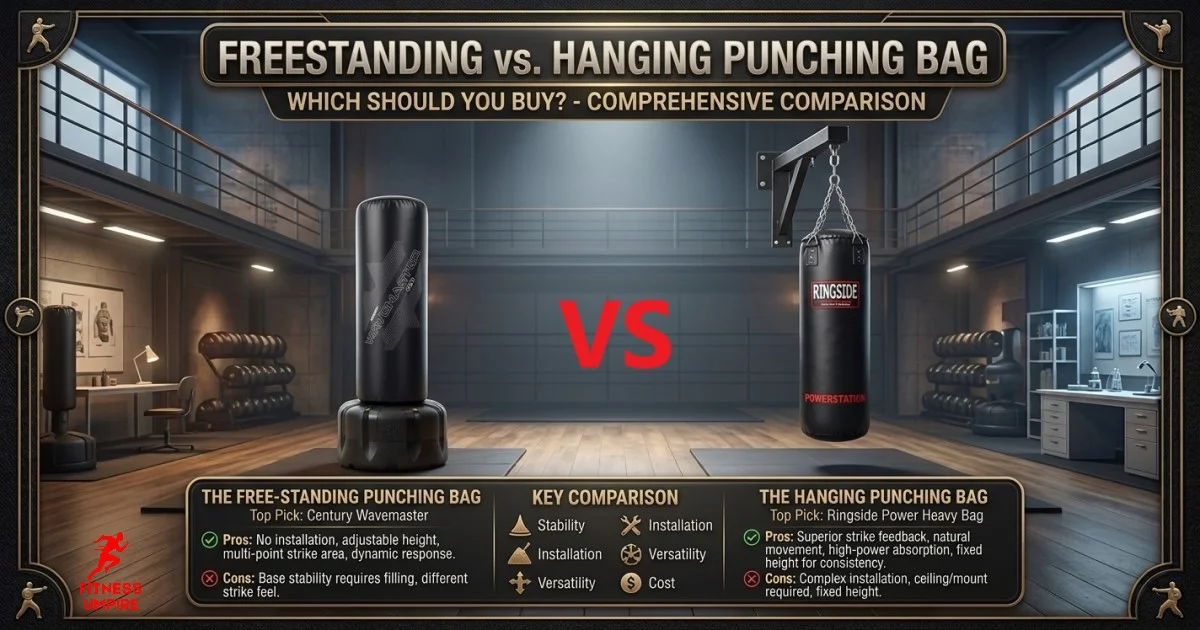
Part of our full freestanding punching bag testing guide
Before “which freestanding bag,” there’s a more basic question: should you be looking at freestanding bags at all? Both formats have real, non-overlapping advantages, and the right answer depends far more on your space and situation than on which one is objectively “better.”
This page is the fork in the road. If you land on freestanding, our main testing guide covers seven tested options in depth. If you land on hanging, that’s a different category — outside what we test here — but this page will tell you which way to lean and why.
The short version _____________________________________________
The Core Trade-off, in One Paragraph
A freestanding bag requires zero installation, is fully portable, and is the only realistic option for renters and apartments — the trade-off is slightly less “give” under full power than a well-hung bag provides. A hanging bag delivers the best power-training feedback through natural pendulum movement — the trade-off is that it needs a structural ceiling mount or a stand, and it’s far less apartment-friendly.
Everything below is about how that trade-off plays out for specific situations — and how much of the gap the best freestanding bags actually close.
At a glance _______________________________________________
Side-by-Side Comparison
| Factor | Freestanding | Hanging |
|---|---|---|
| Installation | None — fill the base and go | Ceiling mount or stand required |
| Power-training feedback | Good with sand fill, not identical to pendulum motion | Best — natural pendulum response |
| Apartment / noise suitability | Workable with a mat — see our apartment guide | Generally unsuitable — both impact and structural noise |
| Portability | Drain and move (water fill) or reposition | Effectively permanent once mounted |
| Renter-friendliness | Fully reversible, no lease risk | Often requires drilling or structural changes |
| Typical setup cost | Bag + base fill only | Bag + stand or mount hardware, often extra |
What it actually costs ___________________________________________
Total Cost of Ownership
Sticker price on the bag itself only tells part of the story — what each setup needs in addition to the bag changes the comparison more than people expect.
| Setup | Bag cost tier | Additional hardware needed | Total cost tier |
|---|---|---|---|
| Freestanding — budget/mid | Budget–Mid | None — water fill is effectively free | Budget–Mid |
| Freestanding — premium, sand fill | Premium | Sand (one-time, low cost) | Premium + minor |
| Hanging + floor stand | Sold separately, often Mid–Premium | Heavy bag stand | Mid–Premium + stand cost |
| Hanging + ceiling mount | Sold separately | Mount hardware, plus installation if no exposed joist is available | Variable — can be the highest of all four, depending on installation |
The pattern that matters: a freestanding setup’s “extra cost” tops out at a bag of sand. A hanging setup’s extra cost is a dedicated stand or mounting hardware — and potentially installation — on top of the bag price.
Closing the gap _______________________________________________
How Close Do Top Freestanding Bags Get to Hanging-Bag Feel?
This is where the comparison gets more interesting than “freestanding is always worse for power.” In our heavy-hitter testing, the Ringside Elite Freestanding Bag posted under 3 cm of lateral shift at full sand fill — by far the lowest of any freestanding bag we measured.
That’s a genuinely stable platform for full-power combinations. What it doesn’t replicate is the pendulum return — a hanging bag swings away and comes back with its own rhythm, which becomes part of how you time combinations. A sand-filled freestanding bag absorbs and stays largely in place rather than swinging and returning.
For most training — including hard conditioning work — that difference is smaller than people expect. For athletes specifically training timing off a moving target, it’s the one thing no freestanding bag fully replaces.
By situation __________________________________________________
Decision Matrix — Which Fits Your Situation
| YOUR SITUATION | RECOMMENDED | WHY |
|---|---|---|
| Renting an apartment | Freestanding | No installation, no lease risk, fully reversible |
| Garage with exposed ceiling joists | Either — hanging gains the most here | Ceiling mounting becomes simple and cheap, making hanging’s power edge easy to access |
| Multi-use or frequently rearranged space | Freestanding | Water-fill bases drain and move; hanging bags are effectively permanent once mounted |
| Competitive-level power training | Freestanding closes most of the gap, hanging still edges ahead | A sand-filled Ringside Elite or Wavemaster XXL is highly stable, but doesn’t replicate pendulum return |
| Beginner or uncertain commitment | Freestanding | Lower total cost, no permanent changes, easy to repurpose the space later — see our beginner’s guide |
Beyond the format question ___________________________________
What Neither Format Solves
Choosing a format is only one part of the picture — some things matter regardless of which one you pick.
Technique development
Neither a freestanding nor a hanging bag teaches form on its own. The bag is a tool for repetition — the technique itself comes from coaching, instruction, or careful self-study, independent of which format you train on.
Shin conditioning specifics
Shell firmness — not bag format — is what determines how useful a bag is for shin conditioning. Our kickboxing guide breaks down shell firmness across freestanding options for exactly this purpose.
Live resistance and reaction
Neither format moves, evades, or counters — both are striking tools, not training partners. Our MMA guide covers what bag work can and can’t replace for combat-sports training specifically.
FAQs ___________________________________________
Freestanding vs. Hanging — Frequently Asked Questions
Is a freestanding punching bag as good as a hanging bag?
For most training — technique, conditioning, combinations — a quality freestanding bag with sand fill gets very close. The main difference is the pendulum return of a hanging bag, which some athletes use for timing. For installation-free, apartment-safe, portable training, freestanding is the more practical choice for the large majority of users.
Can I switch from a freestanding setup to hanging later?
Yes — they’re independent purchases, and starting with freestanding doesn’t lock you out of adding a hanging bag later if your space and goals change. Many serious home gym users eventually end up with both rather than replacing one with the other.
What’s cheaper overall — freestanding or hanging?
Freestanding, in most cases. A freestanding bag’s only “extra” cost beyond the bag itself is sand, which is minor and one-time. A hanging bag typically requires a stand or mounting hardware — and sometimes installation — on top of the bag price, which often makes the total cost higher even when the bag itself is similarly priced.
Do hanging bags work in apartments at all?
Generally no. Hanging bags create both impact noise and structural vibration through a ceiling mount, and most apartment ceilings aren’t suited to the mounting hardware required. Freestanding bags — particularly with a rubber mat, as covered in our apartment guide — are the realistic option for apartment training.
Which is better for beginners?
Freestanding. Lower total cost, no permanent installation, and the flexibility to reposition, drain, or repurpose the setup if training habits or living situations change — all of which matter more for someone still finding out whether the hobby will stick than the smaller training differences between formats.
Decided on freestanding?
See how all seven bags scored across stability, durability, and value — plus our complete buyer’s guide and head-to-head comparisons.

David Paul
Founder & Lead Equipment Tester — fitnessumpire.com
David has been training in boxing and martial arts for over a decade. He founded Fitnessumpire after finding that most online punching bag reviews were written without any real hands-on testing — and that the freestanding bag category was the worst offender.
Testing note: Every bag reviewed on this site was purchased at retail price and tested through an 8-week protocol — 500+ strikes per session, lateral shift measurements at both water and sand fill, decibel readings on hardwood and rubber mat, and weekly durability inspections. No manufacturer samples were accepted.
10+ years boxing & martial arts
7 bags independently tested
500+ strikes per bag
8-week test protocol