
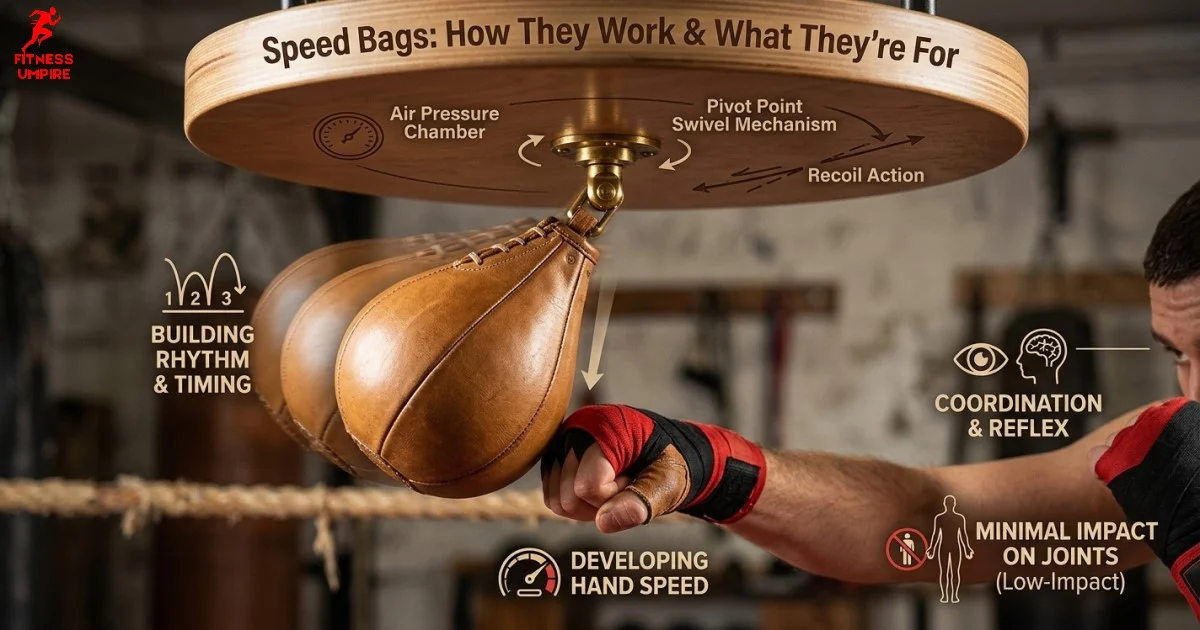
A speed bag is a small, air-filled punching bag designed primarily to train rhythm, hand-eye coordination, timing, accuracy, and shoulder endurance. Unlike a heavy bag, it is not mainly used for developing punching power. The bag rebounds rapidly from a platform-mounted swivel, creating a continuous rhythm that you have to maintain with controlled punches.
For beginners, the speed bag can be frustrating at first. The basic motion looks simple, but keeping the bag moving consistently takes practice. Once the timing clicks, it becomes a useful tool for developing coordination and conditioning.
What Is a Speed Bag?
A speed bag is a compact punching bag suspended from a swivel attached to a horizontal platform. When you strike it, the bag moves backward and forward before returning toward you.
Most speed-bag training involves short, controlled punches rather than full-power strikes. The objective is to keep the bag moving smoothly while maintaining a consistent rhythm.
A typical setup includes three main components:
| Component | What it does |
|---|---|
| Speed bag | Provides the moving target you strike |
| Platform | Holds the bag at the appropriate height |
| Swivel | Connects the bag to the platform and allows it to rebound |
The bag’s movement is what makes speed-bag training different from simply hitting a stationary punching bag.
What Does a Speed Bag Train?
A speed bag primarily trains coordination and rhythmic control, rather than maximum punching power.
Rhythm and timing
The repeated rebound of the bag forces you to develop a consistent striking rhythm. You need to anticipate when the bag will return and time your next punch accordingly.
This makes rhythm one of the most important skills in speed-bag training.
Hand-eye coordination
Because the target is constantly moving, you must watch the bag while coordinating your hands to meet it accurately.
With practice, this can help you become more comfortable tracking and striking a moving target.
Shoulder endurance
Speed-bag sessions involve repeated arm movements, so the shoulders can become fatigued relatively quickly.
The goal is not to generate maximum force with every punch. Instead, you maintain controlled movements over repeated rounds.
Accuracy and control
The speed bag gives you immediate feedback. A poorly timed or poorly positioned strike can disrupt the rhythm, making it obvious that your timing needs adjustment.
Concentration
Keeping the bag moving requires attention to its position, rebound, and your next strike. Longer combinations therefore require sustained concentration as well as physical coordination.
Speed Bag vs. Heavy Bag
A speed bag and heavy bag serve different training purposes.
| Feature | Speed Bag | Heavy Bag |
|---|---|---|
| Main purpose | Rhythm, timing and coordination | Punching technique, combinations and power |
| Movement | Rapid rebound | Moves mainly after being struck |
| Typical strikes | Short, controlled punches | Punches, kicks and combinations |
| Power development | Limited | Major training focus |
| Coordination demand | High | Moderate to high |
| Shoulder endurance | High | Moderate to high |
| Beginner learning curve | Steep initially | Generally easier to understand |
This does not mean one is universally better than the other. They train different aspects of striking.
If your goal is to practice combinations and work on striking a larger target, a heavy bag is generally more appropriate. If you want a compact tool focused on rhythm, coordination and repetitive movement, a speed bag fills a different role.
Speed Bag Platform and Swivel Setup
A speed bag needs a stable platform because the platform determines how the bag hangs and rebounds.
The basic arrangement is:
Wall or frame → platform → swivel → speed bag
1. Mount the platform securely
The platform should be firmly attached to a suitable structural surface. Speed-bag training creates repeated movement and vibration, so a platform that shifts during use can make training difficult.
2. Attach the swivel
The swivel connects the speed bag to the underside of the platform. It needs to move freely so the bag can rebound naturally.
A restricted or poorly functioning swivel can change the bag’s movement and make consistent practice harder.
3. Position the bag correctly
The bag should be positioned so you can comfortably strike its front and sides without reaching excessively upward or downward.
Your exact platform height depends on your body and training setup, but the important principle is that you should be able to maintain a relaxed stance while striking the bag.
4. Check the setup before training
Before starting, make sure the platform is secure, the swivel moves freely, and the bag is properly attached.
A stable setup makes it much easier to concentrate on timing instead of fighting the equipment.
How to Punch a Speed Bag
The basic speed-bag motion is easier to learn when broken into simple steps.
- Stand squarely in front of the bag. Keep your stance comfortable and avoid leaning excessively toward it.
- Keep your hands up. Start with one hand close to the bag.
- Strike with a short, controlled punch. You do not need to hit the bag hard.
- Let the bag rebound. Do not immediately chase it with another punch.
- Watch its movement. Learn when it returns to your striking position.
- Repeat the same rhythm. Focus on consistency before trying to increase speed.
- Introduce the other hand. Once you can maintain a rhythm, begin practicing alternating strikes.
The biggest beginner mistake is usually trying to punch the bag as quickly as possible. Start slowly and learn the rebound pattern first. Speed comes after control.
The Speed Bag Learning Curve Is Real
A speed bag can be surprisingly frustrating when you first start.
You may expect to hit it repeatedly because the movement looks straightforward when someone experienced is doing it. In practice, the bag can quickly get out of rhythm if your punch arrives too early, too late, or from the wrong angle.
That is normal.
Your first sessions may involve:
- Missing the bag
- Breaking the rhythm
- Accidentally sending it sideways
- Losing track of its rebound
- Getting tired in your shoulders
- Having difficulty switching hands
The solution is not necessarily to hit harder or faster. Slow, repetitive practice is usually more useful while learning the basic rhythm.
Once you understand the rebound pattern, the movement becomes much more predictable. From there, you can gradually work on longer combinations and faster sequences.
Common Speed Bag Mistakes
Hitting too hard
A speed bag does not need powerful punches to move. Excessive force can make the rebound harder to control.
Trying to go fast immediately
Speed is part of the name, but beginners generally benefit from learning the movement before chasing maximum speed.
Using the whole arm
Large swinging motions make it harder to maintain a consistent rhythm. Controlled movements are easier to repeat.
Watching your hands instead of the bag
The bag is the moving target. Keeping your attention on it helps you anticipate its return.
Poor platform setup
A platform that moves or a swivel that does not rotate properly can make the bag behave unpredictably.
Is a Speed Bag Good for Beginners?
Yes, but beginners should expect a learning period.
A speed bag is beginner-friendly in the sense that you can start with very basic movements. However, mastering a smooth rhythm takes practice. Someone completely new to speed-bag training should not judge the equipment based on how difficult the first few sessions feel.
Start with short sessions and simple single-hand strikes. Once you can consistently control the rebound, introduce alternating hands and more complex combinations.
For broader punching technique practice, combine speed-bag work with other forms of bag training rather than expecting the speed bag to train everything.
Who Should Use a Speed Bag?
A speed bag can be useful for people who want to work on:
- Hand-eye coordination
- Rhythm and timing
- Shoulder endurance
- Striking accuracy
- Repetitive movement control
- Concentration during training
It is particularly useful as a supplementary training tool rather than an all-purpose replacement for other punching bags.
If you’re deciding between different types of punching bags, the right choice depends on what you want to train. A speed bag emphasizes rhythm and coordination, while other bags are designed around different training goals.
Choosing a Speed Bag
When comparing speed bags, consider more than the bag itself. The swivel and platform are equally important because they determine how the bag moves.
Consider:
- Bag size
- Bag construction
- Attachment method
- Swivel quality
- Platform stability
- Available mounting space
- Your intended training style
A smaller or differently shaped bag may produce a different training experience, while the quality of the mounting system can affect the consistency of the rebound.
If you are ready to compare specific models, see our guide to the best speed bags for options and buying considerations.
Frequently Asked Questions
What is a speed bag used for?
A speed bag is primarily used to train rhythm, hand-eye coordination, timing, accuracy, concentration, and shoulder endurance. It is not primarily a power-development tool.
Is a speed bag good for boxing?
Yes. It can complement boxing training by developing rhythm, coordination, timing and controlled repetitive striking. However, it does not replace other boxing training such as technique work, footwork or heavy-bag training.
Is a speed bag hard to learn?
It can be difficult at first. The rebound happens quickly, and beginners often struggle to establish a consistent rhythm. Starting slowly makes the basic movement easier to learn.
How long should you use a speed bag?
There is no single required session length. Beginners can start with short practice periods and focus on maintaining good control rather than trying to train for a specific amount of time.
Does a speed bag build punching power?
Not primarily. Speed-bag training focuses much more on rhythm, coordination, timing and endurance. A heavy bag is generally more appropriate when power development is a major training goal.
Final Takeaway
A speed bag is a specialized punching bag for rhythm, coordination, timing, accuracy and shoulder endurance. Its compact design and rapid rebound make it very different from a heavy bag.
The biggest adjustment for beginners is learning the rhythm. It can feel awkward and frustrating initially, but the goal is controlled repetition rather than trying to overpower the bag.
Once your basic timing becomes consistent, you can gradually increase your speed and introduce more advanced combinations.
For the next step, compare the available models in our best speed bags guide.