
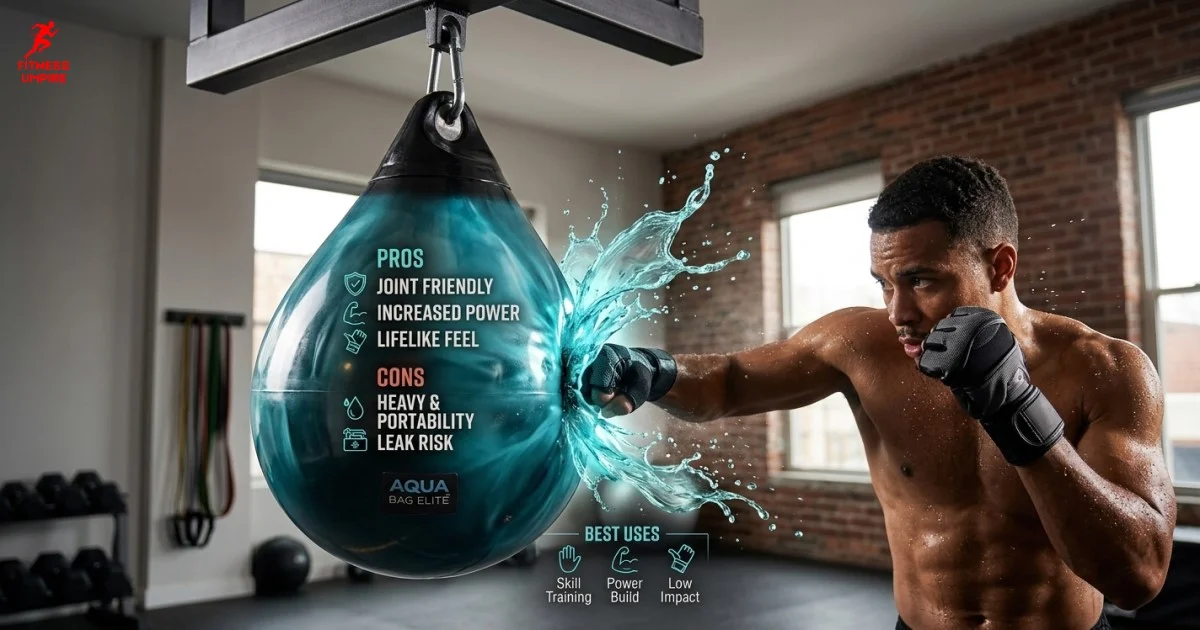
A water-filled, or aqua, punching bag is a heavy punching bag that uses water as its filling instead of traditional materials such as textile scraps, foam, or other dense fillers. The bag is shipped and stored empty, then filled with water at its destination.
The main advantage is portability before filling: an empty water bag is much easier to transport, carry upstairs, or move into a room than a conventional heavy bag that arrives already filled.
Once filled, the water gives the bag substantial weight and stability while allowing it to deform around strikes rather than feeling completely rigid.
What Is a Water-Filled Punching Bag?
A water-filled punching bag is a suspended training bag with a flexible outer shell designed to hold water. Unlike a conventional heavy bag, its final training weight comes primarily from the water inside.
This creates a useful combination:
- Lightweight to transport when empty
- Heavy and stable when filled
- Easy to empty when moving
- Flexible impact surface
- Suitable for home boxing and striking workouts
The exact construction varies between models. Some have a more traditional hanging-bag shape, while others have a distinctive rounded or teardrop-like appearance.
The important distinction is that the bag itself does not need to be extremely heavy during shipping. You add the weight after installation by filling it with water.
Why the Empty-Bag Weight Matters
A conventional filled heavy bag can be difficult to carry through a house, apartment, or narrow staircase. A water bag avoids much of that problem because you can move the empty shell into position first.
That makes the design particularly useful when you:
- Live in an apartment or rental
- Need to carry equipment upstairs
- Have limited storage space
- Move equipment between rooms
- Expect to relocate the bag later
- Want to transport the bag without carrying its full training weight
After filling, however, the bag becomes a substantial training object. Emptying it is what restores its portability.
How Aqua Punching Bags Work
The basic process is straightforward:
- Move the empty bag to its intended location.
- Attach it securely according to the manufacturer’s instructions.
- Locate the filling valve or opening.
- Add the recommended amount of water.
- Close and secure the opening.
- Check the bag and its attachment points before training.
Water should be added according to the manufacturer’s instructions rather than simply filling the bag as much as possible.
The final weight depends on the bag’s design and how much water it is intended to hold. The water also affects how the bag responds when struck, so the manufacturer’s recommended fill level is important for both performance and stability.
Stability After Filling
A water-filled bag can become quite stable once filled, but stability is not determined by the water alone.
For a hanging aqua bag, the ceiling mount, bracket, straps, chains, and other attachment hardware still need to be appropriate for the equipment and the structure supporting it.
For home use, this is especially important. A bag should not simply be attached to a convenient point without checking whether the mounting location and hardware are suitable for repeated impact.
Why Water-Filled Bags Are Convenient for Home Use
The biggest practical benefit is the difference between shipping weight and training weight.
A filled conventional bag has its weight before it reaches your home. A water-filled bag can arrive empty, allowing you to move the bag into position before adding the water.
This can make installation considerably easier for home users.
For example, someone training in a second-floor room may have difficulty getting a fully filled heavy bag through a staircase. With an aqua bag, the shell can be carried upstairs first and filled afterward.
The same principle helps renters and people who occasionally rearrange their training space. When the bag needs to be relocated, you can remove the water first rather than trying to move the full training weight.
Are Water-Filled Punching Bags Good for Travel?
They can be useful for relocation and occasional transport, but they are not automatically a lightweight travel item once filled.
The advantage comes from being able to transport the bag empty.
If you’re moving between homes, changing rooms, or taking the equipment somewhere that has access to water, an empty aqua bag can be significantly easier to handle than a pre-filled heavy bag.
For frequent travel, though, consider the complete setup. You still need a suitable place to hang the bag, appropriate mounting equipment, and access to a water source.
So the portability advantage is best understood as:
Empty = easy to move.
Filled = training weight and stability.
Empty again = easier relocation.
Water vs. Other Punching Bag Fill Materials
Water is only one way to create a heavy punching bag. Traditional bags may use textile materials, foam, synthetic fillers, or other combinations.
The choice affects the bag’s weight, feel, portability, and maintenance requirements.
If you’re deciding between different fill types, compare the materials before choosing a bag rather than assuming that one filling method is universally better.
See our guide to punching bag materials and fill types to understand how water compares with other construction and filling options.
Water-Filled vs. Sand-Filled Bases
Don’t confuse a water-filled punching bag with a freestanding punching bag that has a water-filled or sand-filled base.
They serve different designs.
A water-filled hanging bag uses water inside the punching bag itself. A freestanding bag, by contrast, may use water or sand in its base to provide resistance against movement.
That difference matters when comparing installation requirements and portability.
If you’re choosing between these setups, see our water vs. sand base comparison for a closer look at how the two approaches differ.
Who Should Consider an Aqua Punching Bag?
A water-filled punching bag can make sense for home users who prioritize easy initial transport and flexible relocation.
It may be particularly relevant if you:
- Train at home
- Live in an apartment
- Need to move equipment through stairs or tight spaces
- Don’t want to transport a pre-filled heavy bag
- Expect to relocate your training equipment
- Prefer a water-based impact system
It may be less convenient if you don’t have a suitable mounting location or cannot easily access water where the bag will be installed.
Common Mistakes to Avoid
Filling it beyond the recommended level: More water isn’t automatically better. Follow the manufacturer’s fill instructions.
Ignoring the mounting system: The bag’s contents are only part of the setup. The supporting structure and hardware must also be appropriate.
Treating it as permanently portable: Once filled, the bag is no longer easy to carry. Drain it before attempting major relocation.
Assuming every aqua bag feels identical: Shape, shell construction, size, fill level, and design can all affect how a water-filled bag responds to strikes.
Frequently Asked Questions
Do water-filled punching bags come filled?
Generally, water-filled punching bags are designed to be shipped empty and filled by the user after installation. Check the individual product’s instructions for the exact setup.
Are water punching bags portable?
Yes, primarily when empty. Their major portability advantage is that you can move the unfilled bag and add water at its destination.
Are water-filled punching bags good for home use?
They can be a practical option for home training, particularly when transporting a conventional pre-filled heavy bag would be difficult.
Can you move a water punching bag after filling it?
You should generally drain it before major relocation. Moving a filled bag defeats much of the portability advantage and can make handling considerably more difficult.
Is a water punching bag the same as a freestanding bag?
No. A water-filled punching bag can refer to the bag itself being filled with water, while many freestanding bags use water or sand in a base to provide stability.
Bottom Line
The defining advantage of an aqua punching bag is simple: the bag can be transported and positioned empty, then filled with water when you’re ready to train.
That makes water-filled designs particularly interesting for home users, apartment setups, and anyone who expects to move their equipment. Once filled, the water provides the bag’s training weight, so the portability benefit mainly applies before filling or after draining.
If you’re still deciding which type of punching bag construction fits your setup, compare the different punching bag materials and fill types before choosing a specific model.