
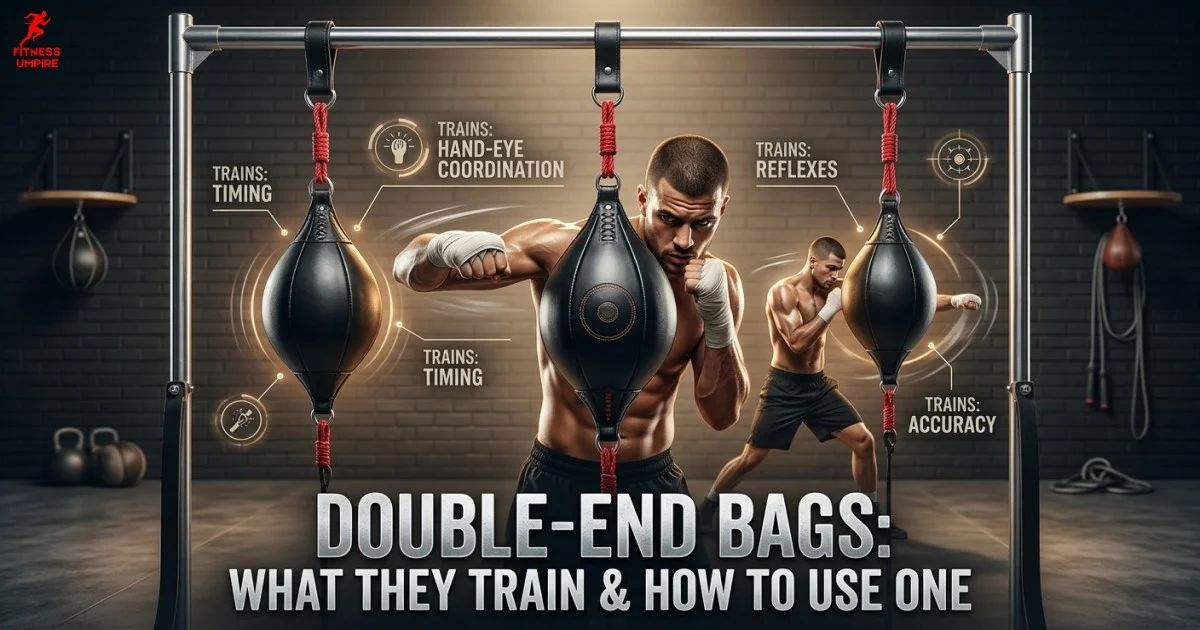
A double-end bag is a boxing and combat-sports training bag suspended between two elastic cords—one attached above and one below. Unlike a heavy bag, it moves rapidly back toward you after being struck, making it useful for training timing, accuracy, hand-eye coordination, rhythm, and defensive movement.
The key difference is movement: a heavy bag mainly gives you a stable target for developing striking mechanics and power, while a double-end bag continuously changes position after each punch.
What Is a Double-End Bag?
A double-end bag, sometimes called a floor-to-ceiling bag, is a small punching bag connected between two anchor points with elastic ropes or cords.
When you punch it, the bag moves away and then returns toward you. It may travel up, down, or sideways depending on the angle and force of your strike. You therefore have to react to the bag rather than simply hitting a stationary target.
A typical setup includes:
- A small boxing bag
- An upper elastic cord
- A lower elastic cord
- Ceiling or overhead anchor
- Floor or lower anchor
- Swivels or attachment hardware
The elastic connection is what creates the characteristic movement. A harder punch can send the bag farther away, while a quick combination can cause it to move unpredictably.
Why Does a Double-End Bag Move So Much?
The two elastic cords store and release energy when the bag moves. After you hit the bag, the tension pulls it back toward its original position.
That creates a repeating training cycle:
Punch → bag moves → bag returns → react → punch again
This makes the double-end bag different from equipment designed primarily for power development.
Double-End Bag vs. Heavy Bag vs. Reflex Bag
These bags can look similar in a training area, but they serve different purposes.
| Bag type | Main movement | What it emphasizes | Typical use |
|---|---|---|---|
| Double-end bag | Fast movement in multiple directions | Timing, accuracy, reactions, rhythm, defense | Boxing and striking drills |
| Heavy bag | Swings after being hit | Power, combinations, technique, conditioning | Punching and kicking practice |
| Reflex bag | Returns from a flexible base or stem | Reaction speed, movement, coordination | Solo reaction drills |
| Speed bag | Rapid rebound from a platform | Rhythm, hand speed, coordination | Repetitive punching patterns |
A double-end bag is particularly useful when you want a target that fights back through movement.
A heavy bag is generally easier to hit consistently because it does not dart back toward your face after every punch. A reflex bag can also move unpredictably, but its movement comes from a different type of setup.
Double-End Bag vs. Heavy Bag
The biggest distinction is stability versus movement.
A heavy bag provides resistance and allows you to work on punches, combinations, body shots, and—in an appropriate setup—kicks. It is also useful when you want to put more force into a strike.
A double-end bag is less about hitting as hard as possible and more about hitting a moving target while remaining ready for its return.
Many striking sessions can benefit from both rather than treating them as interchangeable.
Double-End Bag vs. Reflex Bag
A reflex bag typically uses a spring, flexible shaft, or weighted base to create movement. A double-end bag is suspended between two points and moves within the space created by its elastic cords.
Both can develop reactions and coordination, but the movement pattern is different.
What Does a Double-End Bag Train?
A double-end bag primarily trains the skills required to track, strike, and react to a moving target.
The most important training benefits are:
- Timing
- Accuracy
- Hand-eye coordination
- Rhythm
- Defensive reactions
- Head movement
- Punching combinations
It can also make ordinary bag work more dynamic because you cannot simply wait for the target to remain in one place.
1. Timing
Timing is one of the main reasons fighters use a double-end bag.
The target does not stay where you last punched it. After each strike, it moves and returns. You have to recognize when the bag is entering the correct range for your next shot.
For example, instead of throwing a series of punches at a stationary target, you might:
Jab → allow the bag to return → slip → jab-cross
The goal is not simply to move your hands quickly. You are learning to coordinate your movement with the target’s position.
2. Accuracy
A double-end bag gives you a relatively small moving target.
That encourages you to place punches deliberately rather than throwing them in the general direction of a large heavy bag.
Start with controlled punches and concentrate on making clean contact. As your accuracy improves, you can introduce combinations and changes in rhythm.
Accuracy matters because a moving opponent does not remain directly in front of you like a stationary training bag.
3. Evasion and Head Movement
The bag can return toward your head after you strike it.
Instead of simply stepping backward every time, you can incorporate defensive movements such as:
- Slips
- Pull-backs
- Small ducks
- Lateral movement
- Guard recovery
For example:
Jab → slip → cross → move
The returning bag gives you an external cue to practice reacting after your own attack.
This makes the double-end bag useful for connecting offensive and defensive movements.
4. Hand-Eye Coordination
Because the bag is moving continuously, your eyes have to track its position while your hands prepare to strike.
This creates a coordination challenge that is different from hitting a stationary heavy bag.
Start slowly. Focus on seeing the target clearly instead of trying to create maximum speed immediately.
5. Rhythm and Combination Work
Once you become comfortable with the bag’s movement, you can introduce different rhythms.
For example, you might alternate:
- Single punches
- One-two combinations
- Jab variations
- Short combinations followed by defense
- Changes between fast and controlled punches
The objective is to avoid becoming dependent on one predictable rhythm.
How to Use a Double-End Bag
A good double-end bag session should progress from control → accuracy → combinations → movement.
Don’t start by trying to hit the bag as fast as possible.
Step 1: Establish Your Stance
Stand at a distance where you can comfortably reach the bag without fully extending your arm.
Keep your normal striking stance and maintain your guard after each punch.
Step 2: Start With Single Punches
Begin with a jab.
Allow the bag to move and return before throwing another controlled punch.
This teaches you to watch the bag instead of immediately chasing it.
Step 3: Add the Cross
Once you can consistently connect with single punches, introduce the cross.
Focus on returning your hands to your guard after each combination.
Step 4: Add Defensive Movement
After punching, watch the returning bag and practice an appropriate defensive movement.
A simple sequence might be:
Jab → return to guard → slip → reset
You can gradually introduce combinations as your control improves.
Step 5: Increase the Pace
Only increase speed after you can consistently make clean contact.
A faster bag is not automatically a better workout. If you lose control and start swinging at random, reduce the pace.
For more structured striking drills, see the punching techniques training guide.
How to Adjust Double-End Bag Rope Tension
Rope tension changes how quickly and dramatically the bag moves. This is one of the most important adjustments when learning to use a double-end bag.
There is no single tension setting that works for everyone.
Lower Tension
A relatively relaxed setup can produce more movement and may give the bag a larger, less predictable response.
That can make the exercise challenging because you have to track the target over a greater range of movement.
Higher Tension
Increasing tension generally makes the system feel more controlled and can reduce some of the larger movements.
This can make it easier to establish basic accuracy and rhythm before progressing to more demanding drills.
However, avoid treating maximum tension as the goal. The setup should remain secure and provide useful movement without putting unnecessary stress on the equipment or anchor points.
A Practical Progression
| Skill level | Suggested approach | Training focus |
|---|---|---|
| New to double-end bags | Start with controlled movement | Basic tracking and accuracy |
| Developing | Gradually increase movement and combinations | Timing and rhythm |
| Experienced | Use varied combinations and defensive movement | Reactions, accuracy and evasion |
The important point is to adjust the bag to your skill level, rather than trying to make it as fast as possible from the beginning.
Who Should Use a Double-End Bag?
A double-end bag can be useful for boxers, kickboxers, MMA athletes, and other strikers who already understand basic punching mechanics.
It is particularly suitable for intermediate and advanced strikers because the bag demands more coordination than a stationary target.
Beginners can use one too, but learning basic stance, guard, punches, and movement first can make the experience much easier.
If your primary training involves kickboxing, a double-end bag can complement other striking equipment by giving you a moving target for hand combinations and defensive reactions. See the kickboxing punching-bag guide for how it fits into a broader kickboxing setup.
Common Double-End Bag Mistakes
Trying to Hit Too Hard
A double-end bag is not primarily a power test.
Large, powerful punches can send the bag away from you and make it harder to maintain a controlled rhythm.
Use enough force to create useful movement while maintaining accuracy.
Chasing the Bag
If the bag moves away, don’t immediately follow it with wild punches.
Let it return and learn to time your next strike.
Dropping Your Guard
Because you’re concentrating on the moving target, it can be easy to let your hands fall after making contact.
Practice returning to your normal guard after every punch or combination.
Starting Too Fast
Speed should come after control.
If you cannot consistently see and hit the target, slow the drill down.
Poor Installation
A double-end bag depends on its anchor points and elastic cords. The mounting points should be appropriate for the equipment and securely installed.
Check the manufacturer’s installation requirements before training, particularly when attaching the system to a ceiling or floor.
Is a Double-End Bag Worth Adding to Your Training?
A double-end bag fills a specific role that a heavy bag cannot completely replicate.
It gives you a moving target that reacts to your punches, allowing you to work on timing, accuracy, coordination, rhythm, and defensive movement in the same drill.
It is not necessarily a replacement for a heavy bag. Instead, the two pieces of equipment can complement each other:
Heavy bag → power, combinations, conditioning
Double-end bag → timing, accuracy, reactions, movement
If you already have basic striking skills and want a more reactive solo training tool, a double-end bag can add another dimension to your sessions.
Choosing a Double-End Bag
Double-end bags differ in bag size, construction, attachment system, elastic cords, and included hardware.
If you’re ready to compare models, see our guide to the best double-end punching bags before choosing one.
For a broader overview of punching-bag types, return to the punching bag types hub.
Frequently Asked Questions
What does a double-end bag train?
A double-end bag primarily trains timing, accuracy, hand-eye coordination, rhythm, reactions, and defensive movement. Its constant movement requires you to track the target and adjust your punches.
Is a double-end bag good for beginners?
Beginners can use a double-end bag, but it is generally easier after learning basic punching technique, stance, and guard. New users should start slowly and focus on controlled contact.
Is a double-end bag better than a heavy bag?
They serve different purposes. A heavy bag is useful for practicing power, combinations, and conditioning, while a double-end bag emphasizes timing, accuracy, reactions, and movement.
How tight should a double-end bag be?
There is no universal tension setting. Start with a controlled setup that allows the bag to move without becoming difficult to track, then adjust the tension as your skill improves.
Can you practice head movement with a double-end bag?
Yes. The returning bag can provide a visual cue for practicing movements such as slips and pull-backs. Start slowly and maintain control rather than trying to avoid the bag at maximum speed.
Is a double-end bag good for kickboxing?
Yes. Kickboxers can use it to develop hand accuracy, timing, rhythm, and defensive reactions. It works best as a supplement to other kickboxing training rather than as a complete replacement for other equipment.
Conclusion
A double-end bag is designed around movement and reaction. Instead of giving you a stationary target, it continuously moves after being struck, forcing you to track its position and time your next action.
Its strongest applications are timing, accuracy, hand-eye coordination, rhythm, and defensive movement. Adjusting the rope tension and training speed lets you progress from controlled single punches to more complex combinations and reactions.
For intermediate and advanced strikers in particular, it can be a useful addition to a broader training setup alongside a heavy bag and other striking equipment.