
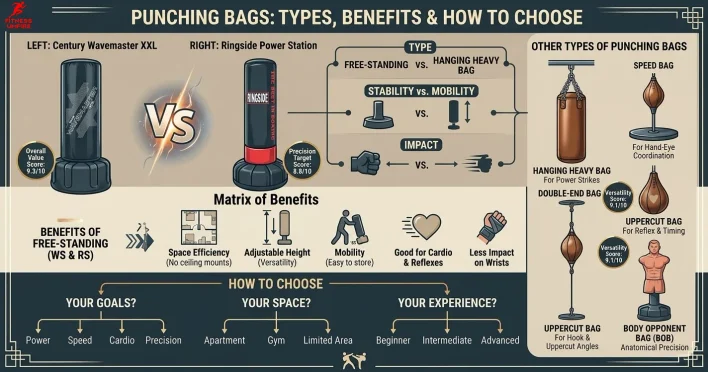
A punching bag is a training target designed for striking practice. Depending on the design, it can help you work on punches, kicks, combinations, timing, accuracy, footwork, conditioning, or power. Some bags hang from the ceiling, while others stand on a weighted base, and each style creates a different training experience.
The right punching bag depends less on choosing the biggest or heaviest option and more on matching the bag to what you train, where you train, your available space, and your experience level.
This guide explains the main types of punching bags, what each is designed for, the benefits they can provide, how to choose one, and what to consider before setting up a home training area.
Choose Your Path
Learn the Types
Not sure what all the different bags are designed to do? Start with our complete guide to punching bag types to compare heavy bags, freestanding bags, speed bags, double-end bags, reflex bags, and other designs.
Not Sure What You Need
The best bag for a beginner, apartment, home gym, boxing workout, or kickboxing setup can be different. Use our punching bag buying guide to narrow down the right type based on your training goals and space.
Ready to Buy 🛒
If you already know what you want, browse our best punching bags guide for a more product-focused comparison of options for different training needs.
What Is a Punching Bag?
A punching bag is a padded training apparatus used to practice striking techniques. Traditional hanging bags are suspended from a ceiling or support structure, while freestanding models use a base that sits on the floor.
The bag’s construction affects how it moves and feels when struck. Factors such as size, weight, shape, filling, outer material, mounting method, and movement all influence the type of training it supports.
For example, a conventional heavy bag provides a relatively stable target for combinations and power work. A speed bag is much smaller and is designed around rhythm, timing, and hand speed. A freestanding bag can be easier to install because it does not require a ceiling mounting point.
Punching bags are commonly used by boxers, kickboxers, martial artists, fitness users, beginners, and people training at home.
Types of Punching Bags
There is no single punching bag that does everything equally well. Different shapes and mounting systems are designed around different training movements.
| Punching bag type | What it is mainly used for |
|---|---|
| Heavy bag | Punches, combinations, power work, and general striking |
| Freestanding bag | Home training, boxing, kickboxing, and setups without ceiling mounting |
| Speed bag | Rhythm, timing, coordination, and rapid punching |
| Double-end bag | Accuracy, timing, reactions, movement, and combinations |
| Teardrop bag | Punches, hooks, uppercuts, knees, and close-range combinations |
| Reflex bag | Reaction time, movement, accuracy, and dynamic striking |
| Wall-mounted bag | Compact punching practice where floor space is limited |
| Aqua/water-filled bag | Striking practice with a water-filled target and distinctive impact feel |
These categories can overlap. For example, a heavy bag may be used for boxing, kickboxing, or general fitness, while a freestanding bag can also function as a heavy bag.
For a deeper comparison of construction, movement, shape, and intended training use, see our punching bag types guide.
Heavy Bags
The traditional heavy bag is one of the most versatile choices for striking practice. It is usually suspended from a sturdy support and designed to absorb repeated punches and, depending on the model, kicks.
Heavy bags come in different lengths, diameters, weights, and fillings. A longer bag can provide more usable striking surface for combinations involving both punches and kicks.
They are particularly useful when your training involves repeated combinations, power development, conditioning, or practicing techniques against a relatively stable target.
The main consideration is installation. A hanging bag needs a suitable support system capable of handling the bag and the forces generated during training.
Freestanding Punching Bags
Freestanding bags have a striking section attached to a weighted base. Instead of being suspended from the ceiling, the base keeps the bag upright.
This makes them particularly practical for many home gyms where permanent ceiling installation is undesirable or impractical.
Depending on the design, a freestanding bag can move, tilt, or rebound when struck. That movement can make training different from working with a conventional hanging heavy bag.
Freestanding models vary considerably, so the height, striking area, base design, stability, and intended training style should all be considered before buying.
Speed Bags
A speed bag is a small bag suspended from a platform. Unlike a heavy bag, its primary purpose is not to absorb powerful full-body strikes.
Speed-bag training emphasizes rhythm, timing, hand-eye coordination, accuracy, and repeated punching patterns.
Because the bag rebounds quickly, it requires a different technique and cadence from conventional heavy-bag work.
A speed bag can complement a heavy bag rather than replace it if your training includes both power work and rhythm-focused drills.
Double-End Bags
A double-end bag is attached at both the top and bottom, allowing it to move rapidly when struck.
Its movement creates a more reactive target than a stationary heavy bag. This makes it useful for practicing accuracy, timing, combinations, defensive movement, and responding to a moving target.
Double-end bags generally require more setup than freestanding equipment because both attachment points need to be installed securely.
Teardrop Bags
Teardrop bags have a distinctive rounded or tapered shape. Their shape can provide useful target areas for punches, hooks, uppercuts, knees, and close-range combinations.
They are especially relevant to training styles where strikes are not limited to straight punches.
Because shapes and dimensions vary between models, look at the intended use rather than assuming every teardrop bag provides exactly the same training experience.
Reflex Bags
Reflex bags are designed to move back toward the user after being struck. Many use a flexible pole or similar mechanism connected to a base.
The unpredictable movement can help with reaction, accuracy, movement, and keeping your hands active.
They can be useful for home fitness and striking practice, but they provide a different experience from a traditional heavy bag. If your primary objective is developing powerful combinations against a relatively stable target, a heavy bag may better match that particular training requirement.
Wall-Mounted Bags
Wall-mounted bags attach directly to a wall or mounting structure. They can be useful when floor space is limited because the equipment occupies less floor area than many freestanding alternatives.
The major consideration is the wall and mounting hardware. The installation surface must be appropriate for the equipment and the forces generated during use.
Wall-mounted designs also tend to provide a different striking experience from a swinging heavy bag.
Aqua and Water-Filled Bags
Water-filled punching bags use water rather than conventional solid or textile filling. Their impact characteristics differ from those of traditional filled bags.
The main attraction is the distinctive feel when striking the bag, but these models still require adequate support and appropriate placement.
As with any punching bag, check the manufacturer’s instructions for filling, mounting, handling, and use rather than treating all water-filled models as interchangeable.
Benefits of Using a Punching Bag
Punching-bag training can support several aspects of physical training, depending on how the bag is used.
Striking practice
A bag provides a repeatable target for practicing punches, kicks, combinations, and other striking movements.
Conditioning
Repeated rounds of striking can make a workout physically demanding. Training intensity depends on the exercises, pace, duration, rest periods, and the individual.
Technique practice
A consistent target allows you to repeat movements and combinations while focusing on mechanics.
Coordination and timing
Moving bags such as speed, double-end, and reflex bags introduce timing and reaction demands that differ from hitting a relatively stable target.
Home workouts
A punching bag can provide a dedicated training station for people who want to practice striking or incorporate bag drills into home workouts.
A punching bag is not automatically a complete training program, however. Footwork, technique, defense, mobility, and recovery can require other forms of practice.
For a more detailed look at these uses, see our guide to punching bag benefits.
How to Choose a Punching Bag
The best starting point is your training goal, not the bag’s appearance.
1. Decide What You Want to Train
Start by identifying the movements you expect to practice most often.
- General boxing and combinations: consider a heavy or freestanding bag.
- Kickboxing: look for a bag with enough usable surface and length for your intended kicks.
- Speed and rhythm: consider a speed bag.
- Timing and accuracy: a double-end or reflex bag may be more appropriate.
- Limited floor space: a wall-mounted option may be worth considering.
- Mixed striking: choose a versatile design with enough target area for the techniques you actually practice.
If several goals matter, a versatile heavy or freestanding bag can serve as the primary training target, with specialized bags added later if needed.
2. Consider Hanging vs. Freestanding
This is one of the biggest decisions for a home setup.
A hanging bag requires a secure mounting point but can swing naturally after being struck. A freestanding bag avoids ceiling suspension and can be repositioned more easily in many home environments.
Neither mounting style is automatically right for everyone.
Think about your ceiling structure, floor space, rental restrictions, portability needs, and the type of movement you want from the bag.
3. Match the Bag to Your Space
Measure the training area before buying.
Consider:
- Available floor space
- Ceiling height
- Clearance around the bag
- Mounting location
- Distance from walls and furniture
- Whether the bag needs to be moved after training
- Storage requirements
Remember that the bag itself is not the only space requirement. You also need enough room to move around it safely.
4. Look at Size and Shape
Bag dimensions affect what you can practice.
A longer bag can provide more vertical striking surface, which can be useful when training both punches and kicks. A compact bag may make more sense for limited space or primarily hand-focused workouts.
Shape also matters. A traditional cylindrical heavy bag, teardrop bag, reflex bag, and speed bag create very different target environments.
There is no universal “best” size without knowing how you intend to train.
5. Consider Weight and Stability
For a hanging bag, weight influences how much it moves when struck. For a freestanding bag, the base and overall construction affect stability.
A bag that moves excessively may not provide the experience you expect for certain drills, while a bag that barely moves can feel very different from one designed for reactive training.
Do not choose based solely on a product’s listed weight. Consider the entire construction and the manufacturer’s intended use.
6. Check Materials and Construction
The outer material can affect durability, maintenance, and feel.
Common exterior materials include synthetic materials and leather, while interiors can use different combinations of textile, foam, or other filling materials.
The stitching, seams, attachment points, straps, chains, zippers, and base construction can also matter.
For a home bag that will receive frequent use, overall construction is generally more important than simply choosing the cheapest model.
7. Think About Installation
A good bag still needs an appropriate setup.
Hanging bags require secure mounting. Double-end bags need suitable attachment points at both ends. Wall-mounted bags require an appropriate mounting surface. Freestanding bags need enough floor space and a suitable location.
Read the manufacturer’s installation requirements before purchasing.
Our punching bag setup guide covers the main considerations for mounting, placement, and getting a home training area ready.
Punching Bag vs. Other Training Options
A punching bag is a training tool rather than a replacement for every form of striking practice.
A heavy bag gives you a consistent target for repeated combinations and power-oriented work. A speed bag emphasizes rhythm and timing. A double-end bag introduces more target movement. A reflex bag emphasizes reactions and movement.
Partner drills and coaching can add elements that a stationary piece of equipment cannot reproduce on its own.
For that reason, choosing one bag should be based on the specific training experience you want rather than trying to find a bag that supposedly replaces everything.
Common Punching Bag Mistakes
Choosing by weight alone
A heavier bag is not automatically better. The correct weight depends on the design, intended use, mounting system, and training goals.
Ignoring the installation requirements
A hanging or wall-mounted bag places forces on its mounting system. Installation should follow the manufacturer’s specifications and the capabilities of the structure.
Buying the wrong shape
A speed bag, heavy bag, teardrop bag, and reflex bag are designed for different experiences. Make sure the bag’s shape matches the techniques you intend to practice.
Forgetting clearance
The space required for a punching bag includes the area around it. A swinging bag can need considerably more room than its static dimensions suggest.
Expecting one bag to do everything
A versatile heavy or freestanding bag can cover many exercises, but specialized bags exist because different designs emphasize different skills.
Skipping basic equipment
Hand protection and appropriate training equipment can matter when repeatedly striking a bag. Beginners should also learn proper technique rather than simply increasing force.
For additional ideas on structuring bag sessions, see our punching bag training tips.
Frequently Asked Questions
What type of punching bag is best for beginners?
A versatile heavy bag or freestanding punching bag can be a practical starting point for many beginners because it allows basic punches, combinations, and conditioning drills. The better choice depends on available space, installation options, and the type of training you want to perform.
Are freestanding punching bags good?
Freestanding bags can be useful for home training, particularly when ceiling mounting is inconvenient. Their performance varies by design, so stability, height, striking area, base construction, and intended use should be considered before buying.
What is a punching bag used for?
Punching bags are used for practicing striking technique, combinations, accuracy, timing, movement, and conditioning. Different bag designs emphasize different skills.
What is the difference between a heavy bag and a speed bag?
A heavy bag is a larger target designed for repeated strikes and combinations, while a speed bag is a small rebound-style bag focused more on rhythm, timing, coordination, and rapid punching.
Can you kick a punching bag?
Some punching bags are designed for kicks, while others are primarily intended for hand strikes. Longer heavy bags and certain specialized bags provide more suitable target areas for kickboxing-style training. Always follow the manufacturer’s intended-use guidance.
Do punching bags need to be hung?
No. Freestanding and some wall-mounted models do not require a traditional ceiling suspension system. A hanging heavy bag does require an appropriate support structure.
How much space do you need for a punching bag?
The required space depends on the bag and your training movements. You need room for the bag itself plus enough clearance to move around it and, for a swinging bag, enough space for its movement.
Are punching bags good for home workouts?
They can be. A punching bag provides a repeatable target for striking drills and can be incorporated into conditioning workouts. The type of bag should match the available space and training goals.
Can one punching bag be used for boxing and kickboxing?
Yes, but the suitability depends on the bag’s dimensions and construction. A bag with sufficient striking surface can accommodate both punches and kicks, while some compact bags are better suited to hand-focused training.
What should I look for when buying a punching bag?
Start with your training style, available space, mounting options, bag type, dimensions, weight, construction, stability, and intended frequency of use. Price should be considered alongside these factors rather than by itself.
Final Takeaway
The right punching bag is the one that matches your training, space, and setup.
For general striking practice, a heavy or freestanding bag can provide a versatile starting point. Speed bags focus on rhythm and coordination, while double-end and reflex bags introduce more movement and reaction. Teardrop, wall-mounted, and water-filled designs offer other specialized configurations.
Before buying, decide what you want to practice, measure your available space, determine whether you can safely mount a hanging or wall-mounted bag, and compare the bag’s size, weight, shape, materials, and construction.
If you’re ready to compare actual products, start with our best punching bags guide. If you’re still deciding which category fits your needs, return to the punching bag types guide or use the how to choose a punching bag framework.
Related Guides
- Punching Bag Types — Compare the major punching bag designs and their intended uses.
- How to Choose a Punching Bag — Match a bag to your training style, space, and setup.
- Punching Bag Setup — Learn the key considerations for mounting and positioning a bag.
- Punching Bag Training Tips — Explore practical ways to structure bag training.
- Punching Bag Benefits — Learn more about what punching-bag training can provide.
- Best Punching Bags — Compare options when you’re ready to buy.