
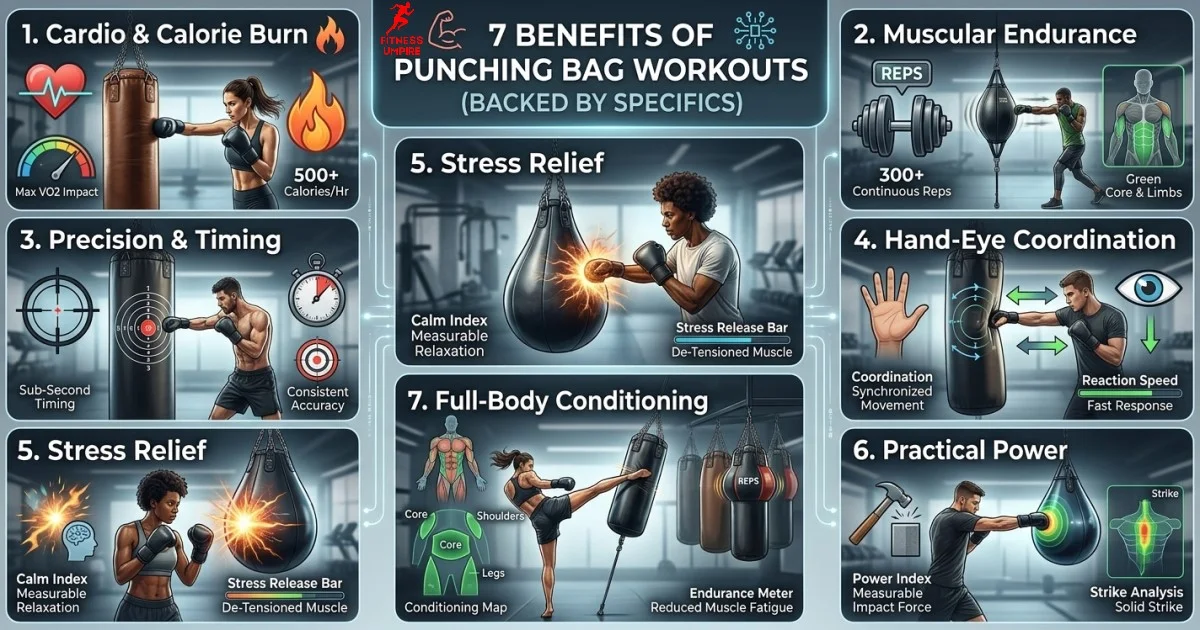
Punching bag training can deliver more than a hard workout. A well-structured bag session can raise your heart rate, challenge the muscles of your arms, shoulders, chest, back, core, and legs, and require you to coordinate punches while maintaining balance and movement.
The biggest difference between simply hitting a bag and getting a useful training effect is how you train. Working through controlled rounds, changing combinations, moving around the bag, and managing your pace can turn a few rounds into a demanding conditioning session.
Here are seven practical benefits of punching bag workouts and what each one actually involves.
1. Improves Cardiovascular Conditioning
One of the clearest benefits of punching bag training is cardiovascular conditioning.
A punching bag workout can alternate between periods of higher-intensity punching and lower-intensity movement or recovery. This makes it possible to structure a session similarly to other forms of interval training.
For example, a beginner could start with:
| Round | Duration | Pace | Focus |
|---|---|---|---|
| Warm-up | 5 minutes | Easy | Movement and technique |
| Round 1 | 2 minutes | Moderate | Basic punches |
| Rest | 1 minute | Easy | Recover |
| Round 2 | 2 minutes | Moderate | Combinations |
| Rest | 1 minute | Easy | Recover |
| Round 3 | 2 minutes | Moderate-high | Combinations + movement |
| Cool-down | 5 minutes | Easy | Gradually lower intensity |
As conditioning improves, the same person could gradually work toward longer rounds or more rounds rather than immediately trying to punch as hard and fast as possible.
The important point is that pace matters. Throwing maximum-power punches continuously is not necessary to make a bag workout challenging. A controlled rhythm with combinations, footwork, and short bursts of faster punches can keep the session demanding while allowing you to maintain technique.
A simple example is 20–30 seconds of faster combinations followed by 30–40 seconds at a controlled pace. Repeating this throughout a round creates changes in intensity without requiring every punch to be thrown at maximum effort.
2. Builds Muscular Strength and Endurance
Punching a heavy bag repeatedly requires your muscles to produce force again and again.
The shoulders, arms, chest, upper back, abdominal muscles, hips, and legs can all contribute to a technically sound punch. Your lower body helps generate and transfer force, while your trunk helps connect the movement between your legs and upper body.
However, punching-bag training should not be confused with traditional strength training.
A bag workout is particularly useful for muscular endurance because muscles repeatedly perform movements over multiple rounds. You may notice this when your shoulders and arms become increasingly fatigued during a longer session.
For example, try three 2-minute rounds:
- Round 1: Jab-cross combinations
- Round 2: Jab-cross-hook combinations
- Round 3: Mixed combinations with movement
Instead of trying to hit harder every time, concentrate on maintaining clean technique as fatigue develops.
For someone who also performs resistance training, the punching bag can therefore complement rather than replace exercises such as presses, rows, squats, and other strength movements.
3. Develops Coordination and Timing
Punching a stationary target might look simple, but effective bag training involves coordinating several movements at once.
You need to control:
- Punch selection
- Hand position
- Foot placement
- Body rotation
- Balance
- Distance from the bag
- Breathing
- Recovery after each combination
This makes the bag useful for practicing movement sequences repeatedly.
Start with something simple such as a jab-cross. Once the movement becomes comfortable, add a hook or change your foot position. The objective is not to make every combination complicated. It is to develop the ability to perform movements smoothly without losing balance or technique.
For example:
Jab → cross → reset
can progress to:
Jab → cross → lead hook → reset
and eventually:
Jab → cross → lead hook → rear hand → move
The bag does not move unpredictably like a live opponent, so it cannot reproduce every aspect of partner training. However, it provides a consistent target against which you can repeatedly practice combinations, distance, rhythm, and movement.
4. Helps Practice Reaction and Rhythm
A punching bag does not truly test reaction time in the same way as a moving opponent or reaction drill. It does, however, provide an opportunity to practice rhythm, timing, and rapid transitions between movements.
You can create simple timing challenges by changing combinations at predetermined intervals.
For example, during a two-minute round:
- First 30 seconds: single punches
- Next 30 seconds: two-punch combinations
- Next 30 seconds: three-punch combinations
- Final 30 seconds: combinations with movement
Another approach is to use an audio timer and change combinations whenever the interval sounds.
This forces you to recognize a cue, select a movement, and execute it without spending too much time thinking about the sequence.
For more advanced training, randomizing combinations can make the session more mentally demanding. The important distinction is that this is practice for timing and response, rather than proof that a heavy-bag workout alone develops the same reactions required during live combat.
5. Provides a Practical Outlet for Stress
A punching bag can also provide a structured way to exercise when you feel mentally overloaded.
The benefit is not that punching a bag magically eliminates stress. Rather, a focused workout gives you a defined physical activity that requires attention, movement, and controlled effort.
A short session can be enough.
For example, try:
- Five minutes of easy movement and warm-up.
- Three 2-minute bag rounds at a moderate pace.
- One minute of easy movement between rounds.
- Five minutes of gradual cool-down.
During the rounds, concentrate on breathing, technique, combinations, and foot position instead of trying to turn the session into an all-out effort.
Regular physical activity can support overall physical and mental well-being, while the repetitive structure of bag rounds can give you a clear break from sedentary or mentally demanding tasks.
If you are particularly tense, starting at a controlled pace is generally more useful than immediately trying to hit as hard as possible.
6. Improves Core and Whole-Body Movement
A punch is not only an arm movement.
Effective punching involves coordinated movement through the lower body and torso. Depending on the technique, your feet, legs, hips, trunk, shoulders, and arms all contribute to the movement.
This makes bag training more dynamic than simply performing repeated arm exercises.
Movement around the bag adds another layer. Instead of standing in one position for an entire round, you can practice stepping, changing angles, and returning to your starting position.
For example, a simple round could include:
Combination → step → reset → combination → step → reset
The goal is to maintain balance while moving rather than allowing your feet to become stationary while your upper body does all the work.
That combination of punching and movement can make the workout feel more like a full-body conditioning session.
7. Makes Exercise More Engaging
Consistency matters when building an exercise routine, and enjoyment can influence whether you continue doing an activity.
A punching bag gives you something concrete to work toward. Instead of repeating exactly the same movement for an entire workout, you can vary:
- Number of rounds
- Round duration
- Punch combinations
- Movement
- Work-to-rest intervals
- Training pace
- Technique drills
For example, one workout might emphasize basic combinations while another focuses more heavily on movement and conditioning.
You can also track simple training markers such as the number of completed rounds, round duration, rest periods, and combinations practiced.
That creates measurable progression without requiring every workout to become harder.
How Long Should a Punching Bag Workout Be?
There is no single duration that works for everyone.
Someone new to bag training may find that several short rounds are enough. A more experienced person may comfortably complete a longer session.
A practical starting structure is:
5-minute warm-up → 3 × 2-minute rounds → 1-minute rests → 5-minute cool-down
Once that becomes manageable, progression can come from adding another round, extending the rounds, reducing excessive rest, or introducing more movement.
You do not need to increase everything simultaneously.
For example:
Beginner
3 × 2-minute rounds
1-minute rest
Intermediate
4–6 × 2-minute rounds
1-minute rest
Longer conditioning session
Several 3-minute rounds
Controlled recovery between rounds
The appropriate workload depends on your current fitness, technique, available recovery, and the rest of your exercise routine.
How to Get More From Each Round
The quality of your bag workout depends heavily on technique and pacing.
Don’t throw every punch at maximum power
Constant maximum-power punching can cause your technique to deteriorate as fatigue accumulates. Instead, use different intensities throughout the round.
For example:
Easy combinations → moderate combinations → short fast burst → controlled recovery
This gives you changes in pace without making the entire round an uncontrolled effort.
Keep your combinations simple
You do not need ten-punch combinations to make a workout effective.
A few basic combinations can provide plenty of practice:
- Jab → cross
- Jab → cross → hook
- Jab → cross → hook → cross
- Jab → move → cross
Focus on returning to a balanced position after each combination.
Use the whole body
Avoid treating the bag like a target that can only be hit with the arms. Controlled footwork and torso movement can make the workout more coordinated and demanding.
Progress gradually
If you currently complete three rounds, you do not need to jump immediately to ten.
Increase one variable at a time and pay attention to how your body responds.
What Punching Bag Training Does Not Replace
A punching bag is useful, but it has limitations.
It does not replace every form of exercise or training. A bag does not provide the same resistance pattern as weight training, and a stationary bag cannot reproduce the unpredictable movement of a live training partner.
For general fitness, you can combine bag work with other forms of exercise such as resistance training, walking, running, cycling, mobility work, or sport-specific practice.
For combat-sports training, bag work is one component alongside technique instruction, defensive work, partner drills, footwork, and other supervised training methods.
Basic Safety and Equipment Considerations
A suitable bag, correctly fitted gloves or other appropriate hand protection, adequate space, and proper setup all matter.
Avoid training through sharp pain or an injury. If your technique breaks down because you are exhausted, reduce the pace or end the round rather than continuing simply to complete a predetermined number.
Your bag should also be installed or positioned according to the manufacturer’s requirements. A poorly secured heavy bag or an unstable freestanding bag can create unnecessary risks.
If you’re new to punching technique, learning the basics from a qualified coach can also help you develop safer movement patterns.
Convinced? Here’s How to Pick the Right Bag
The benefits you get from bag training depend partly on choosing equipment that fits your training environment.
A person training in an apartment may have very different requirements from someone with a dedicated home gym. A beginner may prioritize stability and ease of use, while an experienced athlete may need a bag capable of handling more intense training.
Start with our how to choose a punching bag guide to match the bag type, size, setup, and training style to your needs.
If you already know you want a bag for home training, you can also see our guide to the best punching bags to compare suitable options.
The Bottom Line
Punching bag training can combine cardiovascular conditioning, muscular endurance, coordination, timing, movement, and focused physical activity in a single workout.
The key is structured training rather than simply hitting the bag as hard as possible. Start with manageable rounds, use controlled combinations, vary your pace, allow adequate recovery, and gradually increase the workload as your conditioning improves.
Used that way, a punching bag can be a practical addition to a broader fitness routine—and an engaging way to get moving.