
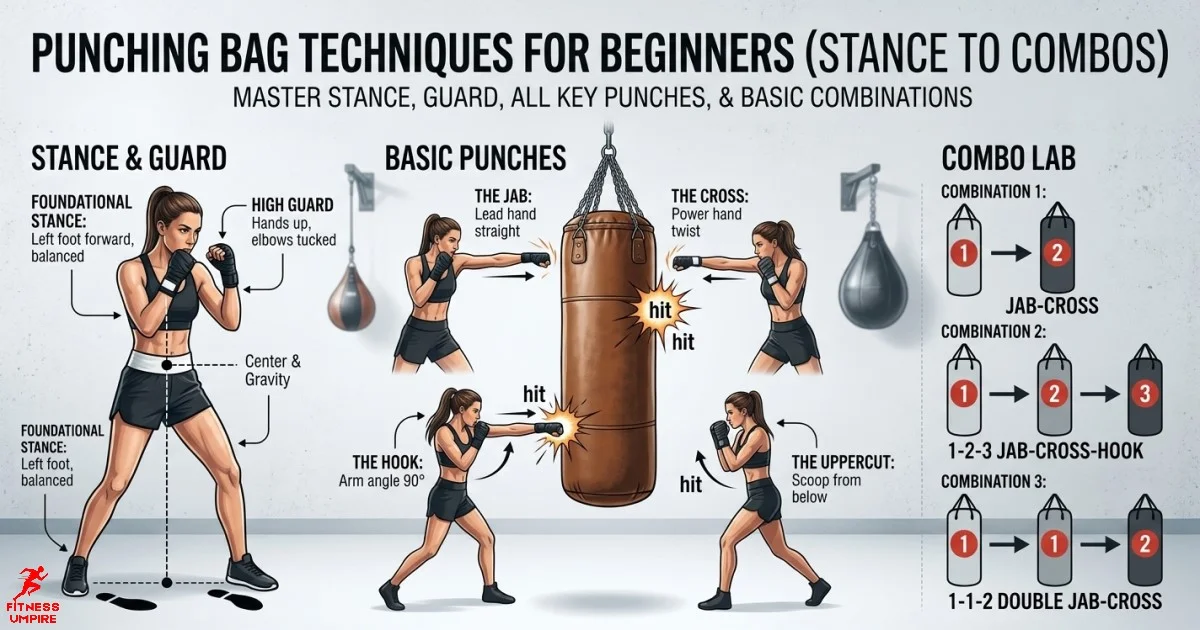
Learning how to punch a punching bag is more than throwing your hands at the target. Good punching technique starts with a balanced stance, a solid guard, controlled movement, and proper alignment. Once those fundamentals are comfortable, you can add the jab, cross, hook, uppercut, and simple combinations.
For beginners, the goal is clean technique rather than maximum power. Stay balanced, keep your hands protected, return each punch to your guard, and gradually increase speed and intensity as your technique improves.
Stance and Guard Basics
Before practicing individual punches, establish a stable stance. Your stance gives every punch a foundation, so poor positioning can make even a technically correct punch feel awkward.
How to Stand When Punching a Bag
For a conventional boxing stance:
- Stand with your feet roughly shoulder-width apart.
- If you are right-handed, place your left foot slightly forward. If you are left-handed, reverse the position.
- Keep your knees slightly bent rather than locking them.
- Keep your weight balanced between both legs.
- Turn your body slightly rather than facing the bag completely square.
- Keep your lead foot and rear foot positioned so you can move without crossing your legs.
- Keep your torso relaxed and ready to rotate.
You should be able to move forward, backward, and sideways without losing your balance.
Avoid standing too close to the bag. You need enough space for your punches to travel naturally and for your arms to reach full extension without forcing the movement.
Keep a Proper Guard
Your guard protects your head while also putting your hands in position to punch.
Keep your hands near your face, with your elbows reasonably close to your body. Keep your chin slightly tucked and your eyes on the target.
Your shoulders should stay relaxed. Constantly tensing your shoulders can make your punches slower and cause unnecessary fatigue.
A useful beginner habit is simple:
Punch → return to guard → reset.
Do this with every individual punch before trying combinations.
How to Throw a Jab
The jab is usually the first punch beginners should learn because it teaches distance, hand position, balance, and returning to the guard.
From your stance, extend your lead hand directly toward the target. As the hand travels forward, rotate the fist into its punching position while keeping your shoulder relaxed.
Do not lean your entire body forward to reach the bag.
At the end of the punch, your arm should be extended naturally without aggressively locking the elbow. Then bring the hand straight back to your guard.
Jab Technique Checklist
- Start from your guard.
- Extend the lead hand along a relatively straight path.
- Keep your non-punching hand protecting your face.
- Avoid lifting your shoulder excessively.
- Stay balanced.
- Return the jab immediately to your guard.
The jab does not need to be your hardest punch. Use it to establish rhythm and distance.
How to Throw a Cross
The cross is the rear-hand straight punch. It generally uses more body rotation than the jab.
Start with both hands in your guard. Drive the rear hand toward the target while rotating your hips and shoulders together. Your rear heel can rotate naturally as your lower body follows the punch.
The important point is that the punch should involve your entire body rather than simply extending your arm.
Keep your lead hand up while the rear hand punches. After contact, bring the rear hand back to your guard and reset your stance.
Cross Technique Checklist
- Start with the rear hand at your guard.
- Rotate the hips and shoulders together.
- Allow the rear foot to rotate naturally.
- Keep your head controlled and balanced.
- Do not overreach.
- Return the hand to your guard.
A common beginner mistake is trying to generate power by throwing the arm harder while leaving the lower body stationary. Controlled rotation is more useful than simply swinging harder.
How to Throw a Hook
A hook travels around the side of the target rather than straight toward it.
From your stance, bend the punching arm and rotate your body toward the target. The shoulder, hip, and foot should work together rather than the arm doing all the work.
Keep the movement compact. A beginner does not need a huge swinging motion to practice a hook effectively.
Think about rotating your body into the punch while maintaining balance.
Hook Technique Checklist
- Keep your guard established before starting.
- Bend the punching arm rather than reaching with it.
- Rotate your hips and shoulders together.
- Keep the movement compact.
- Do not swing wildly around the bag.
- Return to your guard after the punch.
Practice both lead and rear hooks, but learn them individually before adding them to combinations.
How to Throw an Uppercut
An uppercut travels upward toward the target. It requires control because beginners often try to generate the movement by dropping their hand dramatically or swinging from too low a position.
Start from your guard and bend slightly through your legs. Drive upward with your lower body while rotating your torso and bringing the punching hand upward.
The movement should be relatively short and controlled.
Do not exaggerate the upward swing. Your hand should remain connected to the movement of your body instead of becoming a separate arm-only motion.
Uppercut Technique Checklist
- Begin from your guard.
- Keep the movement compact.
- Use your legs and torso rather than only your arm.
- Keep your balance.
- Avoid dropping your hand excessively.
- Return immediately to your guard.
Basic Punching Bag Combinations for Beginners
Once you can perform each punch individually, combine them slowly.
The numbers below use a common boxing numbering convention:
- 1 = lead jab
- 2 = rear cross
- 3 = lead hook
- 4 = rear uppercut
Start slowly enough that every punch remains controlled.
1–2: Jab–Cross
This is one of the simplest combinations.
1 → 2
Throw the jab, return it toward your guard, and follow with the cross. Finish by bringing the rear hand back to your guard.
Focus on maintaining your stance throughout the combination.
1–1–2: Double Jab–Cross
1 → 1 → 2
Throw two jabs before the cross.
The second jab should not cause you to lean forward or lose your balance. Think about maintaining your position while changing the rhythm.
1–2–3: Jab–Cross–Hook
1 → 2 → 3
Start with the jab, follow with the cross, then rotate into the lead hook.
This combination teaches you to transition from straight punches into a rotational punch.
1–2–3–2: Four-Punch Combination
1 → 2 → 3 → 2
Throw the jab, cross, lead hook, then rear cross.
For beginners, the most important part is not speed. Make sure you return to a stable position after each punch and avoid rushing the final cross.
How to Practice Combinations
Start with several slow repetitions. Once the movement feels natural, increase your speed gradually.
You can also use the bag to practice different rhythms:
Slow → slow → moderate
or
1 → pause → 2 → pause → 3
This helps you learn control instead of simply flailing at the bag.
Common Punching Bag Form Mistakes
1. Trying to Punch as Hard as Possible
Beginners often equate good bag work with maximum power. That can cause poor technique.
Start with controlled punches and focus on accuracy, balance, and clean movement.
2. Dropping the Other Hand
When throwing a cross, hook, or uppercut, beginners sometimes let the non-punching hand fall.
Keep the opposite hand in a protective position.
3. Overextending the Punch
Do not reach excessively for the bag. If you have to lean your body forward to make contact, your distance is probably wrong.
Move your feet instead of stretching your arm beyond a comfortable range.
4. Standing Too Square
Facing the bag completely square can make your stance less natural for conventional boxing technique.
Maintain a comfortable staggered stance and stay ready to move.
5. Locking the Elbows
Avoid forcefully snapping the elbow straight at the end of a punch. Keep the movement controlled and natural.
6. Watching Only Your Hands
Keep your eyes on the target rather than staring at your fists. This helps you maintain awareness of the bag and your position.
7. Staying Completely Stationary
The punching bag does not require you to stand in one place. Practice small, controlled movements around the bag once your basic punches are reliable.
8. Losing Balance After Combinations
If a combination causes you to stumble, slow it down.
A combination that looks fast but leaves you off-balance is not useful practice. Build speed only after you can maintain your stance.
Protect Your Hands Before Hitting the Bag
Hand protection is an important part of punching bag training.
Many beginners use hand wraps and boxing gloves to provide support and cushioning during bag work. Wraps help secure the hands and wrists inside the gloves, while properly fitted gloves provide padding between your hands and the bag.
Choose equipment appropriate for your training and make sure it fits correctly. If you are new to bag training, learning how to wrap your hands properly can be just as important as learning the punches themselves.
Do not treat hand protection as a way to compensate for poor technique. Your wrist and hand position should remain controlled throughout every punch.
If you are choosing your first punching bag, see our guide to freestanding punching bags. For a more complete introduction to equipment, setup, and beginner training, see our punching bag guide for beginners.
How to Practice Punching Bag Technique
A simple beginner session can focus on technique rather than trying to exhaust yourself.
Start with your stance and guard. Practice individual jabs, crosses, hooks, and uppercuts at a controlled pace. Then introduce short combinations such as 1–2 and 1–2–3.
As your technique becomes more consistent, practice changing your distance and moving around the bag.
A useful progression is:
Stance → individual punches → two-punch combinations → three-punch combinations → four-punch combinations → movement
The key is to move to the next stage only when you can perform the previous one without repeatedly losing your balance or dropping your guard.
Frequently Asked Questions
What is the proper way to punch a punching bag?
Start with a balanced stance and a controlled guard. Throw each punch with proper body alignment, avoid overextending, and return your hand to your guard after every punch. Focus on technique before increasing power or speed.
Should I punch a heavy bag as hard as I can?
Not when you are learning. Begin with controlled punches and gradually increase intensity as your technique improves. Maximum effort is not necessary for every punch.
What punches should a beginner learn first?
Start with the jab and cross, then learn the lead and rear hooks and uppercuts. Once each punch is comfortable individually, combine them into simple two-, three-, and four-punch combinations.
How do I stop losing balance when punching the bag?
Reduce your punching speed and focus on your stance. Keep your feet positioned under your body, avoid leaning too far toward the bag, and use controlled hip and shoulder rotation.
Should I use gloves and hand wraps on a punching bag?
Hand wraps and appropriate boxing gloves are commonly used for bag training because they provide support and cushioning. Proper fit and technique are important regardless of the equipment you use.
How far away should I stand from a punching bag?
Stand far enough away that you can reach the bag naturally without leaning or overstretching. Your ideal distance changes depending on the punch, so practice adjusting your feet rather than reaching excessively.
Conclusion
Good punching bag technique starts with fundamentals: a balanced stance, a reliable guard, controlled punches, and proper recovery after every strike.
Learn the jab, cross, hook, and uppercut individually before putting them together. Then practice simple combinations such as 1–2, 1–1–2, 1–2–3, and 1–2–3–2 while keeping your balance and protecting your hands.
The goal is not simply to hit the bag harder. The goal is to make every punch controlled, repeatable, and technically sound.