
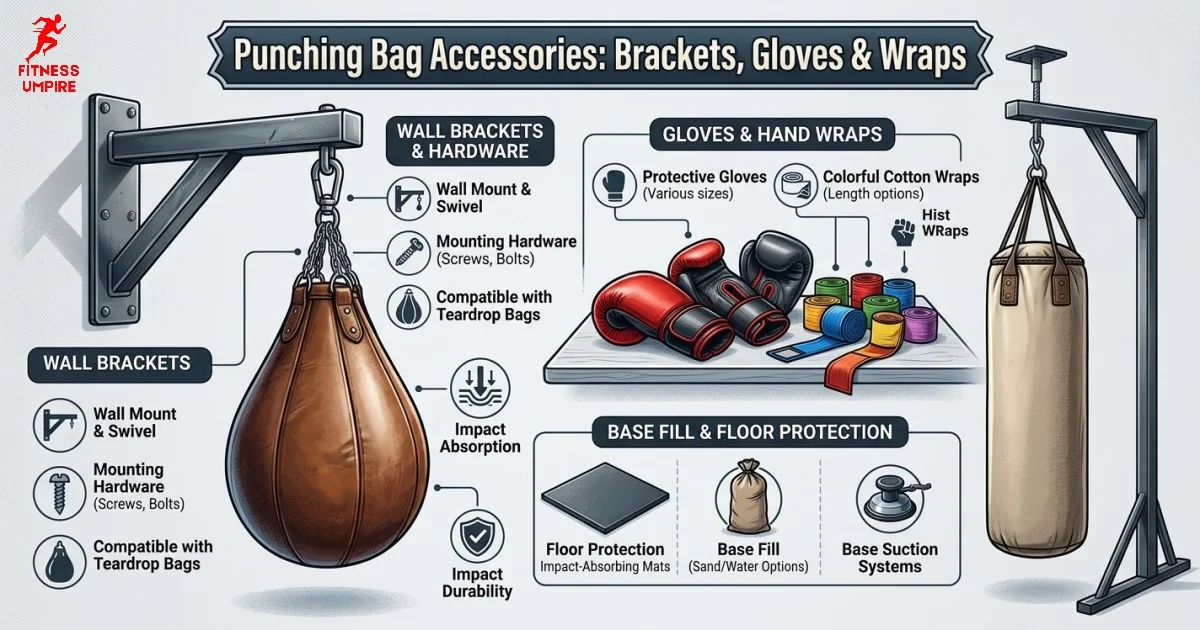
If you’re setting up a punching bag at home, you don’t need a huge collection of accessories. The essentials depend mainly on the type of bag you have, how it is mounted, and how you plan to train.
For a hanging heavy bag, the key equipment is a proper wall or ceiling bracket, mounting hardware, boxing gloves, and hand wraps. For a freestanding bag, you’ll generally need base fill and some form of floor protection instead of a mounting system.
The goal is simple: choose gear that supports the bag safely, protects your hands, and works with your training space.
Wall and Ceiling Brackets: The Foundation for a Hanging Bag
A hanging punching bag needs a secure connection between the bag and the structure supporting it. Depending on your setup, that can mean a ceiling mount, wall bracket, heavy-duty beam attachment, or another manufacturer-approved mounting system.
The bracket itself is only part of the installation. The supporting structure and mounting hardware have to be appropriate for the bag and the surface you’re attaching to.
What to Look For in a Punching Bag Bracket
Before buying a bracket, check:
| Feature | What to consider |
|---|---|
| Mounting surface | Wood framing, masonry, or another structural surface may require different hardware |
| Bag weight | The support system should be appropriate for the loaded bag |
| Movement | A swinging bag creates dynamic forces, not just a static load |
| Clearance | Leave enough room for the bag to move without hitting walls or furniture |
| Hardware | Use hardware suitable for the actual mounting surface |
| Attachment point | Check that the bracket’s connection fits your bag’s chain, strap, or swivel |
A common mistake is choosing a bracket based only on its advertised weight capacity. The structure you’re attaching it to matters just as much.
For the complete installation process, including choosing a suitable mounting location and attaching a hanging bag, see the punching bag mounting guide.
Don’t Forget the Swivel and Chains
Many hanging bags use a chain assembly and swivel between the bag and its mounting point. These components allow the bag to move naturally while reducing twisting in the connection.
If your punching bag already includes the necessary hardware, check the manufacturer’s instructions before replacing anything. If you’re buying components separately, make sure the parts are compatible with the bag and mounting system.
Boxing Gloves and Hand Wraps: The Basic Hand Protection Setup
Boxing gloves and hand wraps serve different purposes, so one shouldn’t automatically be treated as a substitute for the other.
Hand wraps are worn underneath gloves. They provide support around the hands and wrists and create a layer between your skin and the inside of the glove.
Gloves provide the padded striking surface between your hands and the punching bag.
For regular heavy-bag training, having both gloves and wraps is a sensible starting point.
Choosing Punching Bag Gloves
For bag work, look for gloves that:
- Fit securely without excessive movement
- Have adequate padding for bag training
- Allow you to make a comfortable fist
- Have a secure wrist closure
- Match the type and frequency of your training
Glove size is commonly expressed in ounces (oz). The right choice can depend on factors such as your training purpose, the glove manufacturer’s sizing recommendations, and whether the gloves will also be used for partner drills or other activities.
Don’t choose gloves solely because they have the highest ounce rating. Fit and intended use matter too.
If possible, try gloves on before purchasing them. Your fingers should sit comfortably inside the hand compartment, while the wrist closure should feel secure without being uncomfortably tight.
Why Hand Wraps Matter
Hand wraps help support the hands and wrists underneath your gloves. They also provide a barrier that can help keep sweat away from the inside of your gloves.
There are several wrap styles, including traditional cloth wraps and elastic-style wraps. The important consideration is getting a wrap that you can apply securely and comfortably.
A wrap should not leave your fingers numb, cause excessive pressure, or interfere with normal hand movement.
Freestanding Punching Bag Gear
Freestanding bags don’t require a wall or ceiling bracket, but they have their own accessories and setup considerations.
The two most useful additions are base filling material and floor protection.
Base Fill
A freestanding punching bag generally relies on its base for stability. Depending on the model, the base may be designed to be filled with water, sand, or another material specified by the manufacturer.
Follow the manufacturer’s instructions rather than assuming every freestanding bag uses the same filling method.
The amount and type of fill can affect the bag’s stability and how practical it is to move later.
Before filling the base, consider where the bag will stay. A partially filled base may be easier to position, while a fully filled base can be substantially harder to relocate.
Floor Protection
A freestanding bag can move, slide, or rock during training. A rubber gym mat or suitable protective flooring can help create a more stable training area while protecting the floor from scuffs and repeated movement.
Floor protection is particularly useful on hard surfaces such as:
- Hardwood
- Laminate
- Tile
- Vinyl
- Concrete
Choose a mat large enough to cover the area where the bag and your feet will actually move. The mat should also be appropriate for the surface underneath it.
What Punching Bag Gear Do You Actually Need?
Your basic setup can be surprisingly simple.
| Punching bag type | Essential gear | Useful additions |
|---|---|---|
| Hanging heavy bag | Mounting system, suitable hardware, gloves, hand wraps | Swivel, protective flooring |
| Freestanding bag | Base fill specified by manufacturer, gloves, hand wraps | Floor mat, additional training accessories |
| Home boxing setup | Bag-specific support, gloves, wraps | Mat, timer, cleaning supplies |
You don’t need to buy every accessory marketed for punching bags. Start with equipment that solves a specific need: secure support, hand protection, stability, or floor protection.
Common Gear Mistakes to Avoid
Buying the bracket before checking the mounting surface
A strong-looking bracket isn’t automatically suitable for every wall or ceiling. Identify the actual supporting structure first.
Using gloves without wraps
Some people treat gloves as complete hand protection. Wraps and gloves perform different functions, so using both can provide a more complete training setup.
Assuming every freestanding base uses the same filler
Check the manufacturer’s instructions. The recommended filling method can vary between models.
Putting a freestanding bag directly on an unprotected floor
Repeated movement can mark some flooring surfaces. A suitable mat can provide a dedicated training surface and help protect the floor.
Buying accessories without checking compatibility
Mounting components, swivels, chains, gloves, and other equipment aren’t necessarily universal. Check specifications before combining separate components.
Frequently Asked Questions
What accessories do I need for a punching bag?
For a hanging bag, the basic accessories are a suitable mounting system, appropriate mounting hardware, boxing gloves, and hand wraps. For a freestanding bag, you generally need the manufacturer’s recommended base fill, gloves, wraps, and potentially a floor mat.
Do I need a wall bracket for a punching bag?
Only if you’re installing a hanging bag using a wall-mounted system. A ceiling mount or another appropriate structural support can be used for some hanging setups, while freestanding bags don’t require a wall bracket.
Do I need hand wraps with punching bag gloves?
Hand wraps are worn underneath gloves and provide additional support and a protective layer for your hands and wrists. They serve a different purpose from the padding in boxing gloves.
What do you put under a freestanding punching bag?
A suitable exercise or gym mat can be placed underneath a freestanding bag. It can help protect the floor and create a defined training area.
What do you fill a freestanding punching bag base with?
It depends on the model. Some bases are designed for water, while others may specify sand or another filling material. Follow the instructions provided with your particular bag.
Bottom Line
The right punching bag setup doesn’t require dozens of accessories. Hanging bags need an appropriate structural support system, while freestanding bags need a properly filled base and suitable floor protection. For either type, boxing gloves and hand wraps are the core training gear.
Choose accessories based on your specific bag, mounting surface, training environment, and manufacturer’s instructions rather than buying equipment simply because it is marketed as a punching-bag accessory.