
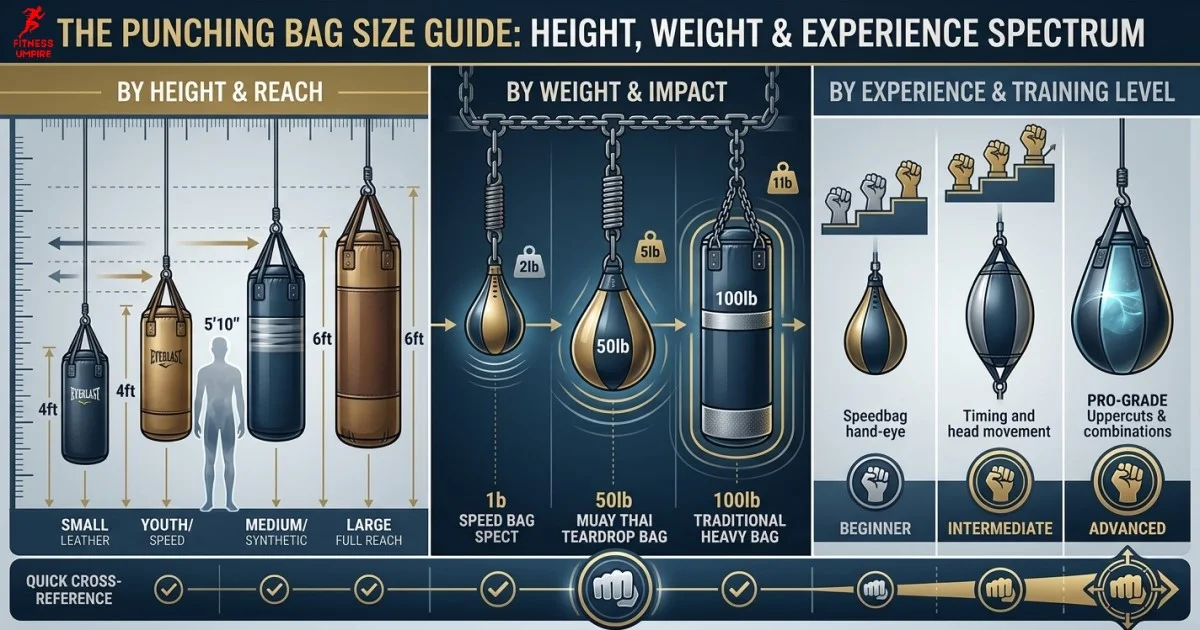
The right punching bag size depends mainly on your body weight, height, training experience, and the techniques you plan to practice. As a general starting point, a heavy bag weighing around 40–50% of your body weight works well for many users, while taller users should also pay attention to the bag’s height and available striking area.
For example, someone weighing 160 pounds might start by considering a bag around 65–80 pounds. Someone who wants to practice powerful kicks, combinations, or more advanced striking may prefer a heavier, larger bag.
Quick Punching Bag Size Guide
| Your Weight | Suggested Bag Weight | Good For |
|---|---|---|
| 80–110 lb | 30–50 lb | Youth, lighter beginners, technique |
| 110–140 lb | 40–60 lb | Beginners and fitness training |
| 140–170 lb | 50–80 lb | General boxing and kickboxing |
| 170–200 lb | 70–100 lb | Regular boxing and harder combinations |
| 200–230 lb | 80–110 lb | Stronger punches and heavier training |
| 230+ lb | 100–120+ lb | Heavy hitters and advanced training |
These are starting ranges rather than strict rules. A person’s technique, striking style, training frequency, and the bag’s construction all affect how heavy the bag should be.
A bag that is too light can swing excessively when hit hard. A heavier bag generally provides more resistance and stability, but simply choosing the heaviest available bag is not automatically better.
What Size Punching Bag Should You Get?
For most adults doing boxing, kickboxing, or general fitness training, a 70–100 pound heavy bag is a practical range to consider. Lighter users and beginners may be more comfortable with a 40–70 pound bag, while heavier or more experienced users may want 80–120 pounds or more.
The bag’s height matters just as much as its weight if you want to practice punches at different levels or include body and leg strikes.
A useful way to narrow the choice is:
- Lightweight bag: easier to move and suitable for lighter users or technique work.
- Medium-weight bag: versatile for general boxing and fitness.
- Heavy bag: more stable for powerful combinations and experienced training.
- Long bag: useful when you want more vertical striking surface, especially for kickboxing and similar training.
How Your Weight Affects Punching Bag Size
Body weight is useful because it gives you a starting point for choosing bag weight.
A simple guideline is to look at a bag weighing roughly 40–50% of your body weight.
For example:
- 120 lb person → approximately 50–60 lb bag
- 150 lb person → approximately 60–75 lb bag
- 180 lb person → approximately 70–90 lb bag
- 200 lb person → approximately 80–100 lb bag
- 220 lb person → approximately 90–110 lb bag
This doesn’t mean you must match the calculation exactly. A beginner who is still learning technique may prefer a lighter bag, while someone with stronger, more consistent strikes may want additional weight.
The goal is to find a bag that gives you enough resistance without becoming impractical for your space or training style.
How Your Height Affects Punching Bag Size
Your height becomes especially important when choosing the physical height of the bag.
If the bag is too short, you may have difficulty practicing strikes at your natural head and body levels. If it is too tall for your available space, you may not be able to install or use it correctly.
For a hanging heavy bag, consider the entire installation height, not simply the advertised bag length. The ceiling, mounting hardware, chains, swivel, and bag itself all contribute to the final height.
For a freestanding bag, look at the manufacturer’s stated floor-to-top height and whether the striking section can be adjusted.
A taller person does not necessarily need a heavier bag. Bag weight and bag height solve different problems: weight affects stability and movement, while height determines where the striking surface sits.
Hanging Bag Ceiling Clearance: How Much Space Do You Need?
Before buying a hanging punching bag, measure your ceiling rather than guessing.
Use this basic calculation:
Available clearance = ceiling height − mounting hardware − bag height
For example, suppose your ceiling is 96 inches high and your mounting hardware and chain require 12 inches. If the bag itself is 48 inches tall:
96 − 12 − 48 = 36 inches
That leaves 36 inches of space below the bag.
However, the important measurement is not simply whether the bag physically fits. You also need enough usable space around it for your normal training movements.
Measure:
- Ceiling height
- Mounting point height
- Chain or strap length
- Bag height
- Available floor space
- Clearance around the bag
Do not install a hanging bag simply because it fits vertically. The mounting point must also be suitable for the equipment and structure supporting it.
What About Freestanding Punching Bags?
Freestanding bags solve a different sizing problem because they do not require a ceiling mount.
Instead of calculating the height of a chain and hanging bag, you need to consider the total height of the assembled bag and the dimensions of its base.
This can make freestanding bags particularly useful when you cannot permanently mount a heavy bag.
Height adjustment is another advantage. A bag with several height settings can be positioned differently for people of different heights or for different striking techniques.
Century Wavemaster Height Example
Century’s original Wavemaster provides a useful example of adjustable freestanding-bag sizing. Century lists seven height adjustments from 47 to 68 inches, measured from the floor to the top of the bag.
That means the same bag can be positioned at different heights rather than forcing every user to train against a fixed target.
Important: the Wavemaster XXL is a different model. Century currently lists the XXL at 69 inches total height, with a 52-inch-tall striking section and an 18-inch diameter. It should not be confused with the original Wavemaster’s 47–68-inch adjustable range.
So if you’re using the Wavemaster as an example of height adjustment, make sure you’re referring to the correct model.
How Heavy Should a Punching Bag Be for Beginners?
Beginners generally do not need to start with the heaviest bag they can find.
A moderate-weight bag can provide enough resistance to practice:
- Straight punches
- Hooks
- Uppercuts
- Basic combinations
- Footwork
- General conditioning
As technique improves, a heavier bag may become more useful because it can remain more stable during harder combinations.
For beginners, control is more important than simply choosing maximum weight. If the bag moves dramatically after every strike, it may be too light for the way you’re training. If the bag feels unnecessarily difficult to work with, a slightly lighter option may be more practical.
Should You Choose a Longer Bag?
Consider a longer bag if you want to practice more than basic punches.
A traditional shorter heavy bag provides a useful punching target, while a longer bag gives you more vertical striking area for combinations involving different target levels and lower-body techniques.
For boxing-focused training, you may not need an especially long bag. For kickboxing or mixed striking, additional vertical surface can be more useful.
This is why choosing a punching bag is not simply a matter of asking, “How many pounds should it weigh?”
You should also ask:
- How tall am I?
- What techniques will I practice?
- How much room do I have?
- Is the bag hanging or freestanding?
- How much movement do I want from the bag?
- Will multiple people use it?
What Size Punching Bag Is Best for a Home Gym?
For a home gym, start with the available space before choosing the bag.
A hanging bag may provide a large striking target, but it requires an appropriate mounting location and enough surrounding clearance. A freestanding bag eliminates the need for a permanent ceiling installation and can be moved when the training area needs to serve another purpose.
If several people will use the same bag, an adjustable freestanding model can also make height changes more convenient.
For a broader comparison of equipment considerations, see our guide to choosing a punching bag.
If your main goal is setting up equipment for adult users, see our guide to punching bags for adults.
For a dedicated training space, our guide to punching bags for a home gym covers the space and equipment considerations in more detail.
Common Punching Bag Sizing Mistakes
Choosing the bag only by weight
Two bags can have the same weight but very different dimensions and striking areas. Weight is only one part of the decision.
Ignoring ceiling height
A hanging bag may fit the advertised dimensions but become impractical once you account for the chain, mounting hardware, and available training space.
Buying the heaviest bag available
More weight is not automatically better. Choose a bag appropriate for your body weight, experience, training style, and mounting or floor setup.
Forgetting the striking area
If you plan to practice kicks or combinations at different target levels, consider the bag’s physical height and usable striking surface.
Confusing model names
Different versions of a product line can have very different dimensions. For example, the original Century Wavemaster has a 47–68-inch adjustable range, while the Wavemaster XXL is listed at 69 inches total height.
FAQ
What is the best punching bag weight for an adult?
For many adults, a 70–100 pound bag is a useful starting range, but body weight and experience should also be considered. Lighter adults may prefer a lighter bag, while heavier or more experienced users may want additional weight.
Is a 50 lb punching bag enough?
A 50-pound bag can be suitable for lighter users, beginners, technique practice, and fitness workouts. Heavier users or people who strike with significant force may prefer a heavier bag for greater stability.
Is a 100 lb punching bag too heavy?
Not necessarily. A 100-pound bag can be appropriate for heavier or experienced users, provided the installation or stand is designed to support the equipment and the bag suits the intended training.
Does height matter when choosing a punching bag?
Yes. Your height affects the useful position of the striking surface. Taller users may benefit from a taller or adjustable bag, especially when practicing strikes at multiple levels.
How much ceiling height do I need for a hanging punching bag?
There is no single ceiling-height requirement because it depends on the bag’s height, mounting hardware, chain or strap length, and desired position. Measure the complete installation before purchasing.
Bottom Line
The right punching bag size is a combination of weight, height, striking area, experience, and available space.
As a starting point, consider a bag around 40–50% of your body weight, then adjust that choice based on how you train. Pay particular attention to the bag’s height if you’re tall or want to practice kicks and strikes at different levels.
For hanging bags, calculate the complete installation height before buying. For freestanding bags, check the total height, base dimensions, and whether the striking height can be adjusted.
If you’re still deciding between different types and sizes, start with our punching bag buying guide and then narrow your choice based on whether you’re buying for adults, a home gym, or a specific training style.