
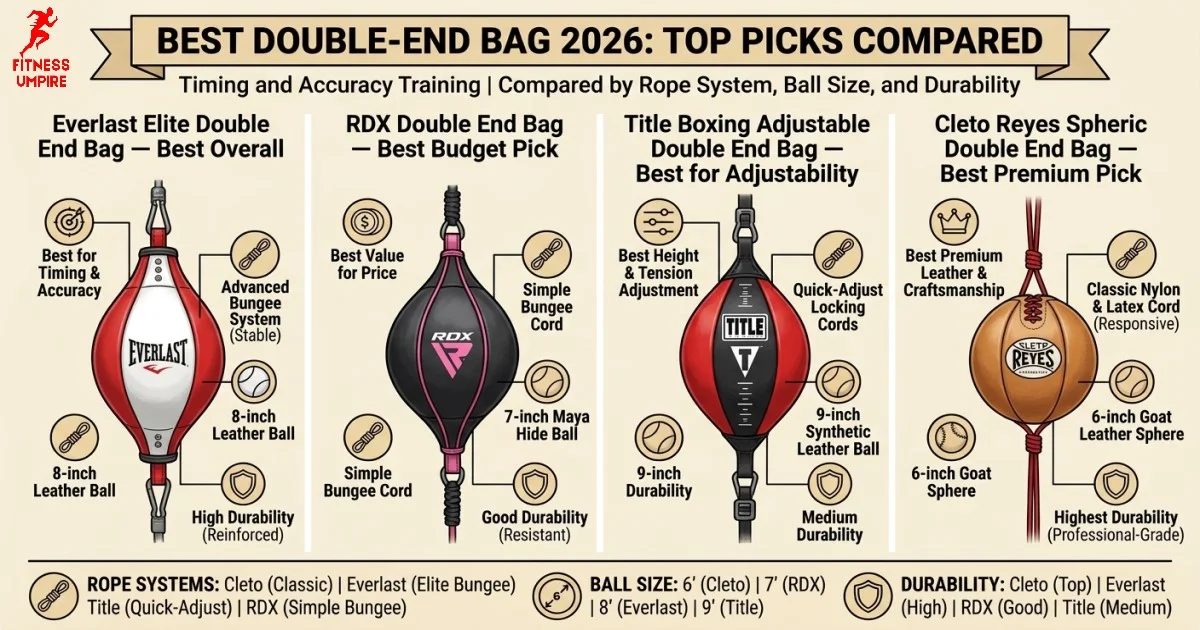
A double-end bag is anchored by cords to the floor and ceiling, so it snaps back at you after every punch. That rebound is what makes it different from a heavy bag: it trains timing, accuracy, and reflexes instead of raw power, and it forces you to keep your hands up and stay on balance between strikes.
We compared the double-end bags that show up most often in boxing gyms and on Amazon’s own best-seller lists, looking at rope and cord systems, ball material, size, and how adjustable each setup is. Below is our quick answer, followed by a full breakdown of each pick and what actually matters when you’re choosing one.
Quick Answer: Best Double-End Bag
If you only read one section, here it is:
- Best overall: Everlast Elite Double End Bag — genuine leather shell, latex bladder, and a rebound speed that suits beginners and intermediate boxers alike.
- Best budget pick: RDX Double End Bag — Maya hide leather construction and a stretchable bungee cord at a fraction of the price of premium bags.
- Best for adjustability: Title Boxing Adjustable Double End Bag — a tie-down cord system that lets you dial in rebound speed as your skill improves.
- Best premium/pro pick: Cleto Reyes Spheric Double End Bag — handmade genuine leather, built to hold its shape under heavy daily use.
- Best value alternative: Ringside Leather Boxing Double End Bag — leather construction with reinforced loops at a mid-range price point.
Top Double-End Bag Picks
1. Everlast Elite Double End Bag — Best Overall
Everlast’s Elite line pairs a genuine leather exterior with a latex bladder, which is the same basic construction used in higher-end reflex bags from other brands. The bladder holds air pressure evenly, so the bag rebounds at a consistent speed instead of going dead on one side after a few sessions — a common complaint with cheaper vinyl bags.
The stock cord setup works for most home users out of the box, and because Everlast sells replacement bladders and cords separately, the bag doesn’t become disposable once a part wears out.
Pros:
- Leather shell holds up to daily punching better than PU or vinyl alternatives
- Latex bladder keeps rebound consistent over time
- Replacement parts are easy to find, so the bag isn’t a one-and-done purchase
- Recognizable brand with wide parts and warranty support
Cons:
- Costs more than entry-level bungee-cord bags
- Requires a solid ceiling and floor anchor point, which isn’t included
- Rebound speed is fixed unless you swap the cord for a different tension
2. RDX Double End Bag — Best Budget Pick
RDX’s double end bag uses Maya hide leather over a lightweight shell, with a single stretchable bungee cord (commonly sold in a 48-inch length) instead of a full floor-to-ceiling tie-down system. That makes it faster to set up than bags that need separate top and bottom anchors, which is part of why it’s a frequent pick for home gyms.
Because the bag relies on one bungee cord rather than a tensioned dual-cord system, the rebound is bouncier and less predictable than what you’d get from a leather-and-latex setup — fine for casual training, less ideal if you’re drilling precise timing for competition.
Pros:
- Lowest price point of the bags on this list
- Simple single-cord setup, no drilling or dual-anchor installation needed
- Maya hide leather outlasts most vinyl bags in this price range
- Compact and easy to store or travel with
Cons:
- Bungee-only rebound is less consistent than a floor-and-ceiling cord system
- Not as durable under heavy daily use as leather-and-bladder bags
- Less suitable for advanced timing drills that need a predictable snap-back
3. Title Boxing Adjustable Double End Bag — Best for Adjustability
Title’s adjustable model uses a tie-down cord system at both the floor and ceiling anchor points, and each cord can be tightened or loosened independently. That’s the key difference from fixed-cord bags: you can slow the rebound down while you’re learning the timing, then tighten it as your hand speed improves, instead of buying a new bag as you progress.
Title also sells the bag in multiple sizes (commonly 7″ and 9″ versions), so you can size down for tighter accuracy work or size up for a more forgiving target.
Pros:
- Independently adjustable top and bottom cords suit beginners through advanced users
- Available in more than one ball size
- Well-known equipment brand with wide gym adoption
- Bladder-style construction on most versions, so rebound stays consistent
Cons:
- Two-point anchor setup takes longer to install than single-cord bags
- Higher-end sizes and bladder versions cost more than base models
- Requires stable ceiling and floor mounts, which some apartments and home gyms don’t have
4. Cleto Reyes Spheric Double End Bag — Best Premium Pick
Cleto Reyes is a Mexican bootmaker best known for gloves, and the same handmade-leather approach carries over to its double-end bag. The genuine leather shell and nylon lining are built to keep their round shape under repeated impact, which matters for a double-end bag specifically — a bag that goes lopsided throws off your read on where it’s going to rebound.
This is the priciest bag on the list, and it’s aimed at boxers training regularly rather than someone hitting a bag a few times a month.
Pros:
- Handmade genuine leather construction holds its shape longer than mass-produced bags
- Nylon lining protects the bladder from direct impact
- Preferred by boxers who already use Cleto Reyes gloves or gear
- Consistent rebound even after months of daily use
Cons:
- Significantly more expensive than every other bag on this list
- Overkill for casual or occasional home use
- Limited size options compared to brands like Title
5. Ringside Leather Boxing Double End Bag — Best Value Alternative
Ringside’s leather double-end bag sits between the budget and premium tiers. It uses a leather shell with reinforced loops at the top and bottom attachment points, which is usually the first place cheaper bags fail — the stitching around the cord loop tears loose before the ball material itself wears out.
It ships with rubber cables rather than a full tie-down system, so setup is closer to the RDX bag than the Title or Everlast models, but the leather construction gives it more durability than typical bungee-only bags.
Pros:
- Reinforced loops reduce the most common failure point on double-end bags
- Leather shell holds up better than vinyl at a similar price
- Comes with cables included, unlike some competitors that sell them separately
- Compact size works well for smaller home gym spaces
Cons:
- Rubber cable setup is less adjustable than a true dual tie-down system
- Smaller size may feel too demanding for absolute beginners
- Fewer size variants than Title’s lineup
Buying Criteria: What Actually Matters
Rope and Cord System
This is the single biggest factor in how a double-end bag feels to use, and it’s worth understanding before you compare specific bags.
- Single bungee cord: One elastic cord runs from the bag to a fixed point (often a headband or floor mount). Fastest to set up, bounciest and least predictable rebound. Good for casual use, less precise for timing drills.
- Dual tie-down cords: Separate cords run from the bag to a ceiling anchor and a floor anchor. This is the traditional double-end bag setup and gives the most control over rebound speed and direction.
- Adjustable tension: Some dual-cord bags let you tighten or loosen each cord independently, which changes how fast the bag snaps back. Tighter cords mean faster, harder-to-track rebounds — better for advanced accuracy work. Looser cords give you more time to react, which is easier for beginners.
If you’re new to double-end bag training, an adjustable dual-cord system is worth paying more for, since you can slow it down while you learn and speed it up later instead of replacing the whole bag.
Ball Material
- Vinyl/PU synthetic leather: Cheapest option. Fine for occasional use, but seams and material tend to crack or split faster under regular impact.
- Genuine or Maya hide leather: More expensive but noticeably more durable, and it holds its round shape better over time, which keeps the rebound path predictable.
- Bladder type (latex vs. rubber): A latex bladder generally holds air pressure more evenly than a basic rubber bladder, meaning less noticeable “dead spots” as the bag ages. If a bag doesn’t list a bladder material, it likely uses a simpler air-retention insert, which is common on budget bags.
Size
Double-end bags are usually sold by diameter, most commonly in the 5–9 inch range. A smaller ball (around 5–6 inches) is harder to hit consistently and better suited to sharpening accuracy once you already have the timing down. A larger ball (around 9 inches) gives beginners a bigger target to build confidence and rhythm before moving to a smaller size.
Adjustability and Installation
Before buying, check what the bag actually requires to mount:
- Ceiling and floor anchors: Most serious double-end bags need a secure point on both the ceiling and the floor. Some kits include floor plates or door-frame mounts; others assume you already have anchor points.
- No-drill options: A few bags use a water-filled base or door-frame clamp instead of screws, which matters if you’re renting or don’t want to drill into a ceiling.
- Replaceable parts: Cords and bladders wear out before the outer shell does on most bags. Brands that sell replacement cords and bladders separately (Everlast and Title both do) let you extend the bag’s life instead of replacing the whole unit.
How to Choose Between These Picks
- New to double-end training: Start with a larger, more forgiving ball and an adjustable cord system so you can loosen the tension while you learn — the Title Boxing Adjustable is built for exactly this.
- Tight budget or first bag ever: The RDX bag gets you training without a full anchor installation, and Maya hide leather will outlast most bags at its price.
- Training regularly and want it to last: Everlast’s leather-and-latex combination is the more durable middle ground before you get into premium pricing.
- Training daily or competing: The Cleto Reyes Spheric is priced for serious use, and its shape retention is the main reason boxers pay more for it.
- Want leather durability without adjustable-cord pricing: Ringside’s reinforced-loop design solves the most common failure point at a mid-range price.
Bottom Line
For most home boxers, an adjustable dual-cord bag with a leather or Maya hide shell offers the best balance of control and durability — that’s why the Everlast Elite and Title Boxing Adjustable top this list. If you just want to start training without a full installation, the RDX bag is the easiest entry point. And if you’re training seriously enough that shape retention and rebound consistency matter every session, the Cleto Reyes Spheric is worth the higher price.
Whichever punching bag you choose, check your ceiling and floor anchor points before buying — the cord system on the box only works as well as what you’re able to mount it to.