
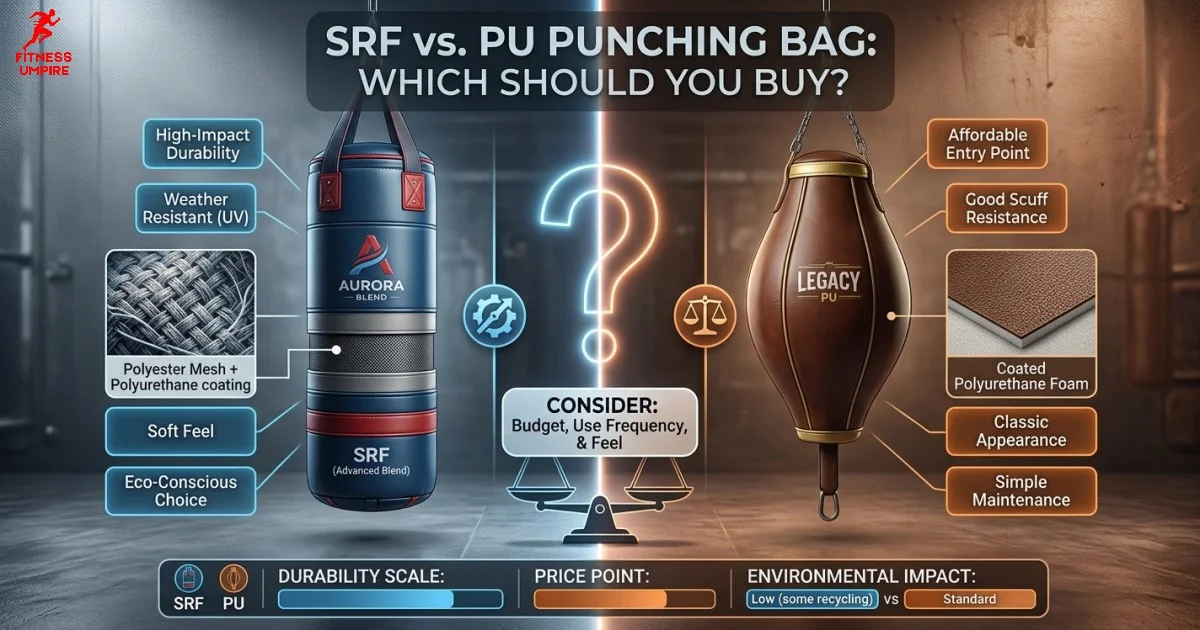
If you are choosing between an SRF-filled and PU-filled punching bag, SRF is generally the more traditional choice when you want a dense, forgiving bag for repeated punching and kicking, while PU can provide a more uniform, firm feel depending on the product’s construction. The important catch is that SRF and PU are not always describing the same part of a punching bag: SRF commonly refers to shredded textile material used as filling, while PU usually refers to polyurethane and may describe either the outer shell or a foam-based construction. Product listings can use these terms inconsistently, so check the manufacturer’s specification before buying.
For most home users, the better choice depends less on the label and more on filling density, bag construction, shell material, weight, and the type of training you plan to do.
SRF vs. PU: What Is the Difference?
The first thing to understand is that SRF and PU can refer to different materials or construction components.
What is an SRF punching bag?
In punching-bag listings, SRF commonly refers to shredded textile or recycled fabric material used to fill the bag. The material is placed in layers or compacted inside the outer shell. Some manufacturers describe SRF-filled bags as using shredded textiles to produce a relatively forgiving striking surface.
Because the filling consists of many pieces of textile material rather than one solid block, the final feel depends heavily on how tightly and evenly the bag is packed.
That means two bags both advertised as “SRF-filled” can feel different.
What is a PU punching bag?
PU stands for polyurethane. In punching-bag products, the term can describe the outer covering, synthetic leather, or a polyurethane-based foam construction rather than necessarily describing the filling itself.
This distinction matters because a product advertised as a PU punching bag may have a PU shell around a different type of filling.
So when comparing SRF vs. PU, don’t assume you are comparing two directly equivalent filling materials. Look for separate specifications for:
- Filling material
- Outer shell material
- Bag weight
- Dimensions
- Construction
- Intended training use
A product listing that simply says “PU” does not tell you everything about how the bag will feel.
SRF vs. PU Punching Bag Comparison
| Feature | SRF-filled | PU construction/filling |
|---|---|---|
| Basic material | Usually shredded textile material | Polyurethane; exact construction varies |
| Feel | Generally dense but somewhat forgiving | Often more uniform and firm |
| Consistency | Depends on packing density | Depends heavily on foam or construction |
| Durability | Strongly dependent on shell and filling quality | Strongly dependent on PU quality and construction |
| Price | Often economical | Usually ranges from budget to premium |
| Best for | General punching and kickboxing practice | Home fitness and users wanting a consistent synthetic construction |
| Main concern | Filling can settle or become uneven if poorly packed | “PU” may describe the shell rather than the filling |
There is no universal density or hardness specification that makes every SRF bag softer or every PU bag harder. The individual bag’s construction matters more than the abbreviation alone.
SRF vs. PU: Density and Feel
SRF feel
A well-packed SRF bag can provide a substantial target without feeling like a completely rigid object. The shredded textile filling distributes impact through the bag, while the shell provides the surface you actually strike.
The important variable is packing density.
A loosely filled bag may feel too soft or develop uneven areas. A heavily compressed bag can feel substantially firmer.
This is why the advertised filling type should not be your only selection criterion.
PU feel
PU-based constructions can provide a more consistent surface, particularly when polyurethane foam is part of the bag’s construction. PU is also commonly used as a synthetic outer covering because it is relatively easy to clean and can provide a smooth finished surface.
However, “PU” by itself doesn’t tell you whether the bag will be soft, medium, or hard.
Bottom line: If striking feel is important, pay attention to the actual product’s construction, weight, dimensions, and user reviews rather than choosing solely from the words “SRF” or “PU.”
Which Is More Durable: SRF or PU?
Durability depends on more than the filling.
The outer shell takes repeated impact, while the internal filling determines how the bag responds to those impacts. Stitching, seams, suspension hardware, inner liners, and filling distribution can all affect service life.
A high-quality SRF-filled bag with reinforced stitching can outlast a poorly constructed PU bag. Likewise, a well-made PU product can provide years of home use.
For durability, check:
- Shell material
- Stitching and reinforced seams
- Suspension points
- Inner liner
- Filling density
- Overall bag weight
- Manufacturer’s intended use
Do not assume that the most expensive material automatically produces the longest-lasting punching bag.
Vinyl vs. Canvas vs. Leather Punching Bag Shells
The shell material is a separate consideration from the filling.
A bag could, for example, have an SRF filling with a synthetic outer shell. This is why comparing “SRF vs. leather” isn’t really an apples-to-apples comparison: one describes the inside and the other describes the outside.
Here is how common shell materials compare.
| Shell material | Durability | Feel | Maintenance | Typical use |
|---|---|---|---|---|
| Vinyl | Good for home use | Smooth and consistent | Easy to wipe clean | Home training, fitness |
| Canvas | Moderate | More basic/textured | Simple but can show wear | Budget/light use |
| Leather | Very high when well made | Natural, premium feel | Requires more care | Frequent or intensive training |
Vinyl punching bags
Vinyl is a common choice for home punching bags because it is relatively easy to maintain and can offer good durability without the price of genuine leather.
It is particularly practical when the bag will be used indoors for regular fitness or recreational training.
A vinyl bag can also be a sensible choice when you want a balance between price, maintenance, and durability.
Canvas punching bags
Canvas is generally a more economical shell material.
It can work for basic training, but repeated high-impact use can place considerable wear on the fabric and seams. For that reason, canvas makes more sense when price is a major consideration or the bag will receive relatively light use.
If you expect frequent, intensive training, examine the construction carefully rather than selecting canvas simply because it is inexpensive.
Leather punching bags
Genuine leather is traditionally associated with higher-end punching bags and intensive training equipment. A well-made leather shell can provide excellent durability and a distinctive natural surface feel.
The trade-off is usually price and maintenance.
If the bag will receive frequent use, the additional cost of a quality leather construction may make more sense than choosing a basic budget shell.
Which Punching Bag Material Is Best for Your Experience Level?
There isn’t one material that is automatically correct for every experience level.
Beginners
If you’re new to punching-bag training, prioritize:
- A forgiving striking surface
- Appropriate overall bag weight
- Reliable construction
- A shell that is easy to maintain
- A reasonable price
An SRF-filled bag with a durable synthetic shell can be a practical starting point.
You don’t necessarily need premium leather simply because you’re a beginner.
Intermediate users
As training becomes more regular, consistency and durability become more important.
An SRF-filled bag can remain a good option if you like its feel and the bag is properly constructed. A quality PU-covered bag can also work well for regular home training.
At this stage, look beyond the material name and compare the complete construction.
Experienced users
Frequent users may place greater demands on stitching, shell durability, suspension hardware, and filling consistency.
A quality leather bag can be appropriate for intensive use, but a high-quality synthetic bag can also perform well.
The key is to match the bag’s construction to the amount and type of training you actually do.
Don’t Confuse Filling With the Bag’s Shell
This is one of the most common sources of confusion when shopping for a punching bag.
Think of the bag as having two separate material decisions:
Inside → filling
- SRF/shredded textile
- Foam
- Other filling materials
Outside → shell
- Vinyl
- Canvas
- PU/synthetic leather
- Genuine leather
A bag can therefore combine materials.
For example, a bag might have SRF filling + a synthetic outer shell. Another might use a different filling with a PU exterior.
This is why reading the complete specification is more useful than relying on a product title.
What About Water-Filled Punching Bags?
Water-filled bags are another construction category and should not be treated as simply another SRF or PU filling.
Instead of relying on packed textile material, a water-filled bag uses water to create its mass. This gives the bag a different response and setup process from a conventional hanging bag.
If you’re deciding between a conventional filled bag and a water-based design, see our guide to water-filled vs. sand-filled punching-bag bases and consider how stability, portability, and setup affect your space.
For a different type of water-based training bag, our Aqua/water punching bag guide is also useful when comparing bag designs.
A Real-World Example: Vinyl and Foam Construction
The Century Wavemaster XXL is a useful example of why shell and filling/construction should be considered separately.
It uses a synthetic exterior and a foam-based striking surface rather than fitting neatly into the SRF-versus-PU-filling comparison.
If you’re considering a freestanding bag, our Century Wavemaster XXL review breaks down its construction and practical characteristics in more detail.
What Should You Look For Before Buying?
Before choosing an SRF or PU punching bag, check these specifications in order:
1. What is actually inside?
Look specifically for the stated filling material. Don’t assume “PU bag” means PU is the filling.
2. How heavy is the complete bag?
Overall weight affects how the bag behaves when struck. Compare the manufacturer’s stated weight rather than judging from dimensions alone.
3. What is the shell made from?
Vinyl, canvas, PU/synthetic leather, and genuine leather have different durability and maintenance characteristics.
4. How is it constructed?
Look for reinforced seams, strong attachment points, and a well-designed inner liner.
5. Where will you use it?
A home user may value easy cleaning and reasonable cost more than premium leather construction.
6. How often will you train?
Occasional fitness use doesn’t necessarily require the same construction as frequent, intensive training.
SRF vs. PU Punching Bag: Final Verdict
SRF and PU should not be treated as direct equivalents because the terms can describe different parts of a punching bag. SRF commonly refers to shredded textile filling, while PU refers to polyurethane and may describe a shell, foam, or another component depending on the product.
If you want a traditional, dense and relatively forgiving filled bag, a well-constructed SRF-filled model can be a practical choice.
If you prefer a synthetic PU construction, look at the exact product specifications rather than assuming all PU bags have the same feel.
For the shell, vinyl offers a practical balance for many home users, canvas is a budget-oriented option, and genuine leather is generally positioned toward higher-end and intensive-use equipment.
Ultimately, the best material combination is the one that matches your training frequency, desired feel, available space, budget, and expected durability.