
Product Review · Updated 2026 _________________________________
Best Compact Smallest Footprint Tested Fastest Assembly
Part of our full freestanding punching bag testing guide
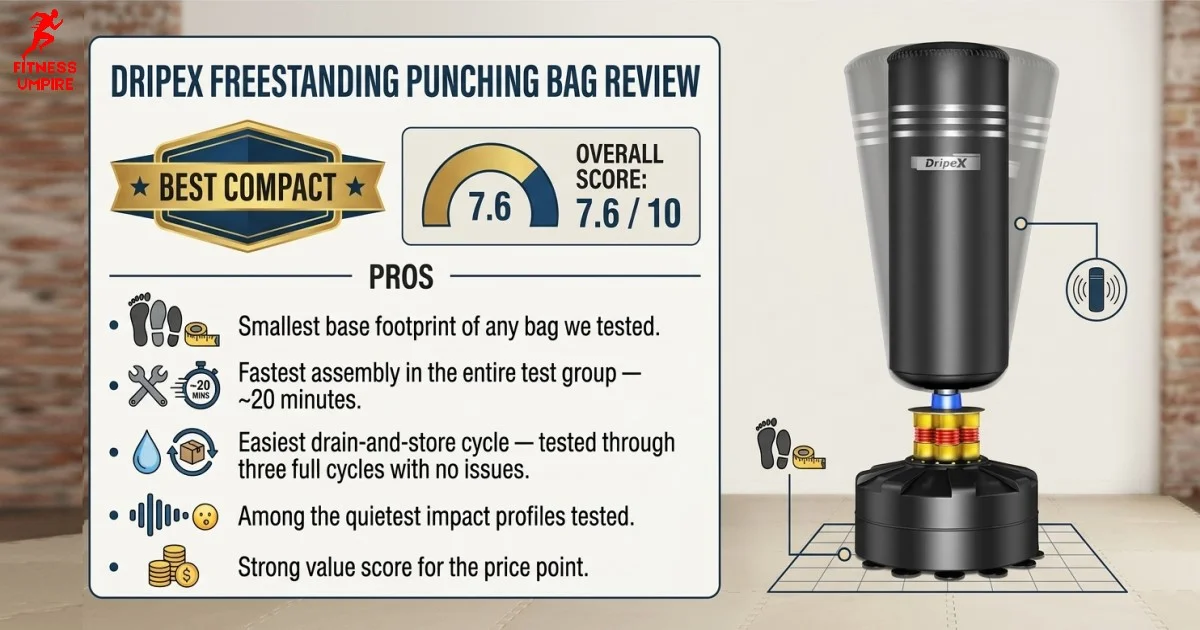
The Dripex makes one trade deliberately and makes it well: the smallest base footprint in our entire test group, in exchange for the most lateral movement under power. If you have genuinely limited floor space — a studio apartment, a shared room, a corner that needs to double as something else between sessions — that trade is worth understanding in detail before you buy.
This isn’t a bag for power training, and it isn’t trying to be. It’s the right tool for a specific situation, and this review is about being precise on exactly which situation that is.
Dripex Freestanding Punching Bag
Dripex Freestanding Punching Bag is a compact, water-filled punching bag designed for beginners, light-to-moderate training, and limited spaces. It features a 16-inch base footprint, adjustable 58–64-inch height, PU leather construction, quick assembly, easy draining and storage, and relatively low noise when used on a rubber mat. Its portability and value make it suitable for controlled home workouts, but it is not recommended for heavy-power training or intensive kickboxing
Product SKU: QJD01-SRK3
Product Brand: Dripex
Product Currency: USD
Product Price: 139.99
Product In-Stock: InStock
7.6
Below: full specs, exactly how the 7.6 score is built, a direct look at the footprint-versus-stability trade-off, our eight-week testing log, and a full walkthrough of the drain-and-store cycle that makes this bag genuinely portable.
Quick specs ______________________________________
Dripex Freestanding Punching Bag — Specifications
| Striking surface diameter | ~13 inches |
| Height range (adjustable) | 58″–64″ |
| Base diameter | ~16 inches — smallest in our test group |
| Unfilled weight (bag + base) | ~40 lbs |
| Max water fill | ~130 lbs (≈170 lbs total) |
| Max sand fill | Not supported |
| Shell material | PU leather |
| What’s included | Bag, base, fill cap tool, assembly hardware, included wrench |
| Assembly time | ~20 minutes |
| Warranty | Manufacturer’s warranty (Dripex) |
The math behind 8.1 _______________________________________________
Score Breakdown
Our overall score is a weighted average across five categories, using the methodology from our main testing guide. Here’s exactly how the Dripex’s 7.6 is built.
| Category | Weight | Score | Weighted |
|---|---|---|---|
| Stability | 30% | 5.6 | 1.68 |
| Durability | 25% | 7.0 | 1.75 |
| Value | 20% | 9.2 | 1.84 |
| Versatility | 15% | 6.4 | 0.96 |
| Assembly | 10% | 9.8 | 0.98 |
| Overall | 100% | — | 7.21 |
Stability is the clear weak point — the lowest score of any bag in our test group, a direct consequence of the small base footprint. Value and assembly are the standout strengths, both among the highest scores recorded across all seven bags. This is a bag whose score tells an honest, internally consistent story: outstanding for what it’s designed for, limited everywhere that footprint matters.
The core trade-off, quantified _________________________________
Footprint vs. Stability — What You’re Actually Trading
Every freestanding bag balances base size against stability — a wider, heavier base resists lateral force better, but takes up more floor space. The Dripex sits at the most compact end of that spectrum in our entire test group. Here’s the trade-off in direct numbers.
BASE FOOTPRINT
~16″
LATERAL SHIFT
12–14 cm
ASSEMBLY TIME
~20 min
STORAGE EASE
Easiest
That 12–14 cm lateral shift figure is the highest of any bag in our test group — roughly three times the Century Wavemaster XXL’s 4 cm at sand fill, and noticeably above even the next-closest bag. It’s the direct cost of a base small enough to tuck against a wall. Whether that cost is worth paying depends entirely on how much floor space you actually have and how hard you intend to train — covered in detail in our apartment guide.
How we tested it __________________________________________________
8-Week Testing Log
| Week | Focus | Key observation |
|---|---|---|
| 1 | Assembly + water fill setup | ~20 minutes — the fastest assembly of any bag in our test group, no tools beyond the included wrench |
| 2 | Baseline stability (boxing combos) | 12–14 cm lateral shift at full water fill — the highest recorded across all seven bags, though the bag never tipped over |
| 3 | Rubber mat test | Walking reduced meaningfully on a 10mm mat, though instability under hard combinations remained the bag’s defining characteristic |
| 4 | Light/moderate training validation | At 50–60% effort and fitness-style shadow combinations, movement was minor and not disruptive to training flow |
| 5–6 | Noise testing | 67 dB on bare hardwood, 58 dB on a rubber mat — among the quietest in our test group, partly because the bag absorbs impact through movement rather than rigid resistance |
| 7–8 | Durability + drain-and-store cycle | No major structural issues after 8 weeks; drained and refilled the base three times to test the storage cycle with no leakage or cap issues |
Setup _________________________________________
Assembly — What to Expect
At roughly 20 minutes, this was the fastest assembly process of any bag in our test group — a direct consequence of having fewer, smaller components than the larger bags in this guide.
- Unbox and lay out components. Fewer parts than larger bags makes this step quick.~3 min
- Assemble the compact base and attach the center pole. The included wrench is the only tool needed.~6–8 min
- Attach the bag to the pole and set initial height. Adjust within the 58″–64″ range.~4 min
- Fill the base with water. Water fill only — sand isn’t supported on this base.~5 min
- Quick bolt check. Confirm everything is tight before first use.~2 min
In use __________________________________________
Real-World Performance
Stability
At full water fill on bare hardwood, the Dripex posted 12–14 cm of lateral shift during our combo testing — the highest figure recorded in this entire guide. The bag never tipped, but it moved noticeably more than anything else we tested. On a rubber mat, that movement reduced meaningfully, though it remained the defining characteristic of this bag regardless of surface. For light-to-moderate training and fitness-style shadow combinations at 50–60% effort, the movement is manageable; for power training, it’s genuinely distracting. See our heavy-hitter guide for bags built for the opposite end of this spectrum.
Noise
67 dB on bare hardwood, dropping to 58 dB on a rubber mat — among the quietest results in our test group. Part of this is a direct consequence of the same trade-off that hurts stability: the bag absorbs impact partly through movement rather than rigid resistance, which reduces the sharp impact sound. Our apartment guide covers how this compares against the full lineup for noise-sensitive situations.
Durability
No major structural issues after eight weeks of moderate testing — but the narrower base and lighter fill capacity are reasonable grounds for caution under sustained heavy use, which our testing protocol doesn’t fully simulate at a multi-year timescale. Based on the construction and our observations, this falls into the same expected lifespan tier as the FITVEN — roughly 2–3 years under regular use.
The actual reason to buy this bag _________________________________
Storage & Portability Walkthrough
If footprint and portability are your priority, this is the section that matters most. We ran the full drain-and-store cycle three times across our testing period to confirm it works as advertised.
- Locate the drain valve at the base of the housing. Position it over a drain, large container, or outdoors before opening.~1 min
- Open the drain cap and allow the base to empty fully. A full ~130 lb water fill takes roughly 5–8 minutes to drain completely.~5–8 min
- Wipe down the empty base and reseal the drain cap. Confirm the cap seats fully to avoid slow leaks if any residual water remains.~2 min
- Tilt and roll the emptied bag to its storage position. At ~40 lbs unfilled, one person can comfortably move and tilt the bag against a wall or into a closet.~2 min
- Refill before your next session. Across three full drain-and-refill cycles in our testing, the cap and valve showed no leakage or wear.~5 min, next session
This cycle is genuinely the bag’s strongest practical feature — nothing else in our test group is built this specifically around the idea of disappearing from a room between sessions.
Fit check _________________________________________________
Who Should Buy This Bag
- You have genuinely limited floor space and the bag needs to disappear between sessions — see our apartment guide
- You’re a beginner training at controlled effort while building technique, not yet throwing full-power combinations — see our beginner’s guide
- You want the fastest possible setup and the option to drain and store the base regularly
- Noise is a real concern and you’re training at light-to-moderate intensity
Who Should Look Elsewhere
- Anyone training with real power — the 12–14 cm lateral shift is the highest in our test group and will be genuinely distracting above beginner intensity; see our heavy-hitter guide
- Kickboxers and Muay Thai practitioners — the compact base struggles under kicks specifically, and the 64″ maximum height limits head-kick training; see our kickboxing guide
- Buyers planning years of daily heavy training — the 2–3 year expected lifespan is among the shortest in our test group
- Anyone with the floor space to consider a more stable option — if footprint isn’t your binding constraint, almost every other bag in this guide outperforms it on raw training quality
How it compares _______________________________________________
Comparison Snapshot
| Bag | Score | vs. Dripex |
|---|---|---|
| FITVEN Punching Bag | 8.1 | Larger footprint but meaningfully more stable, and includes bundled gloves and wraps |
| Everlast Powercore | 8.7 | Quieter and more stable, with a moderate footprint that’s still manageable in smaller rooms |
| RDX Freestanding Bag | 8.5 | Notably more stable with a more durable shell, at a moderately larger footprint and price |
Summary ____________________________________
Pros & Cons
Pros
- Smallest base footprint of any bag we tested
- Fastest assembly in the entire test group — ~20 minutes
- Easiest drain-and-store cycle — tested through three full cycles with no issues
- Among the quietest impact profiles tested
- Strong value score for the price point
Cons
- Highest lateral shift of any bag tested — 12–14 cm at full water fill
- Sand fill not supported — water fill is the stability ceiling
- Weakest kickboxing performance under power strikes
- 2–3 year expected lifespan, among the shortest in the group
FAQs ___________________________________________
Dripex Freestanding Punching Bag — Frequently Asked Questions
Is the Dripex stable enough for serious training?
For light-to-moderate boxing and fitness-style training, yes, particularly with a rubber mat. For full-power combinations or kicks, no — it posted the highest lateral shift of any bag in our test group at 12–14 cm. Our heavy-hitter guide covers more stable alternatives if that’s your training style.
Can I drain and store the Dripex between sessions?
Yes — this is the bag’s core advantage. We tested the full drain-and-refill cycle three times during our review period with no leakage or valve issues. At roughly 40 lbs unfilled, one person can comfortably move and store it.
Is the Dripex good for apartments?
Yes, for noise and footprint specifically — it measured among the quietest bags in our test group at 58 dB on a mat, and has the smallest base of any bag we tested. The trade-off is stability, so it suits light-to-moderate apartment training rather than serious power work. Our apartment guide covers the full comparison.
Can I use sand in the Dripex base?
No — the base isn’t designed for sand fill. Water fill only, up to roughly 130 lbs. If you need sand-fill stability, this isn’t the right bag; our heavy-hitter guide covers sand-capable alternatives.
How long does the Dripex punching bag last?
Based on our eight-week testing and the bag’s lighter construction, an estimated 2–3 years under regular use is realistic — among the shorter lifespans in our test group, consistent with its compact, budget-focused design.
7.6
OUT OF 10
Final Verdict
The Dripex is the right answer to one specific question: “I have very little space — what’s the best bag I can fit and put away?” If that’s your question, this is a well-built, honestly-priced solution. If floor space isn’t your binding constraint, almost every other bag in this guide will serve your training better.

David Paul
Founder & Lead Equipment Tester — fitnessumpire.com
David has been training in boxing and martial arts for over a decade. He founded Fitnessumpire after finding that most online punching bag reviews were written without any real hands-on testing — and that the freestanding bag category was the worst offender.
Testing note: Every bag reviewed on this site was purchased at retail price and tested through an 8-week protocol — 500+ strikes per session, lateral shift measurements at both water and sand fill, decibel readings on hardwood and rubber mat, and weekly durability inspections. No manufacturer samples were accepted.
10+ years boxing & martial arts
7 bags independently tested
500+ strikes per bag
8-week test protocol